
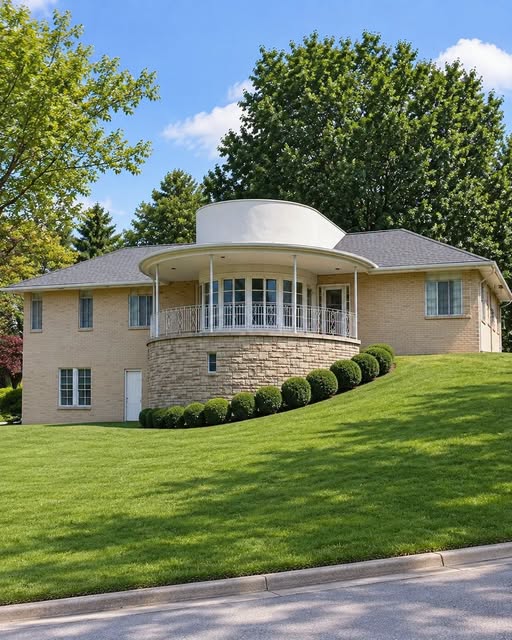
Inside the Strange $65,000 Hilltop House That Looks Like a Forgotten Piece of the Future
A Home That Looks More Like an Observatory Than a House
Perched on a grassy hill, the unusual home immediately raises the kind of question that makes people stop and stare.
Is it a bargain?
Or is it a project so complicated that the low price only hides what comes next?
With three bedrooms, three bathrooms, and nearly 3,000 square feet of space, the property offers far more room than its $65,000 asking price might suggest.
But size is not what makes the house memorable.
Its curved exterior, sweeping windows, and tall cylindrical section make it look part observatory, part movie set, and part architectural experiment from another era.
From a distance, it appears futuristic.
Up close, it feels like a vision that was never fully completed.
The Architecture Is Impossible to Ignore
The home carries strong Art Deco-inspired elements, especially in its rounded forms and dramatic silhouette.
The turret-like cylinder immediately draws the eye upward, while the curves of the structure make it stand apart from more traditional homes nearby.
Nothing about the exterior feels accidental.
It appears to have been designed by someone who wanted the house to make a statement.
The problem is that the statement seems unfinished.
Instead of polished architectural perfection, the property now presents a mixture of bold design and visible neglect.
That tension is what gives the house much of its strange appeal.
The $65,000 Price Changes the Conversation
At $65,000, the house immediately attracts attention because of what buyers appear to receive for the money.
Three bedrooms.
Three bathrooms.
Nearly 3,000 square feet.
A dramatic hilltop setting.
And an exterior that looks unlike almost anything found in a conventional suburban neighborhood.
But the price also raises obvious questions.
A home this distinctive does not sell for such a low amount without requiring serious thought.
The property is not presented as a finished escape where a buyer can simply move in, unpack, and start decorating.
It is a renovation challenge.
Inside, the House Feels Like a Blank Canvas
The interior does not deliver the polished futuristic experience suggested by the exterior.
Instead, the rooms reveal how much work remains.
There is space.
There are large windows.
There are interesting architectural lines.
But there is also the unmistakable feeling of a home waiting for someone else to finish the story.
The generous proportions give a future owner plenty to work with.
Rather than forcing a renovation into small, cramped rooms, the house already contains the volume needed for a dramatic transformation.
The Curved Windows Could Become the Home’s Greatest Feature
One of the property’s strongest assets is the amount of glass built into the design.
The curved windows offer the potential for broad views and large amounts of natural light.
In the right renovation, those windows could become the feature that defines the entire home.
The interior could be opened around them instead of divided into smaller, darker spaces.
Furniture and finishes could be arranged to follow the curves rather than fight them.
Done carefully, the home could feel bright, unusual, and intentionally sculptural.
Handled poorly, those same unusual angles could make the interior awkward.
That is part of the gamble.
The House Demands Imagination, Not Just Money
A renovation project like this requires more than a large budget.
It requires someone willing to understand what makes the structure interesting in the first place.
The easiest approach might be to remove every unusual feature and rebuild the interior into something conventional.
But doing that could erase the exact qualities that make the house worth saving.
The curves, rounded walls, strange tower, and oversized windows are not problems to hide.
They are the identity of the property.
The challenge is finding a way to make those features work together.
Restoration Could Bring the Original Vision Back to Life
The home appears to sit somewhere between Art Deco inspiration and a retro vision of the future.
A thoughtful renovation could lean into both.
Curved walls could be emphasized rather than squared off.
Open spaces could allow the architecture to breathe.
Natural light could become a central design element.
The cylindrical portion of the home could be transformed into a dramatic office, reading room, studio, or observation space.
Instead of trying to make the building resemble every other home nearby, a future owner could allow it to become something completely distinctive.
But Every Unusual Feature Could Also Become an Expense
Unique architecture often comes with unique renovation problems.
Standard materials may not fit easily.
Curved walls can complicate cabinetry, flooring, and furniture placement.
Large windows can be expensive to repair or replace.
Older or unconventional structural elements may require custom work.
Even seemingly simple upgrades can become complicated when the building does not follow standard dimensions.
That means the low purchase price is only one part of the financial equation.
The real cost depends on what is discovered after work begins.
The Property Is More Project Than Turnkey Home
Anyone expecting a finished suburban home would probably be disappointed.
The property is better understood as an architectural project.
It asks a buyer to imagine what could exist rather than focus only on what exists today.
That distinction matters.
Some people see unfinished walls and outdated spaces as problems.
Others see them as freedom.
A conventional house often limits what can be changed without losing value.
This house almost invites reinvention.
Its Hilltop Position Adds to the Drama
The grassy hill surrounding the property strengthens its unusual visual character.
Because the house sits above the streets below, the curved structure appears even more isolated and theatrical.
It looks less like a typical residence and more like an architectural landmark waiting to be restored.
That elevated setting could become another major advantage if the interior were redesigned to take full advantage of the views.
Large seating areas near the windows could make the landscape part of the experience.
At night, the illuminated curves could make the house look dramatically different from anything around it.
The Home Feels Caught Between Two Eras
Part of what makes the property fascinating is that it is difficult to place in a single period.
The rounded forms recall classic Art Deco design.
At the same time, the large glass sections and unusual tower suggest an older idea of futuristic living.
The result is a house that feels both dated and strangely modern.
That contradiction is likely why people find it so visually compelling.
It looks like something imagined decades ago as a vision of tomorrow.
Tomorrow simply arrived without it.
A Buyer Would Need to Decide What to Preserve
Renovating the house would require difficult choices.
Not every original feature necessarily deserves to remain.
Some parts may be impractical.
Others may need major repair.
But removing too much could destroy the character that separates the property from an ordinary three-bedroom home.
The best result would likely come from preserving the strongest architectural ideas while modernizing the spaces around them.
That could mean keeping the curved forms while introducing cleaner finishes, better lighting, updated systems, and more open circulation.
The Interior Could Become Surprisingly Luxurious
Nearly 3,000 square feet provides significant room for creativity.
A future owner would not necessarily need to add space.
The challenge would be organizing what is already there.
Large communal areas could become dramatic living spaces.
The three bedrooms could be redesigned with more privacy and better flow.
The three bathrooms offer enough flexibility for a modern family layout.
And the unusual shapes could give every room its own identity.
With the right materials and lighting, the interior could eventually feel far more expensive than the original purchase price suggests.
The House Could Easily Become a Local Landmark
Most renovated homes disappear into their neighborhoods.
This one probably never will.
Even in its current condition, its silhouette commands attention.
A successful restoration could turn it into the kind of property people recognize immediately.
That might appeal to a buyer who wants something memorable rather than conventional.
It could also make the home more difficult to sell later to anyone who prefers traditional architecture.
Distinctiveness creates opportunity and risk at the same time.
The Biggest Question Is Whether the Vision Is Worth the Gamble
The $65,000 asking price creates the illusion that the decision is simple.
It is not.
A buyer is not merely purchasing walls, bedrooms, and bathrooms.
They are accepting responsibility for an unfinished architectural idea.
The final cost could rise dramatically depending on the condition of the building and the level of restoration attempted.
But the potential result could also be extraordinary.
Few properties offer this much opportunity to create something genuinely unique.
It Is Either a Bargain or the Beginning of a Very Expensive Adventure
That uncertainty is exactly what makes the home so compelling.
To one person, it may look like an outdated shell requiring too much work.
To another, it may look like the kind of project that appears only once.
The purchase price is low enough to invite imagination.
The architecture is unusual enough to make that imagination dangerous.
Every room raises another question.
Restore it?
Modernize it?
Strip it back?
Preserve the original curves?
There is no obvious answer.
A Beautiful Question Mark on a Hill
For now, the strange house remains exactly where it has been: sitting above the quiet streets below, waiting for someone willing to see more than an unfinished interior.
Its sweeping glass, rounded walls, and unusual tower suggest a level of ambition that never completely became reality.
At $65,000, the property offers a rare combination of space, character, and uncertainty.
It could become an unforgettable home.
It could become an expensive renovation nightmare.
Or it could remain untouched, continuing to look like a relic from a version of the future that never happened.
That is what makes the house so difficult to ignore.
It is not simply a property for sale.
It is a challenge sitting on a hill, waiting for someone brave enough to decide how the story ends.