
Part 1 of 2
At first glance, Vutomi looks like any other elephant moving through the African bush.
She walks slowly and deliberately.
She enters the water with the same calm confidence as the elephants around her.
Her massive body disappears beneath the surface until only her back, head and trunk remain visible.
Dark watermarks cling to her skin when she emerges again.
For a few moments, everything about the scene appears completely ordinary.
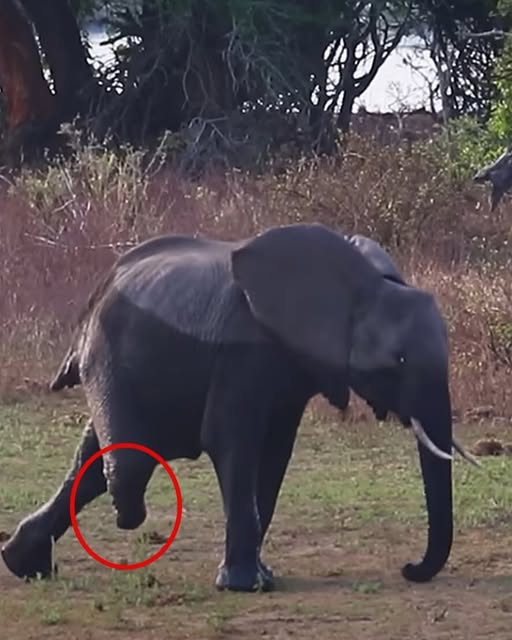
Then Vutomi begins to walk.
And the extraordinary truth becomes impossible to miss.
She has only three legs.
One of the four enormous limbs that should support her weight is gone.
For an animal as large as an elephant, losing a leg creates an enormous challenge.
Balance changes.
Every step requires compensation.
More pressure is placed on the remaining limbs.
And in the wild, there is no veterinarian following behind, no specially designed enclosure and no guarantee of food or safety.
Yet Vutomi survived.
More than that, she adapted.
She has been observed moving with her herd in South Africa, keeping pace despite her unmistakable limp.
Those who have encountered her describe an elephant that appears remarkably comfortable navigating a life that should have been extraordinarily difficult.
No one can say with certainty how she lost the leg.
Reports surrounding Vutomi have suggested several possibilities, including a snare, a heavy trap or even a landmine.
But the exact cause remains unknown.
Whatever happened, it appears to have occurred years ago.
And somehow Vutomi learned how to continue.
Step by step.
Day after day.
She learned how to shift her enormous weight differently.
How to walk without the support of a fourth leg.
How to reach water.
How to feed.
How to move through uneven ground.
And perhaps most importantly, how to remain part of her herd.
Elephants are deeply social animals.
Family groups move together, communicate constantly and rely on one another for protection, knowledge and access to resources.
For an injured elephant, remaining with the herd can make an enormous difference.
Vutomi was not forced into isolation.
She continued moving among other elephants.
Wildlife observers have watched her traveling with them, entering water with them and disappearing into the bush alongside them.
She may move differently.
But she still belongs.
That is what makes her story so striking.
There is no dramatic human rescue at its center.
No prosthetic limb.
No carefully controlled rehabilitation facility.
There is simply an elephant that suffered a life-changing injury and somehow found a way to keep living in the wild.
Those who have seen Vutomi often describe the encounter as deeply moving.
Not because she appears helpless.
She doesn’t.
Quite the opposite.
Her presence challenges the assumption that survival in nature belongs only to the physically perfect.
Vutomi walks with a visible limitation.
But she continues to drink.
Feed.
Travel.
Socialize.
And remain part of the herd.
Her uneven stride has become her normal.
Watching her move through the landscape, it is easy to imagine how difficult the first weeks after losing her leg must have been.
Standing would have felt different.
Walking would have required relearning movements that had once been instinctive.
Keeping pace with other elephants would have demanded enormous effort.
Yet at some point, those difficult movements became familiar.
The three remaining legs grew accustomed to carrying more weight.
Her body adjusted.
And Vutomi continued forward.
But there is another part of her survival that may be just as important as her own remarkable adaptation.
She did not have to face the wild completely alone.
Because whenever Vutomi moved on, the other elephants were still there beside her.