
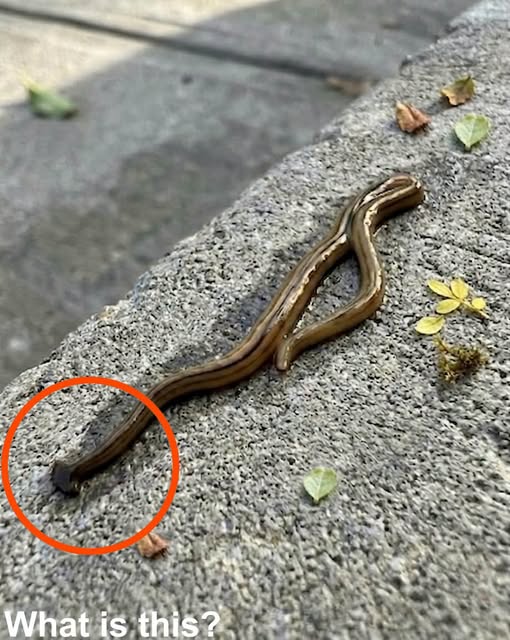
If You See This Strange Hammer-Shaped Creature in Your Yard, Don’t Touch It — Here’s What You Need to Know
The Unusual Worm That Glides Across Gardens May Look Harmless, but Its Hunting Behavior and Remarkable Ability to Regenerate Have Concerned Experts
It was early in the morning, and the ground was still damp from the previous night’s rain.
As I stepped outside, something unusual caught my attention near the edge of the garden.
At first, I thought it was an ordinary earthworm moving across the wet soil.
But when I looked closer, I realized there was something very different about it.
Its body was long, smooth, and strangely glossy. Instead of wriggling like a typical worm, it glided across the ground in one continuous movement.
Then I noticed its head.
It was wide and flattened, extending outward on both sides like a tiny hammer.
For a moment, I wondered whether I was looking at some kind of unusual snake or an unfamiliar insect.
I had never seen anything quite like it.
Curiosity quickly turned into concern. Was it dangerous? Could it bite? And why was it moving through my garden?
After learning more about the creature, I discovered that its unusual appearance was only the beginning of the story.
It was a hammerhead worm, a type of land-dwelling flatworm known for its distinctive head, predatory behavior, and surprising ability to regenerate.
What Exactly Is a Hammerhead Worm?
Hammerhead worms are terrestrial flatworms belonging to a group commonly called land planarians.
Several species are associated with the genus Bipalium, although similar hammer-shaped flatworms occur in other closely related groups.
Unlike ordinary earthworms, these animals have flattened bodies and move using a combination of microscopic hairlike structures called cilia and a slippery layer of mucus.
This allows them to glide smoothly over damp surfaces.
Their most recognizable feature is the expanded head, which can resemble a hammer, shovel, or crescent.
Depending on the species, hammerhead worms may have brown, yellowish, gray, or darker coloring, sometimes with stripes running along their bodies.
Some are only a few inches long, while others can grow considerably larger.
Their appearance often surprises homeowners because they do not resemble the familiar segmented earthworms commonly found in garden soil.
But their unusual shape is not the only reason scientists and gardeners pay attention to them.
Why Hammerhead Worms Are Showing Up in Gardens
Many hammerhead worm species originate from parts of Asia and other warm regions of the world.
Some have spread beyond their native ranges through international trade and the movement of plants, soil, and landscaping materials.
When introduced into new environments, certain species can establish populations in gardens, greenhouses, parks, and other moist habitats.
These worms generally prefer damp conditions because their bodies are vulnerable to drying out.
That is why people often notice them after rainfall, during humid weather, or in shaded areas where moisture remains in the soil.
They may be found beneath flowerpots, fallen leaves, stones, mulch, and garden debris.
Although they can be difficult to spot during dry weather, they may become more visible when conditions are favorable.
In some regions, introduced hammerhead worms are considered invasive because they are not native and may affect local soil organisms.
However, their distribution and ecological effects vary by species and location.
The Surprising Reason They Are Different From Earthworms
At first glance, a hammerhead worm might seem like an unusual version of the common earthworm.
But the two animals are very different.
Earthworms belong to a group of segmented worms known as annelids.
They play important roles in many soil environments by consuming organic material, creating tunnels, and helping mix soil.
Hammerhead worms, by contrast, are flatworms.
Their bodies are not divided into the obvious segments seen in earthworms.
They also have very different feeding behavior.
Rather than primarily consuming decomposing organic matter, many hammerhead worm species actively hunt other small soil animals.
Earthworms are among their most familiar prey.
This predatory lifestyle is one of the main reasons their arrival in new habitats attracts scientific attention.
They Hunt Earthworms Beneath Our Feet
One of the most surprising facts about hammerhead worms is that they are predators.
Despite their slow, quiet movement, they are capable of locating and capturing other soil-dwelling creatures.
Some species feed heavily on earthworms, while others may consume snails, slugs, or additional invertebrates.
Hammerhead worms use chemical cues to help locate prey.
Once they find an earthworm, they can surround or restrain it with their bodies and sticky mucus.
They then use a specialized feeding structure called a pharynx to consume the prey.
It is a feeding process very different from the behavior most people associate with ordinary garden worms.
Because earthworms contribute to soil structure and nutrient cycling, scientists are interested in how introduced predators might affect their populations.
However, the extent of those effects is not the same everywhere, and more research is needed to understand long-term impacts in different ecosystems.
Can Hammerhead Worms Be Dangerous to Humans?
The unusual appearance of a hammerhead worm can make it seem threatening.
But these animals are not aggressive toward people and are not known for attacking humans.
They do not pose the same kind of danger as a venomous snake.
Nevertheless, handling them with bare hands is not recommended.
Some hammerhead worm species have been found to contain tetrodotoxin, a powerful neurotoxin also associated with certain other animals.
Scientists have identified this substance in particular species, including some invasive hammerhead worms.
The toxin may help the worms capture prey or discourage predators.
That does not mean casual proximity to a hammerhead worm will cause poisoning.
Documented serious human poisoning from ordinary garden encounters is not established as a common occurrence.
Still, avoiding direct contact is a sensible precaution, especially when the species cannot be identified.
Children and pets should also be kept from handling or eating unfamiliar worms.
Why Experts Recommend Avoiding Bare-Handed Contact
Hammerhead worms produce mucus that helps them move across surfaces.
This mucus may contain substances involved in their feeding and defense.
Because some species can contain toxins, wildlife and agricultural guidance commonly recommends using gloves or tools rather than touching them directly.
If someone accidentally handles one, washing the affected skin thoroughly with soap and water is a reasonable precaution.
It is also important to avoid touching the eyes or mouth before washing.
If a child or pet swallows an unfamiliar flatworm, or if concerning symptoms occur after exposure, professional medical or veterinary advice should be sought promptly.
The key point is not to panic.
Simply seeing a hammerhead worm in a garden is not an emergency.
But it is worth treating an unfamiliar animal carefully rather than assuming it is harmless.
The Strange Ability That Makes Them Difficult to Eliminate
Perhaps the most astonishing characteristic of hammerhead worms is their capacity for regeneration.
Many flatworms possess remarkable biological abilities that allow them to repair damaged tissues.
Some hammerhead worm species can regenerate missing body parts from surviving fragments.
This means that cutting a worm into pieces may not eliminate it.
Under suitable conditions, fragments can potentially develop into additional individuals.
That is why chopping, crushing, or otherwise fragmenting a hammerhead worm is not recommended as a control method.
Instead of solving the problem, such actions may leave living pieces capable of surviving.
The degree of regeneration depends on the species and the condition of the fragments, but the phenomenon is well known among land planarians.
For scientists, it is an interesting example of biological regeneration.
For gardeners dealing with an introduced predator, it is a reason to use appropriate handling methods.
What Should You Do If You Find One?
If you encounter a suspected hammerhead worm in your yard, the first step is to avoid touching it directly.
Keep children and pets away while you examine the area.
Taking a clear photograph can be helpful, especially if you want assistance identifying the species.
Not every unusual flatworm is necessarily an invasive hammerhead worm, and identification may require examining its shape, color, markings, and location.
Local agricultural extension offices or environmental authorities may be able to provide identification guidance.
In regions where invasive hammerhead worms are being monitored, officials may encourage residents to report sightings.
If removal is recommended, follow local instructions for safely containing and disposing of the animal.
Do not release it elsewhere, and avoid cutting it into pieces.
It is also important not to apply pesticides or other chemicals indiscriminately, because unnecessary chemical use can harm beneficial organisms and the surrounding environment.
Why You Should Not Move Them to Another Location
People sometimes encounter unusual creatures and decide to relocate them to a nearby park, wooded area, or empty lot.
For a potentially invasive species, that can create additional problems.
Moving an introduced flatworm to a new location may contribute to its spread.
Even transferring contaminated soil, mulch, or potted plants can potentially move small organisms between properties.
Hammerhead worms may also reproduce through eggs or, in some species, asexual fragmentation.
As a result, an infestation may not be limited to the individual worm visible on the surface.
Gardeners who regularly exchange plants should inspect pots and surrounding soil for unfamiliar organisms.
Good plant hygiene and careful handling of landscaping materials can reduce the unintentional movement of introduced species.
Are They Harmful to Your Garden?
The presence of one hammerhead worm does not automatically mean a garden is in danger.
However, introduced predatory flatworms can raise ecological concerns.
Earthworms are important components of many soil communities.
Their burrowing can improve soil aeration and water movement, while their feeding helps redistribute organic material.
When an introduced predator consumes earthworms, researchers naturally want to understand whether local populations could be affected.
Some hammerhead worm species have been documented feeding on earthworms and other soil invertebrates.
But the overall ecological impact depends on the species, its population density, the prey available, and the characteristics of the local ecosystem.
It would be inaccurate to assume that a single sighting means all the earthworms in a garden will disappear.
The concern is broader and more gradual: introduced predators can potentially change relationships within soil ecosystems over time.
Why They Seem to Glide Instead of Crawl
One of the most mesmerizing features of hammerhead worms is the way they move.
Unlike earthworms, which extend and contract their segmented bodies, land planarians often appear to slide smoothly across the ground.
The movement is produced partly by microscopic cilia on the underside of the body.
These tiny hairlike structures beat against a layer of mucus secreted by the worm.
The combination allows the animal to move over damp soil, leaves, pavement, and other surfaces.
Its flattened body also contributes to its unusual appearance.
When viewed from above, the worm can look almost like a narrow ribbon with a miniature hammer at one end.
Its movement may seem mysterious, but it is a highly specialized adaptation to life in moist environments.
Why Rainy Mornings Are a Common Time to Spot Them
Moisture is essential for many terrestrial flatworms.
Their soft bodies can lose water relatively easily, making dry and exposed conditions unfavorable.
During hot or dry weather, they often remain hidden in sheltered locations.
After rainfall, the environment becomes more suitable for movement and feeding.
That is why a homeowner may suddenly notice one on a patio, driveway, garden path, or lawn after a wet night.
It does not necessarily mean the worm arrived overnight.
It may simply have emerged from a concealed location because conditions became favorable.
Shaded gardens with mulch, leaf litter, and consistently moist soil can provide suitable habitats.
Understanding these preferences can help explain why sightings are more common at certain times of the year.
How Hammerhead Worms Spread to New Areas
Many small organisms travel unintentionally through human activity.
Plants transported between nurseries, gardens, and landscaping projects can carry organisms hidden in soil or containers.
Hammerhead worms may be moved in this way, especially when they remain concealed beneath leaves or within damp growing materials.
Once introduced into a suitable environment, some species can establish local populations.
Their ability to survive in sheltered spaces and reproduce without requiring frequent encounters between individuals may contribute to their persistence.
This is one reason invasive species management often focuses on preventing spread rather than waiting until an organism becomes widespread.
For homeowners, awareness and careful plant handling can be useful parts of that effort.
Not Every Hammer-Shaped Flatworm Is the Same
The term hammerhead worm refers to several related land flatworms rather than one single species.
Different species may vary in size, color, markings, geographic origin, and preferred prey.
Some are more frequently encountered in gardens than others.
Some species are known to contain tetrodotoxin, but it should not be assumed that every individual has the same toxin concentration or presents the same exposure risk.
Likewise, the ability to regenerate and reproduce can differ among species.
This variation makes accurate identification important.
A photograph showing the head and body markings, together with the location where the animal was found, can help specialists narrow down the possibilities.
It is better to seek reliable identification than to make assumptions based only on an alarming social media post.
The Hidden Ecosystem Beneath Our Feet
Most people spend very little time thinking about the creatures living in the soil around their homes.
Yet gardens contain complex communities of earthworms, insects, fungi, bacteria, and other organisms.
These communities contribute to decomposition, nutrient cycling, and the physical structure of the soil.
Predators are part of natural ecosystems too, but introducing a new predator into an unfamiliar environment can alter existing relationships.
That is why scientists study organisms such as invasive land planarians.
The goal is not simply to label an unfamiliar creature as frightening.
It is to understand how it behaves, where it spreads, and what effects it may have on other species.
A hammerhead worm may be small compared with the animals that usually attract public attention, but it can still play a meaningful role in the environments it inhabits.
The Morning Discovery That Changed How I Look at My Garden
When I first noticed the strange creature moving across the wet ground, I thought I was looking at something almost unreal.
Its flattened head, glossy body, and silent movement made it seem completely unlike the ordinary wildlife I expected to see near my home.
But learning what it was made the encounter even more fascinating.
This was not a miniature snake or a mysterious insect.
It was a land flatworm with specialized movement, unusual feeding habits, and a remarkable capacity to regenerate.
It also belonged to a group that includes species capable of spreading beyond their native habitats and preying on beneficial soil animals.
What initially seemed like a strange visual curiosity became a reminder of how much activity takes place unnoticed in the natural world.
Even an ordinary garden can contain organisms with extraordinary adaptations.
The Important Thing to Remember If You See One
If you discover a hammerhead worm near your home, there is no need to panic.
These creatures are not known for chasing or attacking people.
However, they should not be handled casually.
Some species contain toxins, and their regenerative abilities mean that cutting them apart is not an appropriate response.
Keep children and pets away, avoid bare-handed contact, and consider contacting a local agricultural extension service or environmental authority for identification and removal guidance.
Most importantly, remember that the appearance of an unfamiliar animal does not automatically mean it is dangerous.
Understanding what it is and how it interacts with the environment is far more useful than reacting out of fear.
The next time you notice something unusual moving across your garden after a rainstorm, take a closer look from a safe distance.
It might be an ordinary earthworm.
Or it might be a hammerhead flatworm, one of the stranger predators quietly moving through the world beneath our feet.
Either way, the discovery is a reminder that nature still holds surprises in places we walk past every day.