
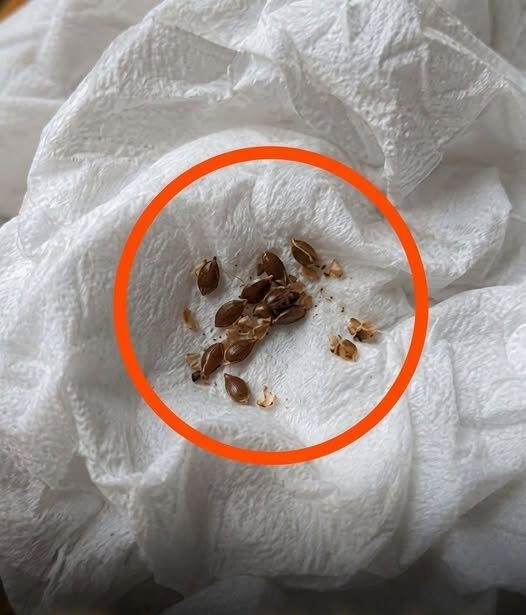
Brown Specks on Bedside Slippers Sparked Concern—Until a Closer Look Revealed Flaxseeds
An Unexpected Discovery Beside the Bed
A cluster of small brown objects resting on a pair of bedside slippers initially looked like something nobody wants to find in a bedroom: insect droppings. Their similar size and oval shape made the discovery seem suspicious.
However, a closer examination revealed an ordinary explanation. The mysterious specks were stray flaxseeds that had accidentally traveled from the kitchen.
What first appeared to be a possible pest problem turned out to be a small household spill. The moment illustrates how easily an unfamiliar object can be misidentified when it appears somewhere unexpected.
Why the Specks Looked Suspicious
The location played an important role in the confusion. Seeds scattered near a kitchen counter might attract little attention, but the same objects sitting on bedroom slippers can prompt very different assumptions.
Their appearance added to the uncertainty. Small, brown and similarly shaped, the specks looked consistent enough to suggest that they shared a single source.
That observation was reasonable, but it did not establish what the source was. Similarity in color and shape alone cannot reliably distinguish a food spill from material left by a pest.
Before the objects were examined more carefully, the slippers provided little context. There was no obvious reason to expect a kitchen ingredient beside the bed, making the harmless explanation less immediately apparent.
A Closer Look Changed the Explanation
The discovery became less alarming once the individual objects were inspected. Rather than insect droppings, they were recognizable as flaxseeds.
The seeds had been carried accidentally from the kitchen. The account does not establish exactly how they reached the slippers, so there is no basis for attributing their movement to a particular person, pet or item of clothing.
That missing detail does not change the identification. It simply leaves a small part of the household mishap unexplained.
The distinction matters because recognizing the material answered the immediate concern. These particular specks were food seeds, and their presence did not itself provide evidence of an infestation.
Location Can Shape Our First Impression
Everyday objects can seem unfamiliar when they appear outside their usual surroundings. A familiar ingredient may be easy to recognize in its packaging yet surprisingly difficult to identify when only a few pieces are scattered elsewhere.
In this case, the bedroom setting encouraged a more troubling interpretation. The initial concern came from the combination of the objects’ appearance and the unexpected place where they were found.
Looking more closely supplied information that the first glance had missed. Instead of treating the initial impression as a conclusion, the discovery was reconsidered.
That approach is useful whenever an unidentified household substance causes concern. Observing its details and considering nearby sources can help separate an ordinary spill from something that needs further attention.
Identifying the Material Before Reacting
A photograph or a brief description of small brown specks may not be enough to identify them confidently. Size, texture, shape and the surrounding circumstances can all matter.
When the identity remains uncertain, avoid assuming that every similar-looking object has the same explanation. The fact that these specks were flaxseeds does not mean all brown particles found on footwear or bedding are seeds.
Equally, an unsettling first impression is not proof of pests. Comparing an unfamiliar object with a plausible household source may resolve the question before unnecessary treatment begins.
Here, the explanation was straightforward once the seeds were recognized. The concern centered on a mistaken identity rather than a confirmed problem with insects.
A Small Spill With a Reassuring Answer
The bedside discovery ended with a much simpler explanation than the one first imagined. Uniform brown ovals that looked concerning on slippers were merely flaxseeds displaced from the kitchen.
No elaborate mystery was needed to account for their appearance. An everyday ingredient had reached an unexpected location, where it briefly looked like something else.
The useful lesson lies in that change of perspective: before deciding what an unfamiliar object means, take the time to establish what it actually is.