
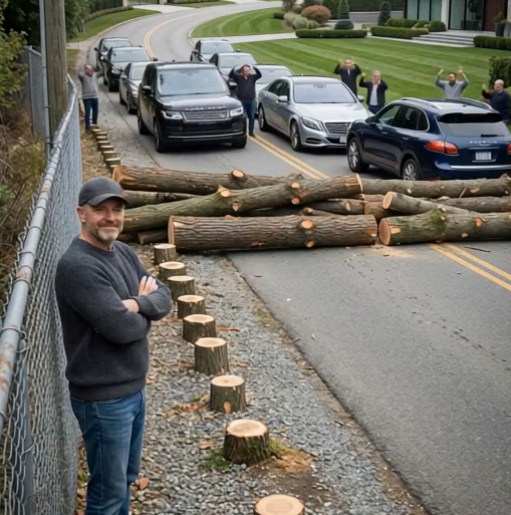
Property Dispute Over Trees Leads to Road Closure and Resolution
A Personal Loss Sparks Determination
Standing on the land that had been part of his family for years, Eli struggled to process what had just happened. The absence of the towering sycamore trees was impossible to ignore. What once stood as symbols of growth, care, and family history had been reduced to nothing more than stumps.
The loss was not just physical. Those trees represented memories tied to his father and the years spent tending the land. Seeing them gone without permission stirred a deep sense of disbelief and frustration.
For Eli, this was not simply about landscaping or aesthetics. It was about respect, ownership, and the violation of something deeply personal.
A Conversation That Changed Everything
Nearby, Mara stood quietly by the fence, her arms folded as she observed the scene. Her expression reflected the weight of the situation. She understood what those trees meant, even if she had not witnessed their entire history.
Breaking the silence, Eli spoke with a firm tone. “We need to do something.” His words carried a sense of urgency and resolve.
Mara looked at him, a mixture of concern and curiosity in her eyes. “What are you planning?” she asked.
Eli paused briefly before answering, but his decision was already made. “We’re closing the road.”
Taking Action Within Legal Boundaries
The road in question was not large or heavily traveled, but it played an important role. It served as a key access point into Cedar Ridge Estates from Eli’s side of the property. Despite its importance, it sat entirely within land that legally belonged to him.
Before taking any steps, Eli made sure to proceed carefully. He spent hours reaching out to a lawyer he trusted, explaining the situation in detail. He wanted to be certain that any action he took would remain within legal limits.
After confirming his rights, Eli moved forward with his plan. The following morning, he arranged for temporary fencing and obtained clear signage indicating that the road was closed.
As he secured the final post into the ground, a sense of control returned. While it did not undo the damage, it represented a step toward accountability.
Immediate Reactions From the Community
The closure did not go unnoticed. Word spread quickly throughout Cedar Ridge Estates, catching residents off guard. What had once been a routine route suddenly became inaccessible.
Within a short time, Eli received a call from Richard, the president of the homeowners association. His tone reflected frustration and urgency.
“Eli, what’s going on with the road?” he demanded.
Eli remained composed despite the tension. “Richard,” he replied calmly, “it seems there’s been a misunderstanding about property boundaries. Until we resolve this matter regarding my trees, I’m afraid the road will remain closed.”
Richard responded quickly, clearly unsettled. “You can’t just do that! People need access. We have rights.”
Eli did not hesitate. “And so do I,” he said. “Those trees were on my land, and you had no right to touch them. Until we settle this dispute, the road stays closed.”
Growing Tension and Divided Opinions
In the days that followed, the situation became the central topic of discussion within the neighborhood. Residents expressed a range of reactions, highlighting the complexity of the dispute.
Some individuals sympathized with Eli, recognizing the importance of property rights and the emotional impact of losing something so meaningful. They saw the closure as a justified response to an unfair situation.
Others, however, viewed the decision differently. For them, the inconvenience of losing access to the road created frustration. They felt caught in the middle of a conflict that did not directly involve them.
Despite the differing opinions, Eli remained focused. His goal was not to create conflict but to ensure that the issue was addressed properly.
Legal Discussions Begin
As the situation continued, formal discussions between Eli and the homeowners association began to take shape. Lawyers became involved, and the matter shifted from a neighborhood disagreement to a structured legal process.
Each side presented its position. Eli emphasized the clear ownership of the land and the unauthorized removal of the trees. The association, on the other hand, sought to resolve the issue while minimizing disruption to the community.
The process required patience. Weeks passed as conversations, documents, and negotiations moved back and forth.
Throughout it all, Eli remained consistent. His stance did not change, and he continued to emphasize the importance of respect and accountability.
Standing Firm Through Pressure
As time went on, the pressure increased. Residents continued to express their concerns, and the inconvenience caused by the road closure became more noticeable.
Despite this, Eli did not waver. For him, the issue extended beyond the immediate situation. It was about protecting what belonged to him and honoring the legacy left behind by his father.
The trees had represented years of care and connection to the land. Allowing the situation to pass without consequence would have meant overlooking something deeply important.
By maintaining his position, Eli ensured that the matter would be taken seriously.
A Resolution Is Reached
Eventually, the homeowners association acknowledged the situation and chose to move toward a resolution. They offered compensation for the loss of the trees, recognizing both their value and the mistake that had been made.
More importantly, they issued a formal apology. This acknowledgment carried significant weight, as it addressed the core issue of respect and responsibility.
With these steps in place, an agreement was reached. The conflict, which had once created tension throughout the community, began to settle.
The Road Reopens
Following the agreement, Eli removed the barriers and reopened the road. Access was restored, and daily routines returned to normal for residents of Cedar Ridge Estates.
While the physical changes were immediate, the experience left a lasting impression on everyone involved. The situation had highlighted the importance of clear boundaries and mutual respect.
For Eli, reopening the road was not a sign of defeat. It was a step forward after ensuring that his concerns had been properly addressed.
Looking Toward the Future
In the aftermath of the dispute, Eli turned his attention to restoring what had been lost. He planted new sycamore trees in place of those that had been removed.
He understood that they would take years to grow. Unlike the original trees, which had stood tall and mature, these new ones represented a fresh beginning.
Each sapling symbolized resilience and the passage of time. While they could not replace the past, they offered a way to rebuild and move forward.
A Lasting Reminder
As the new trees took root, they became more than just replacements. They served as a reminder of what had happened and the lessons learned from the experience.
The dispute had shown that even small actions can have significant consequences when boundaries are not respected. It also demonstrated the importance of standing firm when those boundaries are crossed.
For the community, it reinforced the need for communication and understanding. For Eli, it affirmed the value of protecting what matters most.
Over time, the new sycamores would grow tall, adding beauty and meaning back to the land. And as they did, they would quietly remind everyone that some things cannot be taken without consequence.