
How One Morning in Miller Park Turned Into a Community Response for a Veteran in Need
An ordinary commute took an unexpected turn
The morning began like any other for Silas as he crossed through Miller Park on his way to work.
The air was already heavy with humidity, and the park was filling with commuters, joggers, and students moving quickly through the city’s usual early rush.
That routine changed the moment he noticed a police cruiser parked near a green iron bench on the grass.
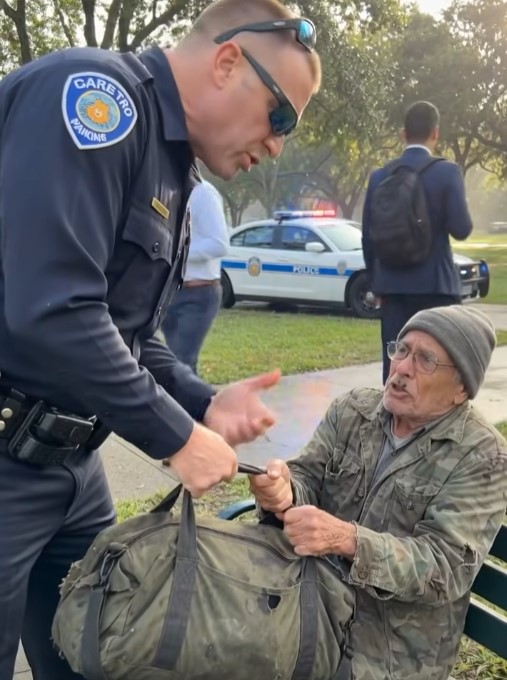
Standing beside the bench was Officer Miller, speaking with an older man known throughout the area as Sam.
For two years, Sam had been a familiar presence in that part of the park.
People knew his face, his worn camouflage jacket, and the small duffel bag and blanket he kept close, but most passed by without stopping.
A tense moment in a public space
That morning, Officer Miller told Sam that a new city ordinance was now being enforced.
The rule prohibited sleeping on park property between 6 AM and 10 PM, and Sam was being told that he had to move.
To many passing through the park, it may have looked like just another difficult urban scene.
But to Silas, it was something else entirely.
He saw an older veteran struggling to stand, trying to gather the few belongings he had left while dozens of people walked past without getting involved.
Sam’s hands were shaking, and he quietly explained that he had nowhere else to go.
Silas stopped walking.
Instead of continuing on, he stepped toward the bench and inserted himself into the moment in the calmest way he could.
He introduced himself, sat down beside Sam, and changed the direction of the conversation.
A simple invitation changed the tone
Rather than arguing in the park, Silas offered Sam something immediate and practical.
He invited him to breakfast.
The offer was straightforward, respectful, and free of pity.
Silas told Sam he was hungry and said he did not want to eat alone.
That small shift mattered.
In place of confrontation, there was a human invitation.
In place of public embarrassment, there was a chance for dignity.
Sam hesitated at first, concerned about leaving the bench and the belongings that represented nearly everything he had.
Silas assured him that the bag would come with them and that breakfast was the next step.
Together, they walked two blocks to Danny’s Morning Grill.
At Danny’s Morning Grill, Sam was treated like a guest
The deli was busy with the usual breakfast crowd when Silas and Sam walked in.
The room noticed them immediately.
Silas, who was known there, was not arriving in his usual office look that day. He wore an old leather vest, while Sam looked exhausted, weathered, and uncertain.
Danny cleared a booth for them, and they sat down in the back.
Sam looked uneasy at first, as though he was afraid to disturb the seat or the room around him.
Silas tried to make the setting as normal as possible.
He ordered two large breakfasts with eggs, bacon, hash browns, pancakes, and strong black coffee.
For Sam, the hot coffee alone seemed to bring visible relief.
It was not only the warmth of the drink that mattered.
It was the feeling of being served, seated, and acknowledged.
A conversation revealed more than appearances suggested
As breakfast arrived, the conversation between the two men deepened.
Sam recognized something familiar in Silas and asked whether he had served.
Silas confirmed that he had and made clear that he understood enough to know Sam was not a stranger in the usual sense.
The bond between them formed quickly.
It was not based on long personal history, but on recognition, respect, and a shared understanding of service and hardship.
That trust opened the door for action.
Silas began making calls from the table.
Help began with three phone calls
The first call went to Big Mac, president of the local chapter of the Iron Disciples, a veteran-owned motorcycle club with deep roots in the community.
Silas told him that a veteran had been living on a park bench for two years and now needed immediate support and a real place to stay.
Mac did not treat it as a passing problem.
He responded with urgency and made clear that he and others would show up.
The second call went to Sarah, who worked in veteran outreach and specialized in helping people secure housing placement.
Silas told her Sam had fallen through the cracks for far too long and needed emergency help that day.
Sarah began checking for available placement options, including emergency units in a renovated apartment complex on Highland.
The third call went to Eli, Silas’s brother, a contractor with crews, trucks, and practical know-how.
Silas asked him to be ready to furnish an empty apartment quickly if a unit became available.
That meant a bed, seating, food, and the basic comforts needed to turn a room into a home.
A larger support network started to form
What began as breakfast for two quickly became something larger.
It was no longer only about food or temporary shelter.
It had become a coordinated effort to move Sam out of survival mode and into a stable living situation.
As people in the deli watched the scene unfold, the attention in the room shifted.
Sam was no longer being viewed as a problem to remove from public view.
He was being recognized as a veteran in need of care and as a person whose life still mattered.
That change in atmosphere reflected the larger point of the morning.
So many people had passed him in the park over the previous two years.
Now, after one person chose to sit down and listen, others were moving into place to help.
Sam spoke honestly about what mattered most
At the table, Sam asked a question that cut through the bustle and planning around him.
He wanted to know why, after so long, anyone had decided to care that day.
It was the kind of question that stayed in the room even when nobody answered immediately.
It reflected not only his personal hardship, but the long stretch of invisibility he had endured in a public place surrounded by people.
Later, when a representative from the Department of Veterans Affairs arrived and told him that his pension and back pay issues had finally been cleared, the emotional center of the story remained the same.
The paperwork mattered. The money mattered. The correction mattered.
But Sam’s response showed that something deeper had been missing.
He made clear that what affected him most was not the financial news.
It was the fact that someone had sat with him.
Housing became the immediate goal
With Sarah working on placement and Eli preparing to help furnish a unit, the effort shifted toward getting Sam indoors that same day.
The Highland apartment complex became the focus.
An available emergency unit could provide what the park never could: privacy, stability, safety, and a chance to recover with dignity.
Eli and his team moved quickly.
They prepared to bring in essentials including a bed, a recliner, food, and household basics.
The goal was not luxury.
It was to ensure that when Sam walked through the door, he would enter a space that felt lived in, welcoming, and ready for him.
That readiness mattered because people who have spent long periods without stable shelter often face a difficult adjustment even when help finally arrives.
Creating a real home meant thinking beyond keys and walls.
The story spread beyond one bench
As more people learned what had happened that morning, the situation began to resonate more widely.
The reason was simple.
The circumstances around Sam were specific, but the larger issue was familiar in many communities.
People often become used to seeing hardship without interrupting their own schedules to respond to it.
A person can remain visible in public and still go unseen in any meaningful way.
Sam had become exactly that kind of figure in Miller Park.
Everyone knew he was there, yet almost no one had stepped into his story.
Silas’s intervention changed that pattern.
His first act was not dramatic.
It was breakfast.
But that basic act of respect triggered a chain reaction involving veteran advocates, community members, family support, and practical resources.
The morning became a lesson in visibility and responsibility
By the time the day moved forward, the original scene at the bench had taken on broader meaning.
It was no longer only about one ordinance, one officer, or one encounter in the park.
It had become a reminder of how easily people in crisis can be reduced to background scenery.
It also showed how quickly that can begin to change when one person chooses engagement over avoidance.
For Silas, the decision had been immediate.
He saw fear in Sam’s eyes and acted before overthinking it.
For Mac, Sarah, and Eli, the situation became a call to use their own roles and skills in service of someone who had been overlooked for too long.
Together, their actions formed a model of response that was both compassionate and practical.
They did not stop at sympathy.
They moved toward breakfast, outreach, housing, furniture, and follow-through.
A man who had been overlooked was finally acknowledged
Sam’s story carried emotional force because it centered on a basic human need that extends beyond food or shelter.
He wanted to be treated as someone worth sitting with.
That was the detail that stayed with the people around him.
For two years, he had lived on a bench in plain sight.
That meant two years of weather, uncertainty, fatigue, and public indifference.
Yet in a single morning, that pattern was interrupted.
Inside Danny’s Morning Grill, over coffee and breakfast, Sam was no longer invisible.
He was heard, named, helped, and planned for.
The process of restoring his stability began with ordinary actions carried out by people willing to take responsibility.
What began with breakfast led to something lasting
The events of that morning in Miller Park offered more than a dramatic episode on a city commute.
They revealed the distance between noticing hardship and actually responding to it.
Silas crossed that distance.
He saw an older veteran being pushed to move along and decided that the next step should not be another warning or another public removal.
Instead, he created a pause in the pattern.
He sat down, introduced himself, offered breakfast, and opened the door to a support system that had not activated before then.
By the end of the day, that choice had set housing plans in motion, mobilized community advocates, and reminded everyone involved that dignity often begins with presence.
Sam’s life had been reduced to a bench, a duffel bag, and a blanket.
But after one morning and one meal, he was walking toward something different: a roof, a room, and people prepared to stand with him.
In the end, the most important change was not only where Sam would sleep next.
It was that he was finally no longer facing the day alone.