
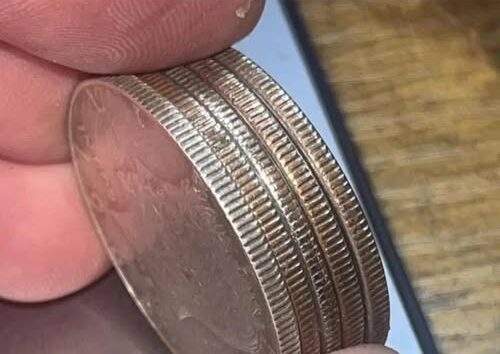
Why Coins Have Ridges Around the Edges and the Centuries-Old Fraud They Were Designed to Stop
The Small Detail Most People Never Notice
Millions of people handle coins every day without paying attention to the tiny ridges carved into their edges. Quarters slide across counters, dimes disappear into cup holders, and loose change gathers in jars at home with little thought given to the design details stamped into the metal.
Yet those small grooves are not random decorations. They were created to solve a serious financial problem that once threatened entire economies.
Long before digital banking and paper money became common, coins themselves carried real value because they were made from precious metals like silver and gold. That value created an opportunity for criminals who found a way to profit by altering the coins while keeping them in circulation.
When Coins Were Made From Precious Metals
Centuries ago, coins were produced using valuable metals that could easily be melted down and reused. A single coin represented not only monetary value, but also the exact amount of silver or gold contained within it.
Because of this, even the smallest reduction in a coin’s weight mattered.
Criminals realized they could carefully shave tiny amounts of metal from the edges of coins without immediately attracting attention. The coins still looked usable and often continued circulating at full value despite containing less precious metal than they originally should have had.
This practice became known as coin clipping.
At first glance, a clipped coin often appeared normal. The missing metal could be difficult to notice, especially after a coin had already experienced wear from years of use.
But while one altered coin may not have seemed important, the damage multiplied quickly when the scheme spread across large numbers of coins.
The Hidden Damage Caused by Coin Clipping
Coin clipping created problems far beyond individual theft.
Every small shaving collected from a coin added up over time. Criminals could gather enough silver or gold from thousands of clipped coins to melt down and reuse the metal for profit.
Meanwhile, the weakened coins continued moving through the economy as if they still carried their full value.
This slowly undermined confidence in currency itself.
Merchants began questioning whether the coins they received were truly worth their stated value. Governments lost valuable precious metal reserves. Financial systems became increasingly unstable as more clipped coins entered circulation.
People started inspecting coins more carefully, and distrust surrounding money grew stronger.
The issue became serious enough that governments searched for ways to stop the fraud before economic confidence deteriorated further.
Isaac Newton’s Unexpected Role
One of the key figures in the fight against coin clipping was Isaac Newton.
Although widely remembered today for his work in mathematics and physics, Newton also played a major role in protecting England’s currency system.
In 1696, he was appointed Warden of the Royal Mint.
Rather than treating the position as symbolic or ceremonial, Newton took the job seriously and aggressively pursued counterfeiters and coin fraud.
During this period, important changes were introduced to make coins more secure and harder to tamper with.
Among the most effective innovations was the addition of reeded edges — the evenly spaced ridges still visible on many coins today.
How Ridges Helped Stop Fraud
The ridged edges served a practical purpose that immediately changed how easily coin clipping could be detected.
Before grooves were added, criminals could remove thin layers of precious metal from smooth-edged coins without obvious signs of damage.
Once reeded edges became standard, however, any tampering became much easier to spot.
If someone shaved metal from the edge of a ridged coin, the groove pattern would appear interrupted, uneven, or incomplete. Even a small amount removed from the edge could expose signs of alteration.
A legitimate coin, on the other hand, displayed a precise and continuous ridge pattern around the entire circumference.
This made clipping far riskier and far more visible.
The ridges essentially acted as an early anti-fraud technology long before modern security features existed.
By making tampering easier to detect, governments were able to restore greater trust in currency and reduce large-scale losses caused by clipped coins.
The Lasting Impact of Reeded Edges
Although modern coins are no longer made from large amounts of silver or gold, the ridges remain an important part of coin design.
Over time, the grooves evolved beyond their original purpose and became useful for several additional reasons.
Modern vending machines and automated coin systems still rely on physical coin characteristics to help identify authentic currency. Edge patterns remain one of the features used to distinguish legitimate coins from counterfeits.
The grooves also provide practical benefits for visually impaired individuals.
Different edge textures allow coins to be identified by touch alone. A ridged dime or quarter feels noticeably different from a smooth-edged penny or nickel.
This tactile difference helps people sort and recognize coins without relying entirely on sight.
Why Some Coins Have Smooth Edges
Not every coin received ridges.
Pennies and nickels generally remained smooth because they were never considered valuable enough for clipping to become a widespread problem.
Their metal content simply did not justify the effort required to shave and collect small amounts from the edges.
Dimes and quarters, however, retained their ridged design because of their historical connection to silver content and anti-fraud protection.
Even after the composition of many coins changed over time, the reeded edges stayed in place as a continuation of earlier security measures.
The distinction between smooth and ridged coins became part of standard currency design that people still recognize today.
A Tradition That Survived for Centuries
Coin ridges eventually became more than just a security feature.
They evolved into a familiar visual and tactile characteristic associated with money itself.
People came to expect certain coins to feel textured along the edges, and the design continued across generations even as the original threat of clipping faded.
Today, most people rarely think about why those grooves exist.
The ridges have blended into everyday life, becoming one of the many details humans stop noticing through repetition and familiarity.
Yet the design continues carrying the legacy of a much older battle involving trust, commerce, and fraud.
The Story Hidden in Everyday Change
The grooves around modern coins may seem insignificant, but they represent a solution to a problem that once affected entire economies.
What appears to be a small design choice was actually created to defend currency from manipulation and preserve public confidence in money.
Each ridged edge serves as a reminder of a time when the smallest fragments of silver or gold could be stolen from circulation little by little until the damage became enormous.
The practice of coin clipping showed how vulnerable financial systems could become when trust in currency began to disappear.
The introduction of reeded edges helped restore that trust by making fraud easier to detect and harder to hide.
Even centuries later, those same grooves remain in people’s pockets, wallets, and cash registers around the world.
What many see as a simple texture is actually surviving evidence of human ingenuity, economic protection, and one of history’s earliest forms of anti-counterfeiting technology.