
The Conductor Who Stopped a Train After Finding a Child’s Hidden Note
A Crowded Station and a Silent Child
Boston South Station was packed on a freezing December evening as commuters hurried toward their trains, eager to escape the winter cold.
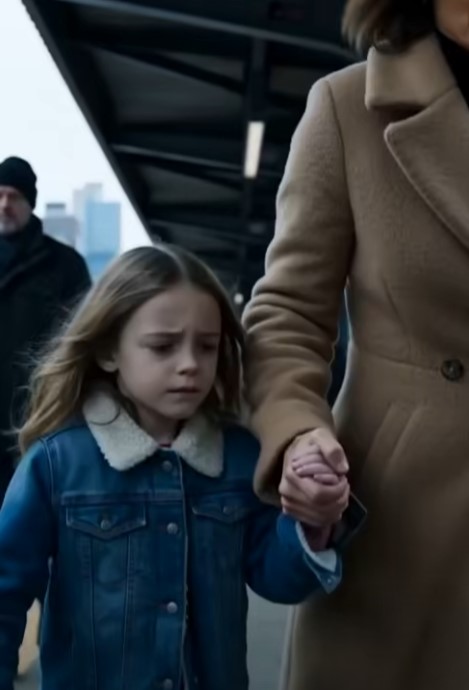
Among the crowd was eight-year-old Lily, walking beside her mother, Eleanor, who held her wrist tightly while rushing toward the 6:15 train to Connecticut.
To strangers passing by, Eleanor looked like a polished mother in a hurry. She wore an expensive coat, carried a designer bag, and spoke as if she were simply trying to get her tired daughter home.
But Lily’s posture told a different story. Her shoulders were drawn inward, her eyes stayed low, and she moved with the careful stillness of a child afraid to make a mistake.
When her sleeve briefly slipped, a passing traveler noticed marks on her arm. Eleanor quickly pulled the sleeve down and offered a smooth explanation about hospital visits and exhaustion.
The stranger accepted the explanation and moved on, leaving Lily once again surrounded by noise, movement, and silence.
A Mother Driven by Fear
Eleanor was not calm. Beneath her polished appearance, she was unraveling.
She warned Lily not to speak, not to look at anyone, and not to draw attention. Her fear centered on Richard, Lily’s stepfather, a wealthy real estate developer from Greenwich whose public reputation hid the terror inside their home.
Days earlier, Eleanor had tried to leave with Lily. She had taken her daughter to a motel near Boston, hoping distance might protect them.
But Richard found them. A threatening message convinced Eleanor that returning was the only way to avoid something worse.
Instead of seeking help, she gave in to fear and began dragging Lily back toward Connecticut.
Lily understood what that meant. If she boarded the train and reached the next stop, Richard would be waiting.
The Conductor Who Noticed
At the entrance to Car 3 stood Marcus Miller, a veteran Amtrak conductor with more than three decades on the rails.
Marcus had seen every kind of passenger, from nervous travelers to families in crisis. Over the years, he had learned to notice what others missed.
His own past made him especially alert. Years earlier, his daughter Chloe had been trapped in a dangerous relationship, and Marcus had not been able to save her in time.
Since then, he watched people closely. He looked for fear behind smiles, hesitation behind ordinary answers, and the quiet signals of someone who needed help.
When Eleanor and Lily approached, Marcus immediately sensed something wrong.
He saw Eleanor’s frantic movements. He saw Lily’s thin jacket, lowered gaze, and silent terror. Then he caught a glimpse of the marks around the child’s wrist.
The Note on the Step
Marcus asked if Lily was all right, but Eleanor quickly answered for her.
She insisted her daughter was only tired and demanded to board. When Marcus hesitated, Eleanor pushed Lily into the train.
In that brief moment, Lily made the only move she could.
Earlier, while waiting in the station, she had found a discarded blue ticket stub and written a short message on it with a broken pencil.
As she passed Marcus, she quietly let the paper fall near his boots.
Marcus noticed it only as the train doors began to close. Something about Lily’s eyes made him bend down and pick it up.
The message was simple and devastating: “The bruises aren’t from falling, and he is waiting for us at the next stop.”
The Emergency Stop
Marcus did not hesitate.
He called dispatch and ordered the train stopped before it could leave the station area. The emergency brakes engaged, startling passengers and sending a wave of confusion through the cars.
Inside Car 3, Eleanor panicked. She knew the delay meant Richard might find out they had not continued toward Connecticut.
Marcus entered the car and approached their seats. He asked Eleanor and Lily to come with him to the vestibule.
Eleanor became defensive and angry, claiming harassment and insisting she had every right to continue traveling with her daughter.
But Marcus held firm. He had Lily’s note in his hand, and he knew the train could not continue as if nothing had happened.
Help Arrives in the Train Car
Officer Sarah Lin, an Amtrak Transit Police officer, arrived from another car after the emergency stop.
She quickly understood that Marcus was not responding to a routine passenger issue. He believed a child was in immediate danger.
Also nearby was Dr. Aris Thorne, a pediatric psychologist who had noticed Lily’s fearful behavior from his seat.
Dr. Thorne identified himself and explained that Lily’s body language suggested serious trauma. He formally raised concern for ongoing abuse and said the child needed immediate separation from the adult traveling with her.
The mood in the car changed instantly. Passengers who had been annoyed by the delay fell silent.
Then Eleanor’s phone rang. The caller ID showed Richard.
Eleanor broke down, saying he would know something was wrong if she did not answer. Officer Lin treated the phone as evidence and moved to secure the situation.
A Fight to Protect Lily
When officers tried to remove Lily from the train, Eleanor reacted in panic.
She lunged toward the child, insisting they had to go back. Officer Lin stopped her and placed her under arrest after the confrontation escalated.
Dr. Thorne shielded Lily from the scene and spoke to her gently, using a calm voice and small details to help ground her.
Lily still did not speak, but she accepted help. She walked away from the train with Dr. Thorne and Marcus, leaving behind the car where her desperate note had changed everything.
At the transit police sub-station, officials began sorting through the legal and medical crisis.
They soon learned that Richard Vance was not an ordinary family member. He was wealthy, connected, and used to getting his way.
The Pressure Builds
Officer Lin discovered that Richard had influence across several institutions and that earlier concerns connected to the family had disappeared from official systems.
Captain Edward Briggs, worried about political consequences, hesitated. He feared the department would face lawsuits if Richard arrived with legal documents demanding Lily’s release.
Dr. Thorne refused to let bureaucracy put Lily back in danger.
He used his medical authority to begin emergency protective steps for both Eleanor and Lily. Eleanor was treated as a person in crisis, while Lily was placed under medical protection pending a forensic evaluation.
Marcus, meanwhile, stepped outside to delay Richard’s entry into the station.
When Richard arrived in a black Mercedes, Marcus blocked his path and used station rules to stall him.
Richard tried money, threats, and powerful phone calls. Marcus did not move.
The Monster at the Door
Richard eventually forced his way toward the back offices with attorneys behind him.
When he entered the breakroom, Lily froze. His calm voice sounded caring to anyone who did not know the truth, but Lily’s reaction revealed the fear beneath it.
Marcus stood between Richard and the child.
Richard mocked him, threatened his career, and claimed his lawyers would undo everything by morning.
Marcus answered with the only power he had: the truth. He warned Richard that Lily’s note, the medical findings, the station footage, and Eleanor’s statements would not stay hidden.
Moments later, Officer Lin’s radio crackled with a message. Federal authorities had entered the station with an arrest warrant for Richard Vance.
The charges involved interstate flight, witness intimidation, and violations involving a minor.
Officer Lin placed Richard under arrest while his attorneys stepped back in shock.
A Child Finally Heard
After hours of paperwork, interviews, and emergency procedures, Lily remained in the station breakroom under Dr. Thorne’s care.
Marcus stayed too, long after his shift should have ended.
Before Lily was taken to the hospital, Marcus gave her a small yellow Amtrak souvenir token. He told her it was a conductor’s token and that it meant she had a lifetime pass on every train he would ever drive.
For the first time that night, Lily showed the smallest sign of a smile.
She did not need to say much. Her note had already spoken for her.
The Aftermath
At Massachusetts General Hospital, Lily received medical care and support from specialists. Her injuries were documented, and she was placed in a secure environment where Richard could not reach her.
Dr. Thorne remained close, helping her slowly begin to feel safe.
Marcus later learned that Richard’s arrest opened a much larger investigation. Authorities uncovered evidence connected not only to the abuse inside the home but also to financial crimes and corruption tied to Richard’s business empire.
Weeks later, Richard appeared in federal court. His public image was gone, replaced by the reality of the charges against him.
The court handed down a severe sentence, making clear that his wealth and influence could no longer protect him.
A New Journey
Six weeks after the night at South Station, Lily returned to Track 5.
This time, she was not being dragged toward danger. She wore a warm red coat, sturdy boots, and carried herself with a new steadiness.
Dr. Thorne walked beside her as she approached Car 3, where Marcus was waiting.
Marcus greeted her like a fellow conductor. Lily reached into her pocket and showed him the yellow token.
“I have my pass, Marcus,” Lily said.
Her voice was small but clear. It belonged to her now.
Marcus approved her pass and welcomed her aboard.
As the train prepared to depart, he looked at the step where the blue ticket stub had once landed.
That tiny piece of paper had stopped a train, exposed a hidden danger, and gave one child the chance to begin again.
The Lesson Behind the Note
Lily’s story is a reminder that suffering does not always announce itself loudly.
Sometimes it hides behind polite explanations, expensive clothing, and the silence of a frightened child who has learned not to ask for help.
Marcus did not save Lily because he had special power. He saved her because he paid attention.
He noticed the fear others overlooked. He picked up what could have been dismissed as trash. He chose to act when delay would have been easier.
In a busy world, that choice can make all the difference.
A crowded station may seem like a place where everyone is invisible, but one person looking closely can change the direction of a life.