
The Tiny Hole Near Your Ear Could Hold a Remarkable Clue About Human Development
A Small Feature Many People Never Notice
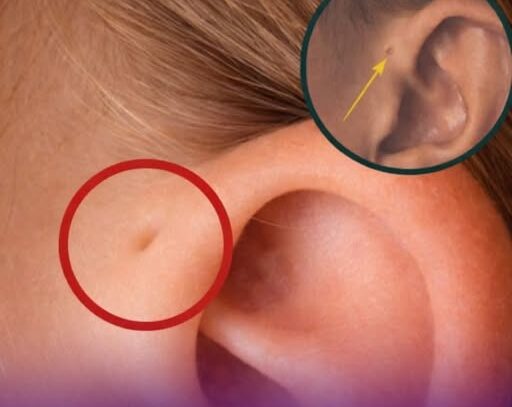
Most people rarely examine the outer edge of their ears closely. Yet for some individuals, a tiny opening can be found just in front of the ear where the upper cartilage meets the side of the face.
At first glance, this small mark may appear to be a scar, an old piercing, or a minor skin irregularity. In reality, it is often a naturally occurring anatomical feature known as a preauricular pit.
Although it is usually harmless and often goes unnoticed, this tiny indentation has attracted the attention of medical professionals and scientists for many years.
Its unusual appearance and unique origin have made it one of the more intriguing developmental traits found in the human body.
What Exactly Is a Preauricular Pit?
A preauricular pit, also referred to as a preauricular sinus, is a small opening located near the front of the ear.
This feature develops before birth during the earliest stages of fetal growth. During pregnancy, structures that eventually form the ears, jaw, and surrounding areas undergo a complex process of development and fusion.
In most cases, these tissues join together completely. Occasionally, however, a tiny opening remains beneath the skin.
That opening becomes what is known as a preauricular pit.
The size and visibility of the pit can vary from person to person. Some are barely noticeable, while others appear as small dimples or distinct openings.
A person may have a pit on only one side of the head or on both sides. When only one pit is present, it is more frequently observed near the right ear.
For the majority of people, it causes no symptoms and requires no treatment.
How It Forms Before Birth
The development of the ears begins surprisingly early in pregnancy. Around the sixth week of fetal growth, several structures work together to create the complex shape of the outer ear.
These developing tissues must merge precisely in order to form the ear’s final structure.
When this process leaves behind a small gap, a preauricular pit can form.
Because the feature originates during fetal development, it is considered a congenital trait, meaning it is present at birth.
Many babies with preauricular pits are completely healthy and may never experience any related issues throughout their lives.
In many cases, the pit remains so small that it attracts little attention unless specifically pointed out.
The Evolutionary Connection That Fascinates Scientists
Beyond its medical explanation, the preauricular pit has generated interest because of a theory connected to human evolution.
Some evolutionary biologists have suggested that the feature may represent a distant developmental link to structures found in ancient aquatic ancestors.
This idea centers on the way embryos develop during the earliest stages of life.
Human embryos and fish embryos share certain developmental patterns. During these stages, structures called pharyngeal arches appear as part of normal growth.
In fish, these structures eventually contribute to the formation of gills.
In humans, the same developmental framework gives rise to parts of the jaw, throat, and ears.
Because of this shared developmental pathway, some scientists have proposed that preauricular pits may be connected to evolutionary remnants associated with those ancient structures.
The theory suggests that the tiny opening could be viewed as a subtle biological reminder of a distant evolutionary past that stretches back hundreds of millions of years.
Although this interpretation remains a topic of scientific interest rather than a proven function of the pit itself, it highlights the remarkable complexity of human development.
Evidence of Evolution Within the Human Body
The concept of evolutionary remnants is not unique to preauricular pits.
The human body contains several features that are often discussed in relation to humanity’s long biological history.
The tailbone, for example, is commonly cited as a reminder of ancestors that possessed tails.
Wisdom teeth are another frequently mentioned example, reflecting dietary and anatomical conditions that differed from those of modern humans.
Within this broader context, preauricular pits are sometimes viewed as another small piece of evidence showing how developmental history can leave traces within the body.
Whether regarded as a simple congenital variation or a possible evolutionary echo, the feature continues to inspire curiosity among researchers and the public alike.
How Common Are Preauricular Pits?
Preauricular pits are considered relatively uncommon, but their frequency varies significantly across different populations.
In the United States and the United Kingdom, estimates suggest that between 0.1 percent and 1 percent of people have the trait.
In many Asian populations, the percentage can be considerably higher, reaching as much as 10 percent.
Some regions of Africa also report prevalence rates ranging from 4 percent to 10 percent.
These differences demonstrate that the feature is distributed unevenly around the world.
As a result, a person living in one region may rarely encounter a preauricular pit, while in another area it may be relatively familiar.
A Trait That Can Run in Families
Genetics often plays an important role in the appearance of preauricular pits.
The trait is frequently inherited, which means it can be passed from one generation to the next.
When one family member has a preauricular pit, it is not unusual to find the same feature in parents, siblings, or children.
This hereditary pattern has contributed to ongoing interest among geneticists studying how physical traits are transmitted through families.
For many people, discovering that a relative shares the same small opening near the ear can help explain why the feature appeared in the first place.
Are There Any Health Risks?
For most individuals, a preauricular pit causes no medical concerns.
Many people live their entire lives without experiencing any symptoms or complications.
However, the small opening can sometimes extend into a narrow tract beneath the skin.
Because of this structure, debris, natural oils, or dead skin cells may occasionally become trapped inside.
When this happens, complications can develop, although such situations are relatively uncommon.
Possible Complications
One potential issue is the formation of a cyst beneath the skin near the pit.
This may appear as a small lump that develops gradually over time.
Another possibility is infection.
If bacteria enter the tract, symptoms such as redness, tenderness, swelling, or discharge may occur.
In some cases, untreated infections can progress into abscesses, resulting in increased discomfort and inflammation.
These complications are not typical for most people with preauricular pits, but they are important to recognize if symptoms develop.
When Medical Attention May Be Needed
Any signs of pain, swelling, drainage, or persistent irritation around a preauricular pit should be evaluated by a healthcare professional.
Medical assessment can help determine whether an infection or other complication is present.
When treatment is necessary, infections are often managed successfully with antibiotics.
For individuals who experience repeated infections, a minor surgical procedure may be considered to remove the tract and prevent future problems.
Early evaluation can help avoid more serious complications and provide lasting relief when symptoms recur.
Why It Should Never Be Squeezed or Probed
Because the opening resembles a small pore or dimple, some people may be tempted to squeeze it or attempt to clean it aggressively.
This is generally discouraged.
Probing, piercing, or squeezing a preauricular pit can increase the risk of irritation and infection.
Allowing healthcare professionals to evaluate any concerns is the safest approach.
In most cases, the feature requires no intervention at all.
A Tiny Detail With a Big Story
At first glance, a preauricular pit appears insignificant.
It is small, often unnoticed, and usually harmless.
Yet behind this tiny opening lies a fascinating story involving fetal development, inherited traits, and theories about humanity’s distant biological origins.
For some people, it is simply a unique physical characteristic passed down through generations.
For others, it serves as an intriguing reminder of the developmental pathways shared by living creatures across vast stretches of evolutionary time.
Whatever perspective one takes, the feature demonstrates that even the smallest details of human anatomy can reveal remarkable insights.
The next time you notice a tiny hole near someone’s ear, it may be more than a simple skin mark. It could represent one of the most interesting and subtle features hidden within the human body.