
I Thought My Marriage Was Over When I Saw the Roses, Then One Envelope Changed Everything
A Porch Filled With Flowers
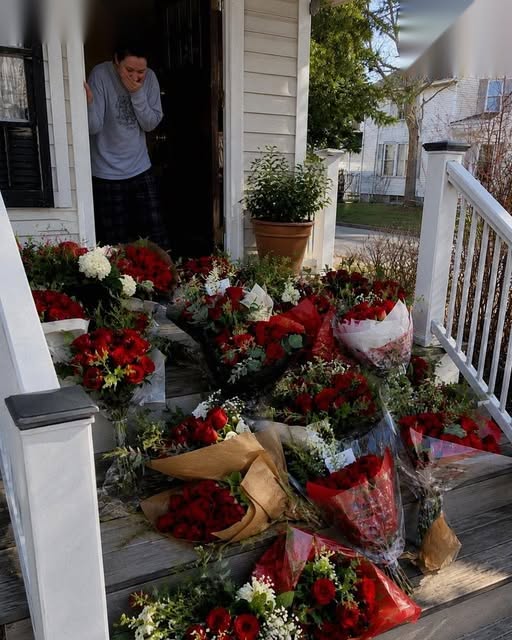
I was sure my marriage was over the moment I turned into our driveway and saw the roses.
There were flowers everywhere. Bouquets covered the porch steps, leaned against the railing, filled the small table by the door, and crowded the welcome mat until there was barely room to stand.
Red roses. Pink roses. Yellow roses. White roses wrapped in paper, tied with ribbons, tucked into jars, and resting in careful bundles like someone had emptied an entire florist shop onto our front porch.
At first, I did not feel touched. I felt cold.
My wife, Jane, was not standing there waiting for me. There was no smile through the window, no excited wave, no explanation shouted through the screen door. Just a silent porch covered in roses.
And in that silence, my mind went somewhere dark.
The Fear I Did Not Want to Name
Jane and I had been struggling for months.
Not in a loud, dramatic way. There had been no slammed doors, no terrible accusations, no packed suitcase waiting in the hallway. Our marriage had been wearing down quietly, the way a shoreline disappears little by little until one day you realize the land is almost gone.
She had been coming home late from school more often. She would walk in exhausted, set her bag down by the door, and give me a tired smile that did not reach her eyes.
Some nights, she barely ate dinner. Other nights, she sat at the kitchen table grading papers until her shoulders bent forward and her handwriting turned uneven from fatigue.
I told myself I understood. Jane was a teacher. Her work did not end when the bell rang.
But understanding something and living beside it are not the same.
Months of Distance
I started to feel like a guest in my own marriage.
She was always answering emails, planning lessons, printing extra worksheets, calling parents, or worrying about students whose names I only heard in passing. She carried the weight of her classroom into every room of our house.
When I asked if she was all right, she usually said she was just tired.
When I suggested she take a break, she said the kids needed her.
When I asked whether she still needed me, she looked wounded, as though I had asked a question she did not know how to answer.
Slowly, I began building a story in my head.
In that story, Jane was drifting away from me. In that story, the late nights were not only about school. In that story, her silence meant she was hiding something.
The Roses Looked Like Proof
So when I saw the roses, I did not see gratitude.
I saw evidence.
A hundred bouquets do not arrive by accident. A hundred bouquets do not appear on a married woman’s porch without meaning. At least, that was what I told myself as I sat in the car, staring through the windshield while my hands tightened around the steering wheel.
I thought of the late nights.
I thought of the phone she sometimes turned face down.
I thought of the way she had been crying quietly in the bathroom two nights earlier, insisting she was fine when I knocked on the door.
By the time I stepped out of the car, I had already decided the worst.
A House Too Quiet
I walked slowly toward the porch.
The flowers smelled sweet and heavy in the evening air. Their beauty only made the scene feel more painful. Each bouquet seemed like a message meant for someone else, a message I had arrived too early or too late to understand.
I called Jane’s name before opening the door.
No answer.
Inside, the house was quiet. Her shoes were by the hallway. Her school bag was on the chair where she always left it. The lamp in the living room was on, casting a soft yellow light across the floor.
For a moment, I thought she might have left a note saying goodbye.
Instead, I found the envelope.
The Envelope With the Crooked Blue Heart
It was sitting on the entry table, partly hidden beneath a stack of cards.
The envelope was plain white, but someone had drawn a crooked blue heart on the front. It looked like a child had made it with a marker, pressing too hard in some places and barely touching the paper in others.
My name was not on it.
Jane’s name was.
I should have waited for her. I should have called out again, searched the house properly, or respected the privacy of something that clearly belonged to my wife.
But fear makes people small.
I opened it.
The First Words That Broke Me
The note inside was written in uneven handwriting.
It was not romantic. It was not secretive. It was not anything my frightened imagination had prepared me for.
It was a thank-you note.
The child who wrote it thanked Jane for helping him believe he was not stupid.
He wrote that he used to hate reading because the words moved too fast and everyone else seemed better. He wrote that Jane had stayed after school with him, had made extra worksheets just for him, and had told him that learning slowly was still learning.
At the bottom of the page was another crooked blue heart.
I read the note once. Then I read it again.
Something inside me shifted, and with it came shame.
Card After Card
I picked up another card.
Then another.
Each one told a different piece of the same story.
One parent thanked Jane for calling every week when their daughter stopped participating in class.
Another thanked her for noticing that their son had been coming to school without breakfast and quietly arranging help without embarrassing him.
A student thanked her for sitting beside her during lunch when she had no friends.
Another family thanked Jane for refusing to give up when their child had already given up on himself.
The roses were not from one person.
They were from many.
What I Had Failed to See
My jealousy had turned my wife’s exhaustion into suspicion.
I had looked at her late nights and seen distance. I had looked at her silence and seen rejection. I had looked at her tired face and wondered why she had nothing left for me.
But those cards told me what I had refused to understand.
Jane had been pouring herself into children who needed someone steady. She had been staying after school not because she wanted to avoid home, but because some child needed one more explanation, one more chance, one more adult who believed progress was possible.
She had carried home more than papers and lesson plans.
She had carried their fears, their struggles, their small victories, and their pain.
The Reason Behind the Bouquets
As I kept reading, the full picture became clear.
Jane had been close to leaving teaching.
She had not told me how close. I knew she was tired. I knew she felt unappreciated. I knew she sometimes came home with red eyes and said it had been a difficult day.
But I did not know she had begun to believe none of it mattered.
I did not know she felt invisible.
I did not know she thought her work was disappearing into the noise of complaints, pressure, paperwork, and endless expectations.
The families had learned she was considering quitting. Instead of letting her walk away without knowing the truth, they had decided to show her what she had meant to them.
The roses were not a scandal.
They were a rescue.
Jane Comes Downstairs
I heard the stairs creak behind me.
When I turned, Jane was standing halfway down, wearing one of my old sweatshirts and looking as if she had been crying.
For a moment, neither of us spoke.
She looked at the open envelope in my hand. Then she looked at the cards scattered across the entry table and the bouquets still waiting outside.
I expected anger.
I deserved it.
Instead, she only looked tired.
That hurt more than anger would have.
The Truth I Could Not Avoid
I told her I was sorry.
Not in the quick way people apologize when they want a problem to disappear. I told her the truth, ugly as it was.
I told her that when I saw the roses, I thought the worst.
I told her I had been feeling left behind, but instead of saying that clearly, I had let resentment grow in silence.
I told her I had mistaken her devotion for rejection.
Jane listened without interrupting.
Then she sat down on the bottom step and covered her face with both hands.
A Different Kind of Breaking Point
She said she had not known how to explain what teaching had been doing to her.
She loved her students. She loved the moments when something finally clicked, when a child’s face changed because they realized they could do the thing they thought they could not do.
But she was tired of feeling like she was failing everyone.
There were always more needs than time. More problems than solutions. More children asking for attention than one person could reasonably give.
She said she had started to wonder whether caring so much had made her weak.
The cards on the table answered that question better than I ever could.
Bringing the Flowers Inside
We carried the bouquets in together.
It took a long time.
Some were heavy with water. Some had handwritten notes tied to the stems. Some had small drawings tucked into the wrapping. One bouquet had a ribbon that had clearly been reused from something else, but Jane held it as carefully as if it were silk.
By the time the last bouquet was inside, the house felt transformed.
Not just by the roses, but by what they proved.
Every late night, every extra worksheet, every quiet encouragement had taken root in someone’s life.
She Had Been Seen
Jane had spent months believing she was invisible.
Now every card insisted she had been seen more clearly than she ever realized.
Children had noticed.
Parents had noticed.
Families had remembered the calls, the patience, the gentle corrections, the second chances, and the way Jane made their children feel less alone.
For months, she had carried the fear that her work did not matter enough.
That night, the answer filled our living room in petals and ink-stained thank-yous.
What the Roses Gave Back
Jane was not suddenly fixed.
That mattered to understand.
A hundred bouquets could not erase exhaustion. They could not remove the pressure from Monday morning. They could not make every difficult day disappear or solve every problem waiting in her classroom.
But they changed something important.
They reminded her that she was not walking into that classroom alone.
Those families had given her more than flowers. They had given her permission to stay, and a reason to believe that what she did mattered enough to fight for again.
The Marriage I Almost Misread
Later that night, we sat together on the couch.
Roses surrounded us on every surface we could find. The coffee table was covered with cards. A few petals had fallen onto the rug. The room smelled like a garden after rain.
I watched Jane read the notes slowly, one by one.
With each card, the defeat that had shadowed her face seemed to loosen its grip.
I realized then how close I had come to damaging something precious because I had mistaken pain for betrayal.
My wife had not been leaving me.
She had been trying not to lose herself.
The Lesson Left on Our Porch
That porch full of roses taught me something I should have known long before.
Love is not always loud. Devotion does not always look romantic. Sometimes it looks like a tired teacher cutting out worksheets at midnight. Sometimes it looks like a woman who has no energy left because she spent all of it helping children find theirs.
Sometimes the person beside you is not pulling away.
Sometimes they are carrying more than they know how to say.
I thought the roses meant my marriage was over.
Instead, they showed me the woman I had failed to see clearly, and the quiet difference she had been making all along.