
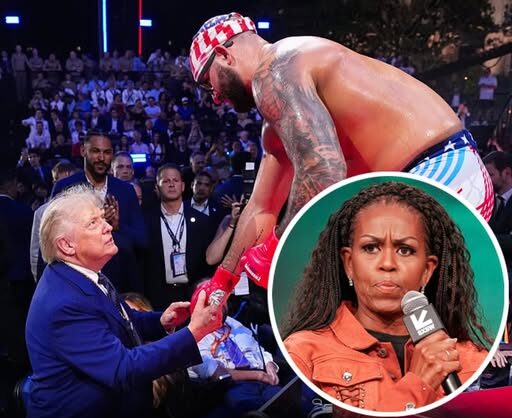
Josh Hokit’s Comment About Michelle Obama Turns UFC Freedom 250 Into a Political Firestorm
A Patriotic Event Becomes a Controversial Moment
UFC Freedom 250 was expected to be remembered as a display of patriotism, power and public celebration.
Instead, one sentence from fighter Josh Hokit shifted the focus away from the event itself and toward a moment that quickly became one of the most discussed scenes of the night.
Standing on the White House lawn, surrounded by lights, flags and a roaring crowd, Hokit took the microphone after his fight and praised Donald Trump.
What followed was not a routine victory speech.
Hokit directed an insult at Michelle Obama, calling her “a man,” a remark tied to a long-running and baseless conspiracy that has repeatedly been used to mock and dehumanize her.
The atmosphere changed almost immediately.
What had been a loud, celebratory crowd turned into a mix of cheers, shock and silence as people processed what had just been said in such a public setting.
Cameras Capture Trump’s Reaction
As the comment landed, cameras quickly shifted toward Donald Trump.
The moment drew even more attention because Trump appeared to lean in toward Hokit after the insult was made.
His words were not clearly heard by viewers at the time, leaving many people to wonder how he responded in the seconds after the remark.
That uncertainty helped drive the clip across social media, where viewers replayed the footage and debated what the exchange revealed.
The focus was no longer only on Hokit’s insult.
It became about the reaction to it, the public setting in which it happened, and the message sent by the response that followed.
Lip Reader Claims Trump Praised Hokit
Lip reader Jeremy Freeman later claimed Trump responded to Hokit by saying, “Too kind, thank you. You are the champion,” after the remark about Michelle Obama.
That claim intensified the controversy.
For critics, the alleged response appeared to reward the fighter instead of rejecting the personal smear.
For others watching the clip, the moment raised questions about whether public figures have a responsibility to challenge cruel or false statements when they are made in front of them.
The alleged words did not address Michelle Obama directly.
They did not correct the claim.
They did not push back against the insult.
Instead, the claimed response centered on praise for Hokit, which made the moment feel even more charged for those disturbed by the original comment.
Why the Remark Sparked Backlash
The comment about Michelle Obama was not viewed as an isolated joke by many who heard it.
It echoed a false and harmful conspiracy that has circulated for years and has often been aimed at attacking her identity, dignity and family.
Because of that history, the sentence carried more weight than a typical political insult.
It was seen by many as part of a broader pattern of personal attacks that move beyond political disagreement and into cruelty.
The setting also mattered.
This was not a private conversation or an offhand remark away from cameras.
It happened during a highly visible event on the White House lawn, with millions of people watching the footage spread afterward.
The combination of the venue, the audience and the public figures involved made the moment impossible to dismiss as ordinary fight-night trash talk.
Dana White Responds to the Controversy
UFC boss Dana White later condemned “nasty and false things about people’s families,” drawing a public line after the backlash grew.
His response reflected the difficulty of separating a sporting spectacle from the political and personal attacks that can erupt around it.
Freedom of speech remained part of the conversation, but so did the question of whether public platforms should be used to repeat baseless claims about someone’s family.
White’s remarks suggested that even in a world known for aggressive language, there are still limits when personal smears replace competition or commentary.
The controversy placed the UFC event in a difficult position.
What was meant to be a celebration of strength became linked to a moment of public insult and political division.
A Victory Speech Overshadowed by One Sentence
Hokit’s post-fight appearance could have been remembered as a traditional victory moment.
He had the microphone, the crowd’s attention and the energy of a major event behind him.
Instead, the insult became the defining part of the scene.
Everything after it was viewed through that lens.
The crowd reaction, Trump’s expression, the alleged lip-read response and Dana White’s later statement all became part of the same story.
The original purpose of the event faded into the background as the public focused on the words spoken from the microphone.
The Larger Question Left Behind
The controversy surrounding UFC Freedom 250 left a larger question hanging over the celebration.
What kind of victory was being cheered?
For some, the moment represented political loyalty and public praise for Trump.
For others, it showed how quickly a patriotic setting can become a stage for personal cruelty.
The insult aimed at Michelle Obama did not change the outcome of the fight, but it changed the meaning of the night for many viewers.
Instead of a clean celebration, the event became a flashpoint over dignity, public responsibility and the line between speech and dehumanizing attacks.
In the end, the most memorable part of UFC Freedom 250 was not a punch, a victory or a patriotic display.
It was a sentence that turned a roaring crowd silent, sent cameras swinging toward Donald Trump, and left viewers debating what should have happened next.