
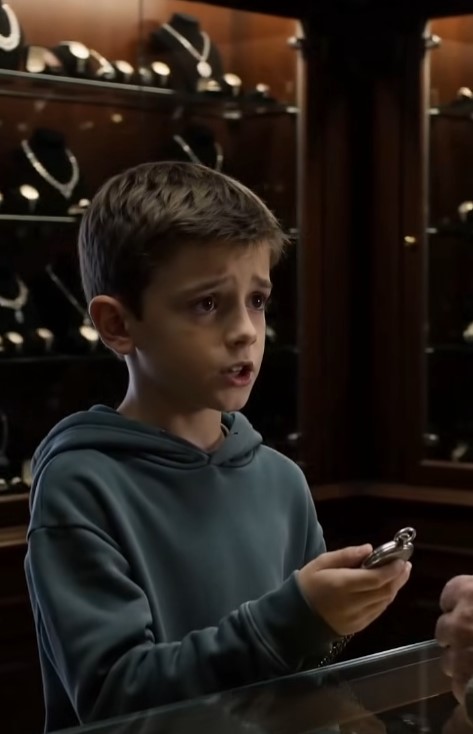
PART 2: THE ROOM BEHIND THE IRON DOOR
For several seconds, nobody moved.
The alarms continued screaming through Harrow House.
Water poured from the ceiling sprinklers, soaking the basement floor and carrying thin streams of dust beneath the shelves.
Victor Voss remained on his knees with one hand pressed against his wounded shoulder.
Two officers restrained him while another kicked the pistol away.
Henry barely noticed.
His attention remained fixed on the iron door at the back of the room.
Emily was leaning against him, too weak to stand without support.
Noah held her hand with both of his.
—What children? Henry asked.
Emily looked toward the small key lying in his palm.
—The ones whose families stopped asking questions.
The police officer from the jewelry shop stepped closer.
—Mr. Whitmore, give me the key.
Henry did not move.
—My daughter has been locked inside this place for twenty-two years.
—And there may be children behind that door who need help immediately.
That reached him.
Henry placed the tiny key in the officer’s hand.
It looked too delicate to open anything important.
It had been hidden behind a photograph inside a watch for decades, no larger than the nail on Henry’s little finger.
The officer crossed the room and inserted it into a narrow opening beneath the iron handle.
The mechanism clicked.
Then came a second sound from deep inside the wall.
A row of locks released one after another.
The door opened slowly.
Cold air moved into the basement.
Beyond it was a corridor lined with small rooms.
There were no windows.
Each door had a number painted across the center.
Some stood open.
Others remained closed.
On the nearest wall hung dozens of photographs.
Children of different ages stared into the camera.
Some were smiling.
Some looked frightened.
Beside each picture was a name, a date, and a handwritten note.
Henry stepped closer.
One note read: FAMILY DECEASED.
Another said: TRANSFER COMPLETE.
A third contained only two words.
NO CLAIMANTS.
Noah pressed himself against his mother.
—I remember this place.
Emily tightened her fingers around his hand.
—You were very young.
—There was a girl who sang at night.
Emily closed her eyes.
—Her name was Lily.
One of the officers called into the corridor.
—Police! If anyone can hear me, call out!
At first, there was only the sound of the alarm.
Then came a faint knock.
Three taps.
A pause.
Three more.
The officers ran toward the sound.
Henry helped Emily follow, but after only a few steps her knees gave way.
He caught her before she struck the floor.
—You need a doctor.
—Not yet.
—Emily—
—Please, Dad. I waited twenty-two years. Let me see this end.
It was the first time she had called him Dad without uncertainty.
Henry lifted her arm around his shoulders.
Together, they continued down the corridor.
The knocking came from Room Twelve.
The door was locked from the outside.
An officer broke it open.
Inside were two children.
A girl of about nine sat on a narrow mattress, holding a younger boy against her chest.
Both wore gray clothing that looked like hospital uniforms.
The girl raised one hand to protect her eyes from the corridor light.
—Are you taking us downstairs? she asked.
—No, the officer said softly. —We’re taking you home.
The girl did not look relieved.
She looked confused.
As if the word home belonged to a language she had almost forgotten.
More officers entered the hidden section.
They opened every door.
Five children were found alive.
Two were too weak to walk.
One could not remember his last name.
In the final room, investigators discovered boxes filled with birth certificates, forged adoption papers, death notices, and letters that had never been mailed.
There were hundreds of them.
Emily stared at the shelves.
—Mine are here.
She moved toward a wooden cabinet marked W.
Henry opened it.
Bundles of envelopes fell forward.
Every one was addressed to him.
Henry Whitmore.
Whitmore Jewelry.
The old city address.
Some envelopes were yellow with age.
Others were recent.
All were sealed.
Henry picked up the oldest one.
The date was twenty-one years earlier.
His hands began to shake.
—You wrote all of these?
Emily nodded.
—At first, every week.
Henry looked at the stacks.
—Why did you stop?
—I didn’t.
She pointed toward a second shelf.
More letters filled it from front to back.
—They told me you returned them unopened. Then they showed me the letter saying Mother had died and that you never wanted my name spoken again.
Henry pressed the oldest envelope against his chest.
—Your mother died looking for you.
Emily covered her mouth.
For the first time since Henry had found her, she began to cry.
Not loudly.
The tears simply slipped down her face as twenty-two years of stolen grief finally found somewhere to go.
Henry reached for her.
She hesitated only a moment before falling into his arms.
Noah stood beside them, holding the gold watch.
He had picked it up from the basement floor.
—Why was the key inside this? he asked.
Emily wiped her face.
—Your grandmother put it there.
Henry stepped back.
—My wife knew?
—Not everything. But she knew someone was watching us before I disappeared.
Emily touched the dented edge of the watch.
—Daniel and I returned to the city six months after we left. We wanted to apologize. We wanted to tell you we had married.
Henry listened without breathing.
—Your mother met us before we reached the house. She said a man had been asking questions about the Whitmore trust and following her from the bank.
—Voss?
—His father.
Emily looked toward the restrained man at the end of the corridor.
Victor Voss was staring back at them.
His face had gone pale from blood loss, but his eyes remained cold.
—The Voss family managed legal accounts for wealthy families, Emily continued. —They knew the trust would eventually pass to me. When Daniel’s father died, they discovered Noah would also inherit the Reed estate.
Henry looked down at his grandson.
—So they kept both of you alive because they needed your signatures.
—And because some parts of the trusts could not be transferred until Noah reached a certain age.
Victor laughed from across the hall.
—You make it sound so cruel.
An officer pushed him against the wall.
—Be quiet.
Victor ignored him.
—Harrow House gave people purpose. Children no one wanted became useful. Families who had too much money and too little discipline were managed.
Henry took one step toward him.
—You forged my daughter’s death.
—Your grief made that easy.
Henry’s fists tightened.
The officer placed a hand against his chest.
—Don’t give him what he wants.
Victor smiled despite the pain.
—He already did. Twenty-two years ago, when he told her not to come home.
Emily moved between them.
She was weak, but her voice was steady.
—My father made one terrible mistake.
Victor’s smile faded.
—You built your entire life around making sure no one could repair theirs.
The officers led him away.
As he passed Noah, Victor stopped.
—Do you think this changes anything? The money will still tear them apart.
Noah looked up at him.
—My mother needed medicine. I tried to sell a clock.
He held the watch against his chest.
—You had everything and still became poor inside.
Victor’s expression hardened.
The officer pulled him forward.
This time, he said nothing.
Medical teams entered Harrow House before sunrise.
Emily was carried outside on a stretcher.
Noah refused to release her hand until a nurse allowed him to climb into the ambulance beside her.
Henry stood near the open doors.
—Can I come?
Emily looked at him.
For a moment, he feared she would say no.
She had every right.
He had loved her, but he had also wounded her with the final words she heard before leaving home.
Love did not erase that.
Then Emily moved her hand toward the empty seat.
—We have twenty-two years to talk about.
Henry climbed inside.
At the hospital, doctors discovered that Emily had been given sedatives for years.
The medication had weakened her body and clouded her memory, but there was no permanent damage that could not improve with time and treatment.
Noah had also been given smaller doses whenever he became difficult to control.
He recovered more quickly.
Within two days, he was walking through the hospital corridors, asking nurses questions and trying to repair a broken wheel on an equipment cart with a spoon.
Henry watched him from Emily’s room.
—He reminds me of Daniel.
Emily turned toward the window.
—Daniel died trying to get us out.
Henry sat beside her.
—What happened?
Emily took a long breath.
—He discovered that Harrow House was changing records for children whose parents had died or disappeared. He found the hidden rooms. He planned to take the evidence to the police.
—Voss killed him?
—They caused a car crash and told me he died instantly.
Her voice became quieter.
—I never saw his body.
Henry looked at her.
—Then how do you know he died?
Emily did not answer.
The door opened.
The jewelry store officer entered with a folder beneath his arm.
His name was Officer Hale.
Henry had been so consumed by the rescue that he had never asked.
—We found something in the Harrow House records, Hale said.
He placed the folder on Emily’s bed.
Inside was a photograph of Daniel Reed.
He was older than the man in the watch picture.
His hair had begun to gray near his temples.
But he was alive.
The photograph had been taken only six months earlier.
Emily’s fingers froze above the page.
—Where is he?
Hale turned to the second document.
—The records show he was transferred to another facility twelve years ago.
—Where?
—The location is listed only as North Annex.
Henry leaned forward.
—Does that place exist?
—We’re trying to find out.
Noah entered the room carrying a cup of water.
He saw the photograph and stopped.
—That’s the man from my dreams.
Emily looked at him.
—You remember him?
—He used to sing when I was little.
Noah put the cup down.
—He said if I ever got lost, I should follow the clocks.
Henry glanced at the gold watch.
—What does that mean?
Noah lifted the piece and turned it over.
—There are numbers on the back.
Henry had examined that watch hundreds of times before giving it to Emily.
He knew every scratch.
But now, beneath the corrosion near the hinge, a series of tiny marks had become visible.
They were not random scratches.
They were coordinates.
Officer Hale copied them.
Within an hour, police identified the location.
An abandoned clock factory stood there, forty miles north of the city.
The building had once belonged to Whitmore Manufacturing.
Henry’s father had closed it before Henry was born.
—North Annex, Emily whispered.
Hale immediately called for a search team.
This time, Henry did not argue when he was told to stay behind.
Emily needed him.
Noah needed him.
And after twenty-two years of reacting too late, he understood that protecting his family also meant trusting others to help.
The police reached the abandoned factory shortly before midnight.
Behind a wall of broken clocks, they found a hidden staircase.
It led to a basement containing medical beds, locked rooms, and another archive of stolen identities.
Only one prisoner remained.
He was weak.
His beard had grown long.
One leg had been badly injured years earlier and never healed correctly.
But when officers showed him Emily’s photograph, he began to cry.
Daniel Reed returned to the city the following morning.
Henry stood beside Emily’s hospital bed when the door opened.
Daniel entered with the help of a cane.
For a moment, no one spoke.
Emily stared at him as if afraid he would disappear if she blinked.
Daniel dropped the cane.
She left the bed despite the nurse’s protest.
They met in the center of the room and held each other with the desperation of people who had already mourned one another.
Noah stood near the doorway.
—Dad?
Daniel turned.
The boy had grown since he last saw him, but his face still carried the same expression he had as a toddler whenever he was uncertain whether it was safe to hope.
Daniel lowered himself painfully to one knee.
—I’m sorry I took so long.
Noah ran into his arms.
Henry turned toward the window.
He wanted to give them privacy.
Daniel called his name.
—Mr. Whitmore.
Henry faced him.
The young man he had once rejected was gone.
Before him stood someone who had survived years of imprisonment while trying to protect his wife and child.
Henry removed his glasses.
—I was wrong about you.
Daniel held Noah with one arm.
—You were trying to protect your daughter.
—No. I was trying to control her.
Henry looked at Emily.
—And other people used my pride to steal her from me.
He held out his hand.
Daniel took it.
But Henry pulled him into an embrace instead.
The investigation into Harrow House continued for months.
Authorities connected Victor Voss and his family to forged deaths, stolen inheritances, illegal confinement, and the disappearance of several children.
The surviving children were identified through the hidden records.
Some were reunited with relatives who had been told they were dead.
Others entered safe homes while investigators searched for their families.
Every letter found inside Harrow House was delivered.
Some arrived decades late.
Many changed lives.
Victor Voss never recovered control of the Whitmore or Reed trusts.
The documents he had spent years manipulating became evidence against him.
Henry used part of the recovered money to create a foundation for children separated from their families through fraud and coercion.
He named it the Emily and Daniel Homecoming Fund.
Six months after the rescue, the bell above the jewelry store door rang again.
The display cases had been repaired.
The old sign outside had received a new coat of paint.
But the shop remained much as it had always been.
Emily sat near the window, reading one of the letters Henry had never received.
Daniel repaired a chair in the back room.
Noah stood behind the counter wearing an apron far too large for him.
Henry placed the restored gold watch on a square of dark velvet.
The dent remained near the hinge.
The scratches had not been polished away.
Henry believed some marks should remain.
They proved an object had survived.
Noah leaned over the counter.
—How much is it worth?
Henry pretended to examine it carefully.
—The gold has value.
—That’s not what I asked.
Henry smiled.
—Then it is priceless.
Noah picked it up and listened to the quiet ticking.
—Mom told me to sell it.
—And you brought it to the only shop where it could never truly be sold.
Emily looked up from her letter.
—Perhaps it knew the way home.
Henry crossed the room and placed the watch in her hand.
—No. You did.
Emily closed her fingers around it.
Outside, snow began falling over the old street.
Inside the jewelry store, the clocks continued moving.
For twenty-two years, time had been used against them.
Now, at last, it belonged to them again.