
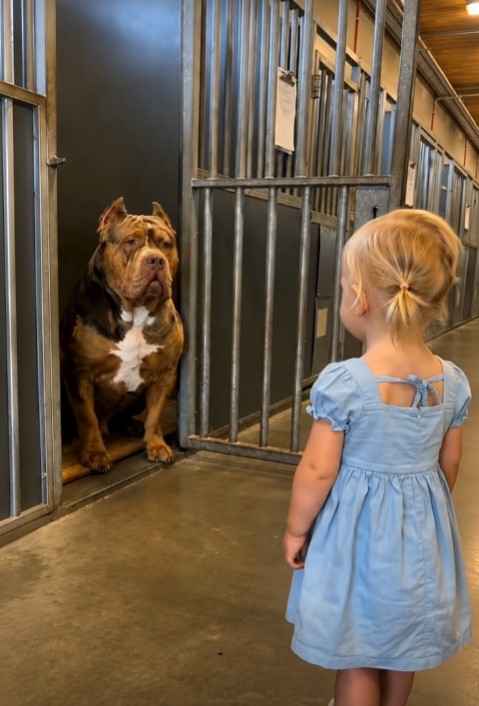
Dangerous Shelter Dog No One Wanted Shows Unexpected Calm When Three-Year-Old Girl Approaches His Kennel
A Dog Everyone Feared
For a long time, Bob was known as the most difficult dog in the shelter.
He was large, strong, covered in scars, and kept in a separate kennel at the far end of the building. Staff members and frequent visitors understood one rule clearly: Bob was not a dog anyone approached casually.
Whenever someone came too close to his kennel, he reacted immediately. He barked, lunged at the bars, and tried to push through the fence as if every person nearby was a threat.
His behavior had already caused serious concern inside the shelter. Several workers had been scratched or bitten while trying to clean his space. One volunteer was badly injured after Bob escaped during a walk and attacked out of fear.
No one at the shelter knew the full story of what had happened to him before he arrived.
The only records showed that Bob had been found on an abandoned property outside the city. His body carried many scars, suggesting he had survived extremely harsh treatment. Some believed he may have once been used in illegal dog fighting, though no one could confirm exactly what he had endured.
Whatever the past had been, the present was clear. Bob trusted no one.
Life Inside Kennel Number Seventeen
Bob’s kennel became a place people avoided.
He growled at adults, teenagers, visitors, and other animals. Families who came looking for pets were warned before they ever reached his area.
— Just don’t go near kennel number seventeen.
Most people listened. Some glanced at him from a distance. Others walked quickly past. No one asked to meet him, and no one considered adopting him.
As weeks turned into months, other dogs came and went. Puppies found families. Gentle older dogs were taken home. Even shy animals eventually met people patient enough to love them.
Bob remained behind.
Each evening, when the shelter closed, staff members would see him sitting alone in the corner of his kennel. During the day, he appeared dangerous and explosive. At night, he looked isolated, tired, and unreachable.
Over time, the shelter’s management began facing a painful question. Bob could not be placed with other dogs. He could not safely interact with visitors. Training attempts had shown little progress, and his care was becoming increasingly difficult.
Some employees quietly began to believe that Bob had no future.
They did not say it with cruelty. They said it with sadness, because they had watched him remain trapped between fear and aggression for far too long.
A Family Arrives at the Shelter
Then one day, a young family walked into the shelter.
A mother and father had come to find a small, gentle dog for their three-year-old daughter, Emily. They wanted a friendly pet, something safe and calm for a child so young.
The staff showed them puppies and explained the personalities of different dogs. They discussed care, routines, and what kind of pet might fit best with a small child in the home.
At first, Emily stayed close to her parents. She walked quietly beside them, watching the dogs with curiosity.
But like many children her age, she did not remain still for long.
While the adults continued talking, Emily wandered away. No one noticed immediately. She moved slowly down the corridor, looking into the kennels as she passed.
Some dogs wagged their tails. Some jumped excitedly against the doors. Others barked as the little girl passed by.
Then Emily reached the last kennel.
It was Bob’s kennel.
The Moment Everything Changed
Bob was sitting inside when Emily stopped in front of him.
Normally, the sight of an unfamiliar person would have triggered his usual reaction. He would bark, growl, and throw himself toward the bars.
But this time, he did not move.
He simply watched the child.
Emily stepped closer. The kennel latch had not been fully secured after the morning cleaning, and no one had noticed the mistake.
The little girl reached toward the door, and her small fingers accidentally pulled the latch. Slowly, the door swung open.
In an instant, the dog everyone feared was free.
Standing directly in front of him was a three-year-old girl.
A staff member saw what had happened and went pale.
— Oh my God…
He ran toward the kennel. Emily’s parents turned and saw the open door.
Her mother screamed:
— Emily, don’t go near him!
Several staff members rushed forward at the same time, but everyone understood the danger. Bob was already outside the kennel. The distance between him and Emily was almost gone.
The shelter fell into a tense silence. The only sound was the frantic movement of people trying to reach the child in time.
Bob stepped closer.
Emily looked at him calmly.
Then she smiled.
An Unexpected Reaction
What happened next stunned everyone watching.
Bob did not bark. He did not lunge. He did not growl.
Instead, the huge dog carefully lowered himself onto the floor in front of the child. Then he rolled onto his side and exposed his belly, asking to be petted.
The staff could hardly believe what they were seeing.
For two years, no one had witnessed Bob behave that way. The same dog who had terrified visitors and injured workers was now lying quietly in front of a small child.
Emily gently stroked his head.
Bob let out a quiet sigh and closed his eyes. In that moment, he no longer looked like the dangerous dog everyone feared. He looked exhausted, vulnerable, and relieved.
For the first time in a very long time, he seemed to feel safe.
Emily’s mother reached her daughter and quickly lifted her into her arms. Even then, Bob did not react aggressively.
He stayed calm. He sat beside them and kept looking at Emily, as if she were the first person who had ever reached him without fear.
A New Understanding of Bob
The incident changed how the shelter looked at Bob.
Staff members had seen him as dangerous for so long that many had stopped looking for another explanation. After what happened with Emily, they decided to bring in a canine behavior specialist who had experience working with abused animals.
The expert observed Bob over several weeks.
The conclusion surprised many people at the shelter.
Bob was not simply a vicious dog. He was a frightened dog.
His aggression was not random. It was a defensive response built from pain, fear, and a past he had never been able to escape.
Most adults appeared to remind him of danger. Before anyone could hurt him, Bob tried to protect himself by acting first.
But Emily did not represent the same threat in his mind. She was small, calm, and unafraid. Around her, Bob allowed a part of himself to appear that no one at the shelter had seen before.
The dog people had called hopeless was still capable of trust.
Regular Visits and Slow Progress
After that day, Emily’s family began returning to the shelter regularly.
The visits were supervised carefully by specialists and staff members. No one treated the situation lightly. Bob’s history still mattered, and safety remained important.
But each visit showed the same pattern. Around Emily, Bob softened.
He learned to stay calm. He allowed gentle contact. Slowly, he became more comfortable with the family and the people helping him.
The change did not happen overnight. Bob had carried fear for too long to forget it immediately. He needed time, structure, patience, and consistency.
Emily became part of that process.
Her presence helped reveal that beneath Bob’s frightening reactions was a dog shaped by trauma, not a dog beyond saving.
For the shelter staff, watching that change was emotional. Many of them had known Bob only as the animal behind kennel number seventeen, the dog everyone warned visitors to avoid.
Now they were seeing something different.
An Adoption Once Thought Impossible
Six months later, Emily’s family made a decision that once would have seemed unimaginable.
They signed Bob’s adoption papers.
Not everyone at the shelter felt completely relaxed about it. Some staff members were still worried, and those concerns were understandable. Bob had a difficult history and had once been considered one of the shelter’s greatest challenges.
But the family had not rushed the decision. They had spent months visiting him, working with specialists, and watching his behavior carefully.
Bob had changed because someone had finally understood what he needed.
Weeks passed after the adoption. Then months passed. Eventually, years went by.
No problems arose.
The dog once described as dangerous became Emily’s loyal protector. The same animal who had spent so long alone in the corner of his kennel found a home with the little girl who had seen him without fear.
A Story of Fear, Trust, and Second Chances
Bob’s story became a powerful reminder that behavior is not always the whole truth.
At the shelter, his aggression had made him seem impossible to reach. People saw the barking, the lunging, and the fearsome scars. They saw a dog who could hurt someone.
What they could not see immediately was the fear behind it.
Emily’s unexpected encounter did not erase Bob’s past, but it revealed something important. He was not beyond love, and he was not beyond change.
He needed the right environment, careful guidance, and someone patient enough to see more than his worst moments.
For a long time, kennel number seventeen had been treated like a warning. After Emily met Bob, it became the beginning of a second chance.
The dog no one dared to adopt finally found the one person who made him feel safe enough to become himself again.