
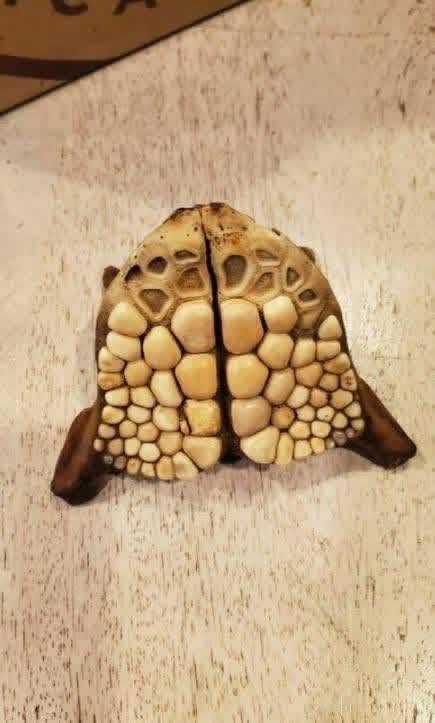
Beachcomber’s Strange Sand Discovery Turns Out to Be Rare Fish Throat Teeth
A walk along the beach can turn into an unexpected mystery in a matter of seconds. For anyone who has ever searched through sand near the shoreline, the experience is familiar: shells, driftwood, smooth stones, and other unusual objects often appear where the water meets the land.
Most finds are easy to identify. A shell may be worn by the waves, a piece of wood may be shaped by saltwater and sun, and small fragments of marine life often wash ashore after storms or shifting tides.
But every so often, the beach leaves behind something far more puzzling. That was the case for a beachcomber in Pensacola, Florida, who discovered a strange, toothy object in the sand that looked as if it might have belonged to something ancient.
A Strange Find Along the Pensacola Shore
The object immediately stood out because of its unusual appearance. It looked hard, fossil-like, and covered with small tooth-shaped structures packed closely together.
At first glance, it did not resemble a common seashell or a typical fish bone. Its surface looked too organized to be random, but too unusual to be quickly recognized.
The discovery was interesting enough that the beachcomber kept it and tried to learn what it was. What began as a simple beach find slowly became a long-running mystery.
Over the years, the object was shown to people who might reasonably have been expected to identify it. Marine biologists examined it. Museum experts also looked at it. Still, the object remained difficult to explain.
The mystery continued for nearly two decades. For twenty years, the beachcomber was left with a strange piece from the shoreline and no clear answer about where it had come from or what creature it had once belonged to.
The Mystery Finally Gets an Answer
The answer eventually came when the object was identified as the pharyngeal teeth of a freshwater drum fish. The freshwater drum is also known by the scientific name Aplodinotus grunniens.
Although the object looked like a fossil or a relic from a much older animal, it was not an ancient artifact. It was part of the feeding structure of a fish.
More specifically, it came from the throat area rather than the front of the mouth. That detail explains why it looked so different from what many people expect fish teeth to look like.
When most people imagine fish teeth, they picture sharp rows inside the mouth. Some fish have pointed teeth used for grabbing prey, while others have smaller teeth suited to different feeding habits.
The freshwater drum is different. Instead of relying only on sharp teeth at the mouth, it has flat grinding teeth located deeper in the throat. These are called pharyngeal teeth.
What Are Pharyngeal Teeth?
Pharyngeal teeth are specialized teeth located in the throat region of certain fish. In the freshwater drum, they are not designed to slice or puncture.
They are designed to crush. Their function is closer to molars than fangs, allowing the fish to grind through hard-shelled food.
This feeding tool is especially useful because the freshwater drum eats prey such as clams and snails. Those animals are protected by shells, which many predators cannot easily break.
The drum’s throat teeth help solve that problem. Once the prey is taken in, the pharyngeal teeth can crush the shell and allow the fish to feed on what is inside.
That explains the object’s dense, toothy appearance. What looked like a strange fossilized plate was actually a natural grinding structure from a fish that feeds on hard-shelled prey.
Why the Object Looked So Unusual
The confusion surrounding the beach discovery makes sense. Freshwater drum pharyngeal teeth do not look like the ordinary teeth most people associate with fish.
They can appear as clusters of rounded, flattened teeth packed tightly together. Their arrangement may resemble a mosaic, a small patch of coral, or even a fossil fragment.
That appearance is part of what made the object so difficult to identify. A person finding it on a beach could easily imagine it came from an ancient creature rather than a modern fish.
Its shape also created a natural puzzle. Because the teeth are located in the throat, they do not look like a jawbone with familiar rows of teeth.
Instead, the structure looks separate, compact, and almost decorative. Without knowing what pharyngeal teeth are, it would be easy to mistake the object for something unrelated to fish anatomy.
A Fish Known for Crushing Hard-Shelled Prey
The freshwater drum’s unusual teeth are closely tied to the way it survives. Its diet includes animals that are not easy to eat without special adaptations.
Clams, snails, and mussels are protected by hard outer shells. A fish without the right feeding equipment would struggle to make use of those food sources.
The drum’s grinding teeth allow it to take advantage of prey that other fish may not be able to consume as effectively. This gives the species access to a food supply that requires strength and specialized structure.
Rather than tearing its food apart with sharp front teeth, the fish uses the throat teeth to break down tough shells. The process depends on pressure and grinding, much like the way molars work in other animals.
This makes the pharyngeal teeth one of the most distinctive features of the freshwater drum. They are practical, efficient, and strikingly different from the image many people have of fish teeth.
Why a Freshwater Fish Was Found Near a Florida Beach
One of the most surprising parts of the discovery is the location. The object was found on a beach in Pensacola, Florida, a place associated with saltwater and the Gulf coast.
The freshwater drum, as its name suggests, is usually connected with freshwater environments. It can generally be found in rivers and lakes throughout North America.
That raises an obvious question. How could the throat teeth of a freshwater fish end up on a salty beach?
The explanation lies in the fish’s ability to tolerate more than one kind of environment. Freshwater drum can live in brackish water, where freshwater and saltwater mix.
Brackish areas often occur in estuaries and other places where rivers, lakes, or freshwater systems meet saltwater. These mixed environments create a bridge between inland waters and coastal systems.
Because of that, it is possible for remains from a freshwater drum to move through connected waterways. Currents, tides, and natural movement of water can carry material from one area to another.
Over time, a hard structure such as pharyngeal teeth could be separated from the rest of the fish and transported. Eventually, it may wash ashore far from where someone would expect to find evidence of a freshwater species.
The Role of Tides and Currents
Beaches are constantly changing. Waves bring material in, tides pull material out, and currents move objects across distances that are not always obvious to people standing on the shore.
A beachcomber may find objects that originated nearby, but they may also discover things that traveled from farther away. Shells, bones, plant matter, and other natural remains can move through water before settling on sand.
In this case, the pharyngeal teeth may have been carried by shifting tides or ocean currents. Because the structure is hard and compact, it could remain recognizable even after the softer parts of the fish had disappeared.
That durability helped preserve the object long enough for it to be found. It also contributed to the mystery, because the remaining structure no longer looked obviously connected to a whole fish.
An Example of Nature’s Adaptation
The freshwater drum’s throat teeth are more than a curiosity. They show how animals develop features that help them survive in specific environments.
For the drum, the ability to crush hard-shelled prey is a major advantage. It opens access to food that requires more than simple biting or swallowing.
That adaptation also affects the ecosystem around the fish. By feeding on animals such as clams, snails, and mussels, the drum plays a part in the balance of freshwater systems.
Every feeding strategy in nature has consequences. When a fish can eat certain prey, it becomes part of a larger pattern of interaction among species.
The pharyngeal teeth are therefore not just strange-looking pieces of anatomy. They are tools shaped by need, diet, and survival.

Why the Discovery Was So Hard to Identify
The long delay in solving the mystery shows how misleading natural objects can be when they are found out of context. A complete fish is much easier to identify than a small, isolated structure washed up on shore.
Once separated from the body, the throat teeth no longer had obvious clues around them. There was no full skeleton, no skin, no fins, and no surrounding anatomy to guide identification.
The object’s fossil-like appearance added to the confusion. Its dense pattern and hard texture made it look older and more mysterious than it actually was.
Even people familiar with marine life could be puzzled by it, especially because the freshwater drum is not the first animal many would think of when examining something found on a saltwater beach.
The location and appearance worked together to make the object seem stranger than it was. Only after the correct connection was made did the shape begin to make sense.
A Small Object With a Long Story
What makes the Pensacola beach discovery memorable is not only what was found, but how long it remained unexplained. For nearly twenty years, the object represented an unanswered question.
It had enough detail to suggest it came from something living, but not enough familiar features to make identification simple. That is the kind of discovery that can stay in a person’s mind for years.
Once identified, the object became less mysterious but more meaningful. It was no longer just a strange toothy piece from the sand. It was evidence of a specialized fish adaptation that many people never see.
The discovery also shows why ordinary beachcombing can sometimes lead to remarkable finds. Even a small object can reveal a hidden part of the natural world.
A Reminder Hidden in the Sand
Beaches often feel familiar, but they are full of moving pieces from different environments. The sand can hold traces of sea life, freshwater life, plants, shells, and remains carried from far beyond the visible shoreline.
The pharyngeal teeth of the freshwater drum are a perfect example of that complexity. They looked like a relic from the distant past, but they were actually part of a fish with an unusual way of feeding.
The object’s journey from a fish’s throat to a Florida beach may never be known in full detail. Still, the explanation shows how natural systems can connect rivers, lakes, brackish water, tides, and coastlines.
For the beachcomber who found it, the answer brought an end to a twenty-year mystery. For everyone else, it offers a simple lesson about the strange things that can appear at the water’s edge.
The next time an unusual object turns up in the sand, it may be worth a closer look. What seems like a fossil, a shell, or a random fragment could be part of a much larger story.
In this case, the story belonged to a freshwater drum fish and its remarkable throat teeth, a natural grinding tool that helped the animal crush clams, snails, and mussels. What looked like a puzzle from the ancient past turned out to be one of nature’s clever designs hiding in plain sight.