
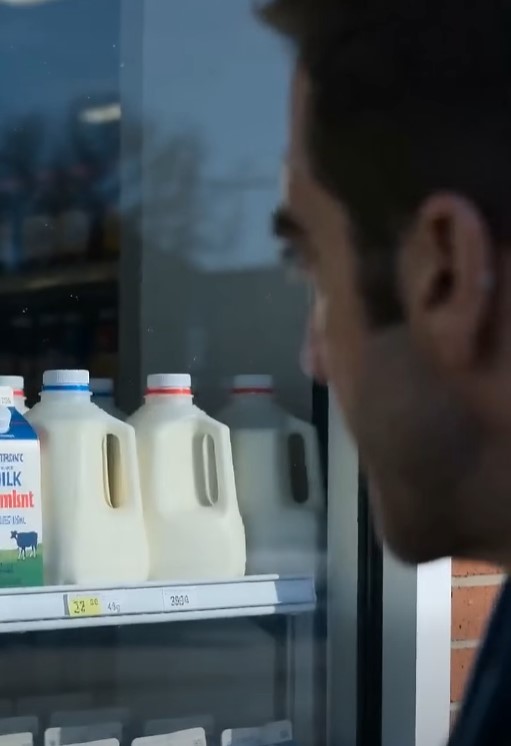
The Billionaire Who Bought Milk for Two Hungry Children and Found a New Meaning of Wealth
A Cold Afternoon That Changed Everything
Chicago’s winter wind moved sharply through the streets, pushing between tall buildings and forcing people to hurry with their heads lowered. Near Madison and Wabash, commuters rushed past storefronts, buses hissed at the curb, and the cold turned every breath into a pale cloud.
Jonathan Mercer stepped out of a black town car with a leather briefcase in one hand and his phone in the other. At thirty-eight, he was already a powerful businessman, known for fast decisions, expensive suits, and a life built around meetings, deals, and reputation.
That afternoon, he was late for an important meeting. His assistant had reminded him several times, and by every practical measure, he had no reason to stop for anyone.
Then he heard a small voice near the entrance of a corner grocery.
“Please, sir.”
Jonathan kept walking at first. Like many people in the city, he had learned how to avoid looking too closely at hardship. But the voice came again, softer and more desperate.
“Please. Just one box of milk.”
The Girl Outside the Grocery
Jonathan turned and saw a young girl standing beside the salt-stained grocery window. She was wrapped in a coat too big for her small frame, her cheeks red from the cold, and her worn backpack held tightly against her chest.
Nearby, a little boy sat on an overturned milk crate, wrapped in a faded blanket. His face was pale above a red scarf, and he watched Jonathan with the quiet fear of a child who had already learned not to expect help.
The girl said her name was Lila. Her brother was Sam. She explained that their mother was sick and in the hospital, their stepfather had left before Christmas, and they had been unable to stay at a shelter because there were not enough beds.
“My baby brother’s hungry,” she said. “I’m not asking for money. Just milk. I’ll pay you back when I grow up. I promise.”
The sentence struck Jonathan harder than he expected. It was not the request itself, but the seriousness behind it. The girl was not begging for comfort. She was trying to protect her brother’s dignity while asking for the smallest kind of help.
When a grocery worker came outside and told the children they could not stand there because customers did not like it, Jonathan turned toward him.
“They’re customers now,” he said.
A Basket That Became More Than Food
Jonathan opened the grocery door and invited the children inside. Lila hesitated, as if kindness was something that could disappear if she trusted it too quickly.
Inside the store, she reached for the cheapest carton of milk. Jonathan stopped her and began filling a basket with more than milk. He added bread, peanut butter, fruit, soup, crackers, cereal, juice boxes, a warm rotisserie chicken, and gloves for both children.
Lila kept whispering that it was enough, but Jonathan knew it was not. Hunger was not solved by one carton of milk, and the cold outside was not softened by a single meal.
At the register, the clerk rang up the groceries in silence. Jonathan paid, then bought hot chocolate for the children. Sam held the cup carefully, sipped, and closed his eyes as if warmth itself had become a miracle.
Jonathan could have ended the moment there. He could have returned to his office, told himself he had done a decent thing, and allowed life to move forward.
But when they stepped back outside, the children stood beside the grocery bags with nowhere to go.
The Phone Call That Opened a Door
Jonathan looked toward the glass tower where powerful people were waiting for him. Then he looked at Lila and asked where they planned to sleep that night.
“We’ll find somewhere,” she said, lifting her chin with painful pride.
Jonathan knew a bluff when he heard one. He made a call, not to his assistant or driver, but to Ruth Bell, a woman who ran a family shelter on the West Side. His company had once donated to the shelter, though he had never visited and barely remembered approving the check.
Ruth told him the shelter was full. Jonathan asked what the children needed. She said they needed a motel voucher for the night, a caseworker in the morning, and someone to confirm their mother’s situation at the hospital.
Jonathan said it would be done.
By evening, Lila and Sam were sitting in a clean motel room, eating chicken and soup while a caseworker checked their information. Ruth arrived with donated pajamas and the kind of firm compassion that made children feel protected rather than managed.
Jonathan stood near the door, clearly out of place in the small room, but unable to leave.
Lila asked why he was still there. He did not have an answer that sounded complete. He only said he wanted to make sure they were all right.
A Child’s Promise
Before Jonathan left, Lila pulled a school notebook from her backpack. With a pencil worn nearly to the wood, she wrote a note and handed it to him.
I owe Mr. Mercer for milk and food. I will pay him back when I grow up.
She signed it with her name: Lila Hart.
Jonathan told her she did not owe him anything, but Lila insisted that she did. He folded the note and placed it inside his coat pocket.
The next day, he canceled meetings and helped make sure the children’s mother was located at the hospital. A caseworker confirmed that a relative in Milwaukee might be able to care for them temporarily. Ruth arranged the paperwork, and Jonathan quietly paid for the motel room for a week.
He also created a fund through the shelter without putting his name on it.
Within days, Lila and Sam were gone from the motel. Jonathan returned to boardrooms, contracts, and the life he knew. The moment faded into the background of his busy years, though the note stayed with him.
Fifteen Years Later
Over the next fifteen years, Jonathan became wealthier and more powerful. His company survived challenges, scandals around competitors, difficult markets, and hostile takeover attempts. His name appeared on donor walls and plaques, and his office overlooked the Chicago River from the top floor of a tower.
Everything around him was expensive, but little in his life felt warm. His penthouse had beautiful views and quiet rooms. His calendar was full, yet his evenings were mostly empty.
One afternoon, while reviewing a hospital expansion proposal, his assistant Marsha entered his office. A young woman was outside asking to see him.
Jonathan said no at first because she was not on the schedule.
Then Marsha added that the woman had said she came to repay a box of milk.
Jonathan’s hand stopped moving. In an instant, the office disappeared from his mind, replaced by the image of a little girl outside a grocery store in the snow.
He told Marsha to send her in.
Lila Returns
The woman who entered was not the child Jonathan remembered, yet he recognized her immediately. She wore a simple navy dress under a white coat, her hair pulled back, and her manner calm and steady.
She introduced herself as Lila Hart.
Jonathan remembered her as the little girl in the snow. Lila told him that his help had changed more than one night. Ruth Bell had helped locate their aunt, supported their mother’s care, and continued checking on the family for years.
Lila explained that Sam had grown up to become a firefighter-paramedic. She showed Jonathan a photograph of herself, Ruth, and Sam in uniform.
Then she told him what she had done with her life. She had gone to Northwestern on scholarship, continued to medical school, and became a pediatrician focused on community health.
She now worked with families facing homelessness, unsafe housing, medical costs, food insecurity, and the complicated systems that often keep children from receiving care.
A New Kind of Request
Lila had come to Jonathan with a plan. She wanted to open a children’s clinic on the West Side, not as a temporary charity space, but as a real center where families could receive medical care, vaccines, referrals, food support, mental health help, and guidance with forms and services.
Jonathan asked how much it would cost before even opening the full proposal.
Lila told him that people usually asked that question right before deciding she was dreaming too big. She admitted that she was dreaming big, but not foolishly.
Her folder contained budgets, staffing plans, letters of support, neighborhood maps, partnerships with schools and shelters, and photographs of an empty brick building with boarded windows.
The plan was detailed and practical. It had been built by someone who had personally seen where families were falling through the cracks.
Lila said she wanted to name it the Mercer-Hart Children’s Clinic.
Jonathan told her that she did not owe him his name on her work. Lila said she knew. She was not asking to be rescued. She was asking him to stand beside something that had started because he once stopped walking.
The Fight for the Building
Lila explained that the clinic had volunteers, medical staff, and partial grants ready, but the property was at risk of being sold to a private developer. The deadline was Friday, and it was already Tuesday.
Jonathan asked for the developer’s name. When she told him, his expression changed. He knew the company and understood what its involvement could mean for the neighborhood.
He immediately called his attorney, Leonard Finch, and canceled his next meeting.
Over the next two days, Jonathan read every part of the grant file and property records. He found that the clinic proposal had not been formally rejected. It had been delayed, misplaced between departments, and overshadowed by faster paperwork from the developer.
There was no dramatic conspiracy, only neglect and indifference. That made the situation no less serious.
At City Hall, Jonathan attended a meeting with Lila, Leonard, Ruth, and a deputy commissioner. He made it clear that the application had been complete, the funding category existed, and the city had made public commitments to youth health access in that district.
He offered to secure the property for ninety days while the city completed its review. If the grant was not properly released, his foundation would cover the gap.
By Friday afternoon, the property was secured. By Monday, the grant process was moving again.
The Milk Box Promise Becomes Public
The story eventually became public after a volunteer shared the childhood note that Lila had kept a copy of for years.
I owe Mr. Mercer for milk and food. I will pay him back when I grow up.
People responded with small donations, letters, and messages. Some sent twelve dollars, some twenty-five, and one elderly woman mailed five dollars with a note saying she had once been a hungry girl too.
Lila did not enjoy the attention at first, but Ruth reminded her that allowing people to help was not the same as begging. It was building.
When Lila spoke publicly, she kept her message simple. She had been a child who asked for milk. Someone stopped. That should not have been rare enough to become news, but it was.
Jonathan watched her and began to understand the difference between being impressive and being useful.
Building the Clinic
Renovation began in July. The old brick building had once been a pharmacy, then a tax office, and then nothing at all. Its floors were damaged, its roof leaked, and the basement smelled damp.
When the boards finally came off the windows, sunlight entered the building like something returning after a long absence.
Lila walked through the space with nurses, contractors, volunteers, organizers, and neighborhood mothers who knew exactly what families needed. The waiting room had to fit strollers. The intake desk had to feel welcoming, not intimidating. Exam rooms needed space for grandparents. There had to be a quiet room for overwhelmed parents.
Jonathan listened more than he spoke. At first, people became tense whenever he entered, but over time he learned when to step back, where to stand, and how not to make the project about himself.
One afternoon, he found Lila and Sam arguing over a mural in the waiting room. Sam joked that the milk carton in the painting was too large and looked as if it was attacking the girl.
The room filled with laughter. When Sam recognized Jonathan, he walked over and shook his hand. He said he did not remember much from that winter day, but he remembered the hot chocolate.
Jonathan told him it had been terrible hot chocolate.
Sam said it had been the best thing he had ever tasted.
Opening Day
The clinic opened in April, almost sixteen years after the day outside the grocery store. The weather was clear and warm enough for children to run without coats. Chairs filled the courtyard, a blue ribbon stretched across the entrance, and volunteers, nurses, neighbors, and reporters gathered outside.
Inside, the clinic smelled of fresh paint, disinfectant, and cupcakes donated by a local bakery. Murals covered the walls, including one showing the Chicago skyline under sunrise and another showing hands holding a house together.
Near the front desk, under soft light, hung a copy of Lila’s childhood note.
Jonathan stared at it for a long time. Lila told him she almost had not included it, but Ruth had said people needed proof that small things count.
During the ceremony, Lila made sure the day did not become a celebration of officials. A mother spoke about emergency room visits for her son’s asthma. A retired nurse spoke about dignity. Sam spoke briefly before emotion overtook him.
Then Jonathan stepped to the microphone.
He told the crowd that sixteen years earlier, a little girl had asked him for a box of milk. He admitted that he had not stopped because he was unusually generous or wise. He had stopped because, for one moment, he paid attention.
He said the clinic was not proof that kindness fixed everything. It was proof that when someone was seen at the right moment, a future could change.
“I thought I bought milk. She turned it into a building.”
A Legacy Beyond a Name
When the ribbon was cut, the crowd cheered. The first patient was a little boy with asthma whose grandmother had arrived early because she did not trust free services to still be available if she came on time.
Lila knelt to speak to the boy at eye level. A nurse brought coffee to his grandmother. A volunteer helped with forms. Nobody rushed them, sighed at them, or made them feel small.
Jonathan watched from the hallway and finally understood what legacy truly meant.
It was not a name on glass or a plaque on a wall. It was a grandmother breathing easier because her grandson was helped. It was a parent who did not have to choose between food and medicine. It was a teenager finding support before silence became too heavy.
As the day ended, Jonathan and Lila stood beneath the sign for the Mercer-Hart Children’s Clinic.
Jonathan told her she had repaid him a thousand times over.
Lila said he had invested in hope.
Jonathan joked that hope gave terrible quarterly reports. Lila answered that it offered excellent returns.
The Doors Stayed Open
The clinic did not solve every problem. Some days the waiting room overflowed. Grants were sometimes late. Families disappeared and returned months later in worse situations. Some children needed more than medicine, and some parents arrived carrying years of frustration.
But the doors stayed open.
Jonathan began visiting every Thursday, then twice a week. He learned the names of nurses, janitors, volunteers, and children who showed him stickers after their shots. He brought coffee, tried to repair cabinets, and once spent hours assembling waiting room chairs with Sam while Ruth criticized both of them.
Lila kept building. One clinic became three. Three became seven. In time, Mercer-Hart centers opened in Milwaukee, Detroit, Cleveland, and St. Louis, each shaped by the neighborhood it served.
Every center carried the same framed note near the front desk.
I owe Mr. Mercer for milk and food. I will pay him back when I grow up.
People continued donating in meaningful ways. A retired teacher sent twenty dollars every month for children who needed someone to notice. A grocery store chain funded nutrition rooms after one cashier connected personally with the story.
One day, a little girl entered the Chicago clinic holding a carton of milk. Her mother apologized, explaining that the child had seen the mural and insisted on bringing something for someone hungry.
Lila accepted it with care. Jonathan was there that day, and the little girl looked up at him and asked whether he was the milk man.
Jonathan crouched and said he supposed he was.
The True Measure of Wealth
That evening, after everyone had gone, Jonathan stood alone in the waiting room. The lights were low, and the city moved beyond the windows. On the wall, the mural showed a child in a winter coat holding out a box of milk beneath a painted sky.
He thought about how close he had come to walking past Lila and Sam all those years ago. He had been rushed, guarded, and convinced that important things happened in boardrooms.
He had been wrong.
The important moment had happened on a sidewalk in the cold, when a hungry child asked for something small and he looked long enough to see her.
Lila found him there and asked if he was all right.
Jonathan said he had been thinking about how close he came to walking past her.
“But you didn’t,” she said.
Outside, a bus sighed at the curb. Somewhere down the hall, a nurse laughed. In an exam room, a baby cried, then quieted as someone began to sing.
For years, Jonathan had believed wealth meant having enough that nothing could touch him.
Now he understood something different. Real wealth was being touched by something human and allowing it to change what came next.