
After My Wife Died, I Sent Her Son Away — Ten Years Later, a Phone Call Led Me to a Shocking Discovery
After the Funeral, Everything Between Us Changed
My wife’s death came without warning. One morning, she was standing in our kitchen preparing to leave, reminding me to pick up groceries on my way home. By the following day, she was gone.
Nothing in the house physically changed after her death, yet everything felt different. Her cup remained where she had left it, her clothes still hung inside the closet, and her books were beside the bed. But without her presence, the home seemed empty in a way I had never experienced before.
There was one other person still living there with me: her sixteen-year-old son.
The Boy Who Had Never Felt Like My Son
My wife already had a child when I met her. She rarely discussed the boy’s biological father, and all I really knew was that he had disappeared from their lives years earlier.
When my wife and I married, her son was six years old. From that point forward, I helped provide for him. I bought his clothes, paid his school expenses, and took him to the doctor whenever he became sick.
To anyone looking at our family from the outside, I probably appeared to be a devoted stepfather. I fulfilled the responsibilities expected of a parent and made sure the boy had what he needed.
But there was something I never admitted openly while my wife was alive. Despite everything I did for him, I never truly thought of him as my own child.
I kept those feelings hidden because I knew how deeply my wife loved her son. He was the most important person in her life, and I understood that hurting him would also hurt her.
So while she was alive, I controlled my emotions and continued playing the role expected of me.
Her death changed that.
Two People Grieving Under the Same Roof
After the funeral, I became consumed by my own grief. Everywhere I looked, I saw reminders of the woman I had lost.
Her son was grieving too, although I failed to recognize the depth of his pain at the time. He became extremely quiet. He spent long periods alone in his room and sometimes simply stared through the window without saying anything.
Instead of recognizing those behaviors as the grief of a teenager who had just lost his mother, I became increasingly irritated by his presence.
I had lost my wife, but he had lost the person who had been at the center of his life. His biological father had already disappeared years before. With his mother gone, the teenager was essentially alone.
I did not understand that clearly until much later.
At the time, all I could see was my own pain.
The Argument That Changed Everything
One evening, the tension between us finally erupted into an argument. Years later, I could no longer remember exactly what started it. It may have been something insignificant, but the anger that followed was anything but insignificant.
During that argument, I said the words that would remain with me for years.
“Pack your things and leave. You mean nothing to me.”
The boy looked at me calmly. His reaction only increased my anger because I expected him to shout back or defend himself.
Instead, I continued.
“I don’t care where you go or what happens to you.”
I expected him to protest. Part of me may even have expected him to beg me to reconsider.
He did neither.
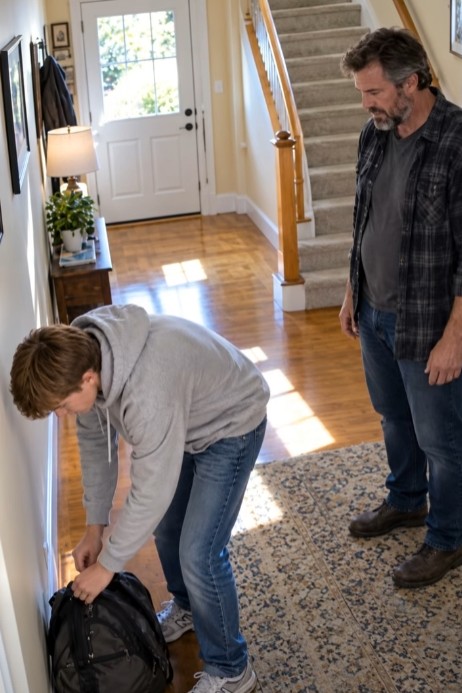
Without saying anything, he walked upstairs. He packed a small number of belongings into an old backpack and returned about twenty minutes later.
Then he walked out of the house.
I watched him leave and made no attempt to stop him.
Ten Years of Silence
Several months later, I sold the house. I moved to another neighborhood, devoted myself to my business, and gradually built a different life.
The years passed.
Occasionally, I thought about my wife’s son. I wondered where he had gone after leaving the house that evening and what kind of life he might have built for himself.
But wondering was as far as I went.
I never searched for him. I never tried to contact him. I never attempted to discover whether he had found somewhere safe to stay after I sent him away.
Eventually, ten years had passed since the night he walked out carrying that old backpack.
Then my phone rang.
A Mysterious Invitation
The caller was a woman I did not know. She asked whether I would attend the opening of an exhibition on Saturday because someone there particularly wanted me to come.
I saw no reason to attend and was preparing to decline the invitation. Then she mentioned the name of a very famous artist.
Her words caught my attention, but they also confused me.
“Why me?” I asked.
The woman paused before answering.
“Do you want to know what happened to the boy you abandoned ten years ago?”
The question immediately changed everything.
For years, the boy had existed only as an uncomfortable memory from a painful period of my life. Suddenly, someone I had never met knew exactly who he was and what I had done.
By the time the call ended, I knew I had to attend the exhibition.
The Photographs on the Gallery Walls
On Saturday, I went to the exhibition.
When I entered the enormous hall, I expected to see paintings. Instead, there were photographs covering the walls.
I approached the first one.
It showed a thin teenage boy carrying a backpack and sleeping on a bench near a train station.
The next photograph showed the same teenager sitting outside a store and drawing on a piece of cardboard.
I recognized him.
It was my wife’s son.
I continued through the exhibition, and every new photograph revealed another part of the life he had lived after leaving my house.
There were images connected to a shelter, a cheap room, a construction site, and a small workshop. With each photograph, the reality of what had happened became more difficult to ignore.
The sixteen-year-old boy I had sent away had not simply disappeared into another comfortable home.
For several weeks after leaving, he had lived on the streets.
A Talent Discovered at the Lowest Point
One of the gallery employees quietly explained what had happened during the years that followed.
Eventually, the teenager had been allowed to sleep at a shelter. While he was there, a volunteer noticed something about him: he was constantly drawing.
The volunteer gave him old paints and paper so he could continue.
What may initially have seemed like a simple activity gradually became a path forward. The boy continued creating art even while trying to rebuild the rest of his life.
Later, he began helping at a small art studio. He studied while also working nights, balancing the need to support himself with his determination to develop his abilities.
Years passed, and eventually his drawings attracted the attention of the famous artist whose name had been mentioned during the mysterious phone call.
That artist helped him begin a professional career.
The boy who had left my house carrying only a few possessions in an old backpack had survived homelessness, found a way to continue studying and working, and turned his ability to draw into something that changed his future.
The Final Photograph
I eventually reached the final wall of the exhibition.
A huge photograph hung there. It showed a young man standing beside a painting.
Ten years had changed his appearance, but I knew exactly who I was looking at.
Beneath the photograph was a small plaque.
“This exhibition is dedicated to a person who once lost his home but managed to rebuild his life.”
I stood in front of the photograph for a long time.
The teenager I remembered was gone. In his place was a grown man who had built a life after experiencing circumstances that could easily have destroyed his future.
Then I heard a voice behind me.
It belonged to the artist.
“He asked me to give you something.”
The Backpack From Ten Years Earlier
The artist handed me an old, worn backpack.
I recognized it immediately.
It was the same backpack my wife’s son had packed on the evening I ordered him to leave.
Ten years earlier, I had watched him carry it out of my house without trying to stop him. Now it was back in my hands.
Inside were several old belongings that he had kept through the years. Among them was a photograph of his mother.
I turned the photograph over.
There was a message written on the back.
“Thank you for leaving me when I needed help the most. Because of you, I achieved a lot.”
I read the words again.
Then again.
A Truth That Could No Longer Be Avoided
The exhibition hall was filled with people, yet at that moment I barely noticed anyone around me.
All I could think about was the sixteen-year-old boy standing in my house ten years earlier. He had just lost his mother, his biological father had long been absent, and the person who had helped raise him since he was six had told him that he meant nothing.
I had once convinced myself that he was not truly my child and therefore was not my responsibility after his mother died.
The photographs surrounding me showed what that decision had actually meant.
He had slept near a train station. He had spent weeks without a home. He had eventually found shelter, and someone else had noticed the talent that had been quietly developing inside him.
From there, he had worked, studied, drawn, and gradually rebuilt his life.
His success did not erase what had happened. The beautiful gallery and the recognition he eventually received could not change the fact that, at sixteen, he had been forced to face the world without the home he had known.
The old backpack in my hands made that impossible to forget.
For ten years, I had occasionally wondered what became of him without ever taking the step of finding out.
Now the answer surrounded me on every wall.
The boy I had once pushed out of my life had grown into a successful young artist. He had transformed one of the darkest periods of his life into part of a story of survival, work, determination, and achievement.
And the final message he chose to send me was not a request, an accusation, or an invitation to explain myself.
It was simply the message written behind his mother’s photograph.
Standing there with his old backpack in my hands, I finally understood something I had been unwilling to recognize ten years earlier.
When my wife died, I had not been the only person in that house who lost someone.
Her son had lost his mother too.
And on the night when he needed the only home he had left, I was the person who took it away from him.