
An Angry Father Stormed Into the Classroom—But What the Boy Said Silenced Everyone
He Entered the School Ready to Defend His Son, Never Expecting to Discover the Truth
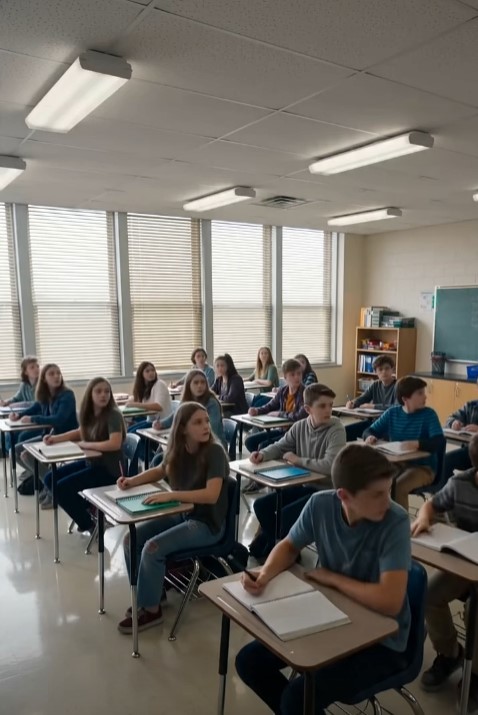
The classroom was completely silent when the door suddenly swung open.
Twenty students looked up from their desks as a tall man in a dark blue shirt stepped into the room. His face was tense, his fists were clenched, and his eyes immediately searched the rows of frightened children.
Behind him stood the school principal, trying to keep pace.
“Mr. Carter, please,” she whispered. “We should discuss this in my office.”
But Daniel Carter was no longer interested in private conversations.
His twelve-year-old son, Ethan, had come home from school the previous afternoon with a swollen cheek, a torn backpack, and dirt covering his clothes. When Daniel asked what had happened, Ethan initially refused to speak.
After nearly an hour, the boy finally said that another student had attacked him during lunch.
Daniel had barely slept that night.
He had raised Ethan alone since the death of his wife four years earlier. Every promise he had made to her seemed to echo in his mind, especially the promise that he would always protect their son.
By sunrise, Daniel had convinced himself that the school had failed Ethan.
He drove there without an appointment, demanded to speak with the principal, and insisted on seeing the student he believed was responsible.
Now, standing in the center of the classroom, he pointed toward a quiet boy seated near the window.
“Stand up,” Daniel ordered.
The boy slowly lifted his head.
His name was Noah Bennett.
He was smaller than Ethan and wore an oversized gray sweater. His face was pale, and a faint bruise was visible near his jaw.
Daniel noticed the bruise but ignored it.
“You think you can attack my son and hide in this classroom?” he demanded.
Several students lowered their eyes.
The teacher stepped forward, but the principal quietly stopped her. Something about the children’s expressions suggested that the situation was more complicated than Daniel understood.
Noah remained seated.
“I told you to stand up,” Daniel repeated.
This time, Noah obeyed.
His hands trembled at his sides, but he looked directly at Daniel.
“I didn’t attack him,” the boy said.
Daniel’s anger intensified.
“My son came home bleeding.”
“I know.”
“His backpack was destroyed.”
“I know.”
“You expect me to believe you had nothing to do with it?”
Noah swallowed hard.
“No,” he answered. “I had everything to do with it.”
A shocked murmur moved through the classroom.
Daniel stepped closer.
The principal immediately positioned herself beside him, worried that his anger was becoming uncontrollable.
“Then tell me why,” Daniel said. “Tell me why you hurt my son.”
Noah looked toward Ethan’s empty desk.
“He wasn’t the one I was trying to hurt.”
The room became completely still.
Daniel stared at him, confused.
Noah reached into his backpack and pulled out a damaged red notebook. Its cover was bent, and several pages had been torn loose.
He placed it carefully on the desk.
“This belongs to your son,” he said.
Daniel recognized the notebook immediately.
Ethan carried it everywhere but never allowed anyone to read it. Daniel assumed it contained drawings, homework notes, or private thoughts about losing his mother.
“What does that have to do with anything?” Daniel asked.
Noah opened the notebook.
Inside were pages filled with names, dates, and short descriptions of incidents that had happened at school.
One entry described a student whose lunch money had been stolen.
Another mentioned a girl who had been mocked because her family could not afford new clothes.
A third described Noah being pushed into a bathroom stall by three older boys.
Daniel’s expression slowly changed.
Noah turned several more pages.
“Ethan has been writing down everything they’ve done,” he explained. “He said adults couldn’t stop something they didn’t know about.”
The principal looked stunned.
She had never seen the notebook before.
Noah continued.
For months, a small group of older students had been threatening younger children during lunch and after school. They took money, damaged belongings, and warned their victims not to report them.
Ethan had witnessed several incidents.
Instead of looking away, he started documenting them.
He recorded dates, locations, names, and statements from frightened students. He planned to give the notebook to the principal once he had gathered enough information.
But the older students discovered what he was doing.
The previous afternoon, they cornered Ethan behind the gym.
Noah saw them grab his backpack and pull out the red notebook.
When one of the boys began tearing out pages, Noah intervened.
“I jumped on him,” Noah admitted. “Then the others started hitting both of us.”
Daniel’s breathing slowed.
The story he had created in his mind was beginning to collapse.
“If you were helping Ethan,” he asked quietly, “why did he say you attacked him?”
Noah looked toward the floor.
“Because they told him they would come after my little sister if he told the truth.”
The principal covered her mouth.
Noah’s sister was only eight years old and attended the elementary school across the street.
“He lied to protect her,” Noah continued. “He knew you would come here angry. He thought everyone would believe I started the fight, and the other boys would leave my sister alone.”
Daniel looked around the classroom.
The students who had lowered their heads were now watching him. Some appeared frightened. Others looked close to tears.
“Is this true?” the principal asked.
One girl near the front slowly raised her hand.
“I saw them behind the gym,” she whispered. “Noah was trying to help Ethan.”
Another student stood.
“They’ve been taking my lunch money since October.”
Then another child spoke.
“They broke my glasses last month.”
Within moments, nearly half the classroom had raised their hands.
Daniel felt the anger drain from his body, replaced by shame.
He had entered the school believing Noah was a violent child who needed to be confronted. Instead, Noah had risked his own safety to protect Ethan.
Daniel looked again at the bruise near the boy’s jaw.
It had not come from Ethan.
It had come from the same students who had attacked his son.
“Where are those boys now?” Daniel asked.
The principal turned toward the doorway.
“They were removed from class this morning,” she said. “But until now, we did not understand the full extent of what happened.”
She picked up the red notebook and carefully examined the pages.
“This changes everything.”
The notebook contained more than accusations. It included dates, classroom numbers, descriptions of stolen property, and the names of witnesses.
The school immediately contacted the families involved and began a formal investigation.
But Daniel remained focused on Noah.
The boy stood in front of him with his shoulders lowered, as though he still expected to be blamed.
Daniel took one step forward.
Noah flinched.
That small movement broke something inside Daniel.
He stopped, unclenched his fists, and lowered himself so they were at eye level.
“I came in here ready to punish you for something you didn’t do,” Daniel said.
Noah said nothing.
“I should have listened before I judged you.”
The entire classroom watched.
Daniel’s voice began to shake.
“My son came home because you stepped into a fight that wasn’t yours. You could have walked away, but you didn’t.”
Noah looked toward Ethan’s desk again.
“He’s my friend,” he said simply.
Daniel closed his eyes for a moment.
He had spent the night imagining a cruel student attacking Ethan. He had never considered that the boy he blamed might be the reason his son made it home safely.
“I’m sorry, Noah,” he said.
Noah’s eyes filled with tears, but he quickly wiped them away.
Daniel stood and turned toward the classroom.
“I owe all of you an apology,” he said. “I came here angry when I should have come here ready to listen.”
The principal placed a hand on his shoulder.
Then the classroom door opened again.
Ethan stood in the hallway.
His cheek was still swollen, and a small bandage covered his eyebrow. Daniel had believed he was resting at home, but Ethan had convinced a neighbor to bring him to school.
The moment Noah saw him, his expression changed.
Ethan walked into the classroom and stopped beside his friend.
“I’m sorry,” he said.
Noah shook his head.
“You were protecting my sister.”
Ethan looked at his father.
“I knew you’d be mad,” he said. “I thought if I gave you Noah’s name, you’d come here and make everyone afraid to touch him again.”
Daniel stared at his son.
It had been a desperate plan created by a frightened twelve-year-old. Ethan had been trying to protect Noah in the only way he believed he could.
Daniel wrapped both boys in his arms.
For several seconds, nobody in the classroom spoke.
Then one student began clapping.
Another joined.
Within moments, the entire room was on its feet.
The applause was not for Daniel.
It was for two boys who had protected each other while the adults around them failed to recognize what was happening.
The investigation continued for several weeks.
Security footage confirmed the confrontation behind the gym. The students responsible faced disciplinary action, and their families were contacted.
The school introduced a confidential reporting system so children could ask for help without publicly identifying themselves.
Counselors also began meeting with students who had remained silent because they feared retaliation.
Ethan’s notebook became the central piece of evidence.
But Daniel remembered something more important than the names and dates written inside it.
He remembered Noah trembling beside his desk while an angry stranger accused him of being dangerous.
He remembered how quickly certainty could become cruelty when nobody stopped to ask for the truth.
Several days later, Daniel invited Noah and his sister to dinner.
At first, Noah seemed nervous inside the Carter home. He sat stiffly at the table and answered every question with only a few words.
Then Ethan brought out a new red notebook.
He placed it in front of Noah and opened the cover.
On the first page, Ethan had written a single sentence:
“This time, we tell the truth together.”
Noah smiled.
Daniel stood in the kitchen doorway watching them, realizing that he had entered the classroom believing strength meant arriving without fear.
But real strength had been sitting quietly at a student’s desk.
It was a bruised boy who refused to abandon his friend.
It was a frightened child who documented the truth when everyone else looked away.
And it was a father admitting, in front of an entire classroom, that he had been wrong.