
A Bus Driver Told a Woman in a Wheelchair to Wait for the Next Bus—Then a Supervisor Stepped Forward
Rebecca Had Already Waited 25 Minutes, and the Wheelchair Space Inside Was Empty
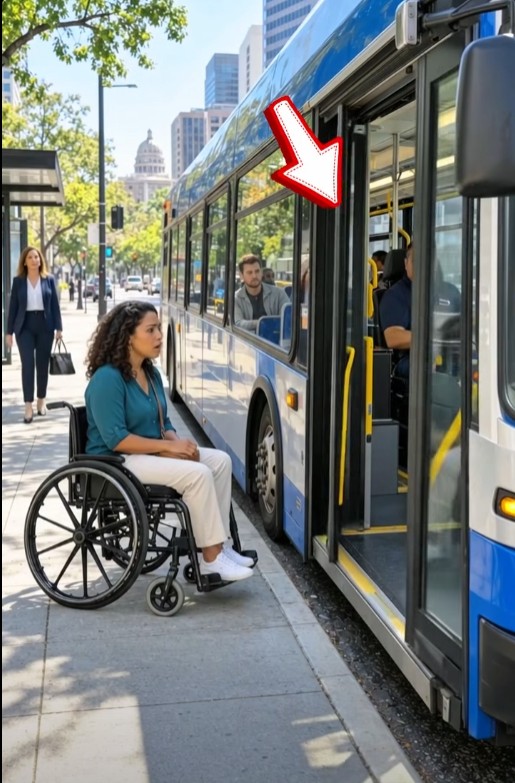
The bus doors opened, but the driver stayed in his seat. Rebecca Lawson rolled closer to the curb, expecting him to lower the ramp. Instead, he looked down at her and said, “Sorry, ma’am. You’ll have to take the next bus.”
From the sidewalk, Rebecca could see the empty wheelchair space through the window. The accessibility symbol was beside the front doors. “Why? This bus is accessible, isn’t it?”
The driver, Martin Keller, glanced at his dashboard. “I’m already behind schedule, and the ramp takes time.”
Rebecca had been waiting for twenty-five minutes. The first bus had never come, and Martin couldn’t tell her when another would arrive. As passengers turned toward the open doors, a woman in a navy jacket stopped beside Rebecca’s wheelchair.
“Excuse me,” she said firmly. “Why are you refusing to let this passenger board?”
Rebecca Had Left Home Early
At thirty-six, Rebecca knew which buses on her route had low floors and which stops gave her enough room to line up her manual wheelchair with a ramp. She used that knowledge every day to get across town to the community health center, where she worked as an administrative coordinator.
That morning, she had left early for a staff meeting. She reached the stop with time to spare and watched the transit display announce a delay. The scheduled departure passed without a bus pulling up.
When Martin’s bus finally arrived, Rebecca saw the accessibility symbol and felt relieved. She had planned for a late bus. She hadn’t planned to stand at an open door explaining why she needed to get on.
Martin said he couldn’t hold up everyone already aboard. A passenger near the front looked at the empty space and asked, “There’s plenty of room. Why can’t she get on?”
Rebecca appreciated hearing someone speak up, though she could feel more people watching now. She had a meeting to get to, and the minutes she had allowed for delays were already gone.
The Woman in the Navy Jacket Asked Two Questions
The woman introduced herself as Angela Price, a field supervisor for the city’s transit authority. She had been walking toward a nearby transit office when she heard the exchange. She showed Martin her employee identification and asked Rebecca to tell her what had happened.
Rebecca explained that she had waited through one missed service and that Martin had told her to wait again. Martin pointed to the time. Traffic had backed up along the route, and dispatch had already asked drivers to report significant delays. After almost twelve years behind the wheel, he knew how quickly those delays could build.
Angela listened, then asked, “Is the wheelchair ramp functioning?”
“As far as I know.”
“Is the designated wheelchair space available?”
Martin looked back into the bus. “Yes.”
“Then we need to follow the boarding procedure.”
Angela acknowledged that Martin was behind schedule. Dispatch could record the delay, she explained. Right now, he needed to secure the bus and put down the ramp.
Rebecca Boarded in a Few Minutes
Martin set the parking brake and operated the boarding controls. The front of the bus lowered slightly, and the ramp extended toward the curb. Angela checked where it met the pavement and asked Rebecca if she wanted assistance.
Rebecca thanked her and said she could manage once the ramp was in place. She lined up her chair and rolled aboard. A few passengers shifted to give her room to turn, and Martin completed the safety checks for the wheelchair space.
The whole procedure took only a few minutes. By the time Martin was ready to pull away, the passengers who had been watching were settling back into their seats.
“I’m sorry for the inconvenience,” he told Rebecca.
“Thank you. I just needed to get to work.”
The Supervisor Stayed to Find Out What Went Wrong
Before stepping off the bus, Angela asked Martin to call the operations center. He reported the delay and explained that a supervisor had intervened after an accessibility dispute. Dispatch confirmed it would record the delay, and Angela documented the incident for review.
Martin acknowledged that he had let the timetable dictate his decision. He had assumed the ramp would cost him time and told Rebecca to wait before checking the equipment or the available space.
Angela went over what to do when a bus was running late. She also explained how to handle a real equipment fault or a stop where a ramp could not be lowered safely. In those situations, passengers needed a clear explanation and help arranging another way to continue their trip.
From the wheelchair space, Rebecca listened. She was grateful Angela had happened to walk past. She also knew how easily the bus could have driven off if Angela had taken a different route to the office that morning.
Weeks Later, Rebecca Saw the Same Driver Again
Rebecca arrived at the health center later than planned and explained the delay to her supervisor. That afternoon, Angela called to tell her the transit authority was looking into the refusal.
The review found no reported ramp fault or safety restriction that would have prevented Rebecca from boarding. Martin received additional instruction on accessible boarding and passenger communication. The authority reminded drivers how to report delays and began checking ramp operation and the way service disruptions were communicated.
Rebecca kept taking the same route. On a later morning, she saw Martin through the windshield as the bus approached. For a moment, she wondered whether he remembered her.
He pulled up to the curb, secured the bus, and lowered the ramp. Passengers shifted a little to give her room, and Rebecca rolled into the same space she had seen through the window weeks earlier. Then the doors closed, and she was on her way to work.
This is a fictional story.