
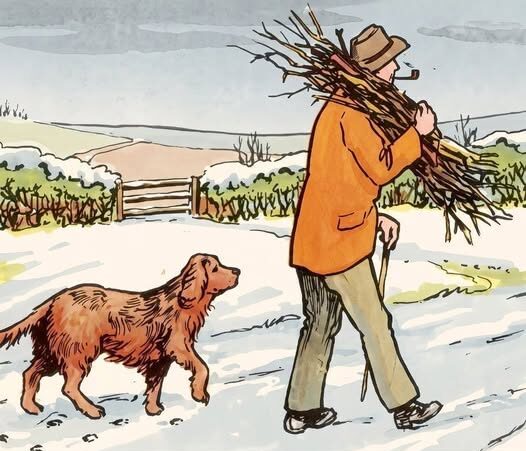
Can You Spot the Footprint Mistake in This Snowy Dog-Walking Puzzle?
A Familiar Winter Scene With a Detail to Examine
A man walks through a snowy landscape with his dog. The scene sounds ordinary, but the puzzle asks viewers to examine something that can be easy to overlook: the tracks left behind them.
The challenge is to compare the footprints in the snow with the movement of the man and his companion. Somewhere in that relationship, the description suggests, there is an inconsistency.
No accompanying puzzle image or confirmed solution is included here, so the precise mistake cannot be identified from the text alone. The clue nevertheless establishes where the investigation should begin: with the tracks rather than the walkers’ appearance.
Look at What Each Walker Leaves Behind
The most useful starting point is to consider the man and the dog separately. Each moves through the landscape differently, so their trails should be examined as distinct patterns before being considered together.
For the man, follow the apparent route of his footsteps through the snow. Compare that route with where he is standing and the direction in which he appears to be traveling.
Then examine the dog’s trail. Look for the marks that appear associated with its movement and consider how they connect with its position.
The question is whether the visible evidence fits the scene. A trail that appears plausible on its own may still deserve a closer look when compared with the figure supposedly responsible for it.
Follow the Trails Across the Whole Scene
It can be tempting to focus only on the prints nearest the man or dog. However, tracing each visible trail across the scene may make an inconsistency easier to recognize.
Start at one end and follow the marks in sequence. Notice whether the route remains understandable or whether something changes without a clear explanation within the picture.
Compare the trail with the walker’s current location. The puzzle directs attention to the connection between movement and the marks in the snow, so both parts need to be considered together.
This approach avoids jumping to an answer based on a single unusual shape. A mark may look strange in isolation while making more sense as part of the wider trail.
Separate a Useful Clue From an Assumption
The description asks viewers to think about the tracks a person and a dog should leave. That is a useful prompt, but it does not establish that every foot must produce a separately visible mark.
Tracks can overlap, and a picture may not show every part of a trail equally clearly. Simply counting legs and comparing that number with a few visible impressions would therefore be an incomplete way to solve the challenge.
The stronger question concerns consistency. Do the trails, positions and apparent movement work together, or does one detail contradict the rest?
Without seeing the illustration, it would be speculation to claim that prints are missing, pointing in the wrong direction or assigned to the wrong walker. Any of those answers would introduce a detail absent from the supplied description.
Why the Ordinary Setting Matters
The scene’s familiarity gives the challenge its starting point. A person taking a dog for a walk is easy to recognize, allowing the viewer to understand the overall situation quickly.
Once that first impression is established, attention can shift to smaller details. The puzzle asks whether the evidence beneath the walkers supports the story suggested by their presence.
The snowy ground becomes important because it records movement within the scene. Instead of looking only at the main subjects, the viewer must examine what appears behind or beneath them.
That changes the task from recognizing objects to comparing relationships. Identifying a man, a dog and snow is straightforward; deciding whether their tracks fit together requires closer observation.
Check the Picture Before Accepting a Solution
A satisfying answer should point to a specific visible inconsistency and explain why it conflicts with the scene. It should not depend on inventing events that the picture does not show.
After choosing a possible mistake, return to the full illustration and test it. Consider whether the explanation accounts for the relevant tracks and whether another visible detail changes the conclusion.
The clue provided here is clear about where to look, but it does not reveal what is actually depicted. The exact solution remains unconfirmed until the image can be examined.
For now, the challenge is to follow both trails carefully and compare them with their walkers. The important detail lies in whether the footprints tell the same story as the scene above them.