
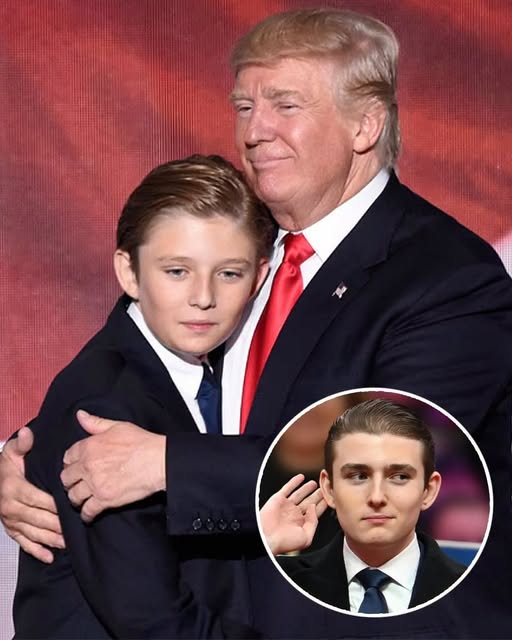
Trump’s Remark About Barron Being “Too Cool” to Say He Loved Him Came During an Unexpected Conversation
A Family Anecdote Shared in the Oval Office
Donald Trump once described his youngest son, Barron, as reluctant to say aloud that he loved his father. The anecdote became public through journalist Jonathan Karl’s account of an Oval Office meeting, rather than through an interview with Barron himself.
Karl recalled the exchange in his 2021 book Betrayal: The Final Act of the Trump Show and discussed it during a television appearance that November. The meeting he described took place in early March 2020, when Barron was a teenager.
Trump’s remark arose during a conversation about whether he might attend the White House Correspondents’ Dinner. Karl and fellow journalist Zeke Miller had gone to discuss the event with him.
During that discussion, Trump compared Karl’s reserved response to the behavior he attributed to his son. What followed was a brief reenactment of a father asking for affection and a teenager apparently resisting the request.
Why Barron Entered the Conversation
The meeting’s subject was professional rather than personal. Karl was then serving as president of the White House Correspondents’ Association, and Trump had skipped its annual dinner during previous years of his presidency.
Karl described taking a restrained approach to the possibility of Trump attending. He did not want to plead with the president to participate, particularly given Trump’s contentious relationship with the press.
Trump apparently noticed that reserve. In Karl’s recollection, he described the journalist as cool and compared him with Barron.
He then acted out a short exchange about asking his son whether he loved his father. Trump characterized Barron’s reluctance as an example of a child being too cool to make the declaration.
The comparison connected two very different relationships: a president speaking with a journalist about a public event, and a father describing an exchange at home. It was that unexpected shift that made the conversation memorable to Karl.
Karl Remembered the Encounter Differently From a Sentimental Family Story
When discussing the episode publicly in November 2021, Karl described it as an unusual experience. His emphasis was on the surprising direction of the meeting, not simply on a touching moment between father and son.
That context matters because the anecdote can acquire a different tone when detached from the conversation in which it was told. Presented alone, it may sound like a straightforward family recollection shared during a personal interview.
The documented account is more specific. Karl was recounting what Trump had said to him during a discussion about the correspondents’ dinner.
There are therefore several layers between the original family interaction and the reader. Trump described the exchange, Karl remembered that description, and the episode later reached the public through his book and television discussion.
It remains an account of Trump’s version of a moment with his son. Barron’s own explanation of the exchange is not part of it.
A Familiar Question, but No Complete Picture
The central question is recognizable beyond this particular family. Parents sometimes seek an affectionate response, while children may react with embarrassment, humor or a desire to avoid being put on the spot.
That familiarity helps explain why the story attracts attention. A person usually seen through political events briefly appears in the ordinary role of a parent looking for reassurance.
However, familiarity should not become certainty about what Barron felt. The anecdote does not establish why he responded as described or what meaning he attached to the conversation.
Nor can one retold exchange measure the closeness of an entire relationship. A hesitant answer in a particular moment does not demonstrate an absence of affection, just as a parent’s humorous interpretation cannot reveal everything happening within a family.
Readers can recognize the potentially awkward human element without turning it into a judgment about either person’s private emotional life.
Keeping the Timing Clear
The episode concerns a meeting in 2020 and public discussion in 2021. It should not be presented as a newly disclosed conversation between Trump and Barron in 2026.
That distinction is especially relevant when older family anecdotes circulate alongside current photographs. A remark about a teenager belongs to the period in which it was made.
Barron has generally maintained a lower public profile than his father and several older siblings. His occasional appearances do not provide a continuous record of his relationship with his parents.
The enduring interest in this story comes from its unusual combination of public and private settings. A discussion about a prominent Washington event briefly turned into a comparison involving a president’s youngest child.
What the account supports is limited but clear: Karl remembered Trump portraying Barron as too cool to express affection aloud during a brief exchange. The private relationship behind that recollection remains much larger than the anecdote.