
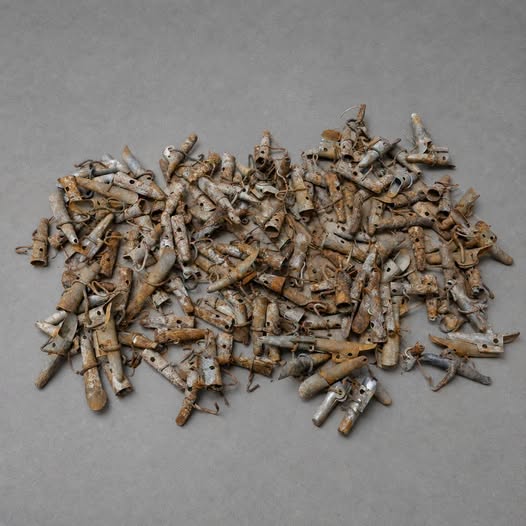
These Strange Metal Pieces Found in an Attic Have a Surprisingly Useful Purpose
They May Look Like Random Old Hardware, but They Were Once an Essential Tool for Making Maple Syrup
At first glance, the small metal pieces can look completely ordinary.
They might be mistaken for old plumbing fittings, forgotten machine parts, or leftover hardware that has been sitting untouched for decades.
Finding an entire bucket of them in an attic only makes the mystery more interesting.
But these unusual objects actually had a very specific purpose.
They are maple sap taps, commonly known as spiles.
What Is a Maple Sap Spile?
A spile is a small tube-shaped tool inserted into a drilled hole in the trunk of a maple tree.
Its purpose is to guide naturally flowing sap out of the tree and into a collection container.
In the simplest terms, a spile works like a tiny faucet.
Without one, sap coming from a tapped tree could run down the bark and become difficult to collect cleanly.
The spile creates a controlled path for the liquid.
These Tools Were Essential to Traditional Maple Syrup Production
Before modern tubing systems became common, maple producers usually collected sap in individual buckets hanging from trees.
A small hole was drilled into the trunk.
The spile was gently tapped into place.
Then a bucket was attached beneath it.
As sap flowed through the spile, it dripped directly into the container.
Many traditional spiles were designed with a small hook or lip specifically for holding those buckets.
Why Does Sap Flow Out of a Maple Tree?
Maple sap does not flow strongly throughout the entire year.
The best conditions generally occur in late winter and early spring.
That is when nighttime temperatures fall below freezing while daytime temperatures rise above freezing.
Those temperature changes create pressure differences inside the tree.
When conditions are right, sap moves through the tree and can flow from a properly drilled tap hole.
The spile does not create the sap flow.
It simply gives the sap a controlled route out of the tree.
Timing Was Extremely Important
Traditional maple producers watched the weather closely.
If temperatures stayed too cold, sap flow could slow dramatically.
If temperatures became consistently warm, the season could quickly come to an end.
This made maple syrup production intensely seasonal.
Families and farmers often had only a limited window each year to collect enough sap.
Why Would Someone Have an Entire Bucket of Spiles?
Finding dozens of these metal pieces together strongly suggests that someone once tapped multiple maple trees.
They may have produced syrup for their own family.
They may have operated a small farm.
They could also have collected sap seasonally as a side business.
Because metal spiles were durable and reusable, they were commonly cleaned after the season and stored until the following year.
A bucket in an attic, barn, or shed would therefore have been a perfectly practical storage solution.
The Metal Style Often Points to an Older Collection Method
Older maple operations frequently relied on individual buckets attached directly to trees.
Metal spiles were ideal for that setup.
Modern commercial producers often use networks of plastic tubing instead.
The tubing carries sap from many trees toward a central collection point.
That system reduces the need to visit and empty individual buckets repeatedly.
Bucket Spiles and Tubing Spiles Work Differently
Traditional bucket spiles typically have a design that allows a container to hang directly beneath the tap.
They are simple, sturdy, and easy to recognize once you know what you are looking at.
Modern tubing spiles are usually smaller and shaped to connect directly to flexible plastic lines.
Both perform the same basic job.
They direct sap away from the tree.
Fresh Maple Sap Does Not Look Like Syrup
One of the most surprising things about maple production is how different fresh sap looks from finished syrup.
Fresh maple sap is mostly water.
It is thin.
It is usually clear or nearly clear.
And it tastes only mildly sweet.
It does not resemble the thick amber syrup found in a bottle.
The Sap Has to Be Concentrated
After collection, the sap is heated so that much of the water evaporates.
As the water disappears, the natural sugars become increasingly concentrated.
Eventually, the liquid thickens into maple syrup.
A large volume of sap is required to produce a much smaller amount of finished syrup.
A commonly used rough estimate is around 40 liters of sap for approximately one liter of syrup, although the exact amount varies depending on the sugar content of the sap.
That Made Syrup Production Labor Intensive
Imagine tapping dozens or even hundreds of trees.
Each bucket had to be checked and emptied.
The sap then had to be transported.
After that came hours of boiling and careful monitoring.
What now appears on a supermarket shelf as an ordinary bottle once required considerable seasonal labor.
Those small metal spiles were the first step in the entire process.
Can Tapping Harm a Maple Tree?
When maple trees are tapped responsibly, they can generally continue growing and producing sap over many seasons.
The drilled hole is relatively small.
After the season ends and the spile is removed, the tree gradually seals the area naturally.
Healthy, mature trees can therefore be tapped repeatedly when appropriate practices are followed.
Too Many Taps Can Cause Problems
Responsible producers take the size and health of the tree into account.
Drilling too many holes or repeatedly tapping unhealthy trees can cause unnecessary stress.
Modern maple producers generally follow established guidelines designed to protect the tree while still allowing sap collection.
The goal is to harvest without causing lasting damage.
Why These Objects Can Be So Difficult to Identify Today
For someone unfamiliar with maple production, an old spile does not immediately explain itself.
There are no obvious moving parts.
There may be no markings.
And without the bucket and tree, its shape can look almost meaningless.
That is why attic discoveries like these can generate so many guesses.
People may assume they are plumbing fittings, machine components, or even pieces from some forgotten household appliance.
They Are Really Pieces of Agricultural History
These simple tools represent a period when many foods were produced much closer to home.
Maple syrup was not simply something purchased at a grocery store.
For families living around maple forests, it could be something harvested directly from their own land.
The season began with trees, drills, spiles, buckets, and cold weather.
It ended with carefully boiled syrup ready for the table.
The Attic Find May Reveal Something About the Home’s Past
If a house is located in an area where maple trees are common, a bucket full of old spiles may offer a clue about previous residents.
Someone may have operated a sugar bush.
A family may have tapped trees every spring.
The tools may have belonged to a farmer or hobby syrup maker.
Even if the exact owner is no longer known, the objects still reveal something about the kind of work once done there.
What Looked Like Junk Had a Very Specific Job
The mystery becomes surprisingly simple once the pieces are recognized.
Those strange metal fittings were designed to be inserted into maple trees.
Sap flowed through them and into buckets.
The collected liquid was then boiled down until it became maple syrup.
So that forgotten bucket in the attic is not filled with meaningless scrap metal.
It contains the remains of a traditional food-making process that families and farmers used for generations.
The Final Answer
The unusual metal objects are maple sap taps, also called spiles.
They were used during maple sugaring season to direct sap from drilled maple trees into buckets or other collection systems.
What first appears to be nothing more than obsolete hardware is actually a small but important piece of maple syrup history.