
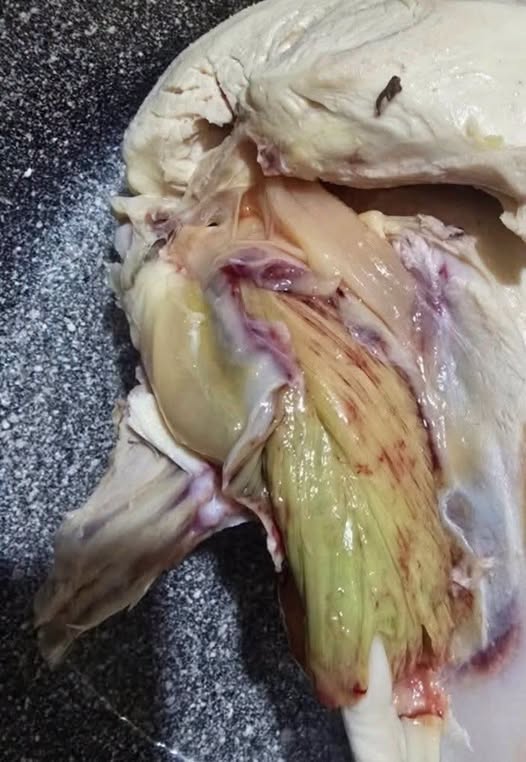
Why Chicken Can Look Green Inside — And When You Should Throw It Away
Seeing Green Chicken Does Not Always Mean the Same Thing
Cutting into a piece of chicken and discovering green or greenish-brown meat inside can be alarming.
The outside may look completely normal, the chicken may appear fully cooked, and then an unexpected patch of discoloration appears deep inside the breast.
That reaction is understandable because unusual color is often associated with spoiled food.
But green discoloration in poultry can have several possible explanations, and color alone does not reliably determine whether meat has spoiled. The USDA notes that fresh meat and poultry can undergo normal color changes, while spoiled products generally show other warning signs as well.
One Possible Explanation Is Deep Pectoral Myopathy
A particularly striking cause of green meat in chicken is a condition known as deep pectoral myopathy, commonly called green muscle disease.
The condition affects the deep pectoral muscle, often called the breast tender or tenderloin.
It is most often associated with large meat-type chickens and can remain completely hidden until the bird is cut open or deboned. Mississippi State University describes the condition as a degenerative muscle problem involving necrosis and atrophy of the deep breast muscle.
That explains why a chicken can appear normal from the outside while an internal section looks dramatically different.
Why the Muscle Turns Green
The deep breast muscle plays a role in raising the bird’s wing.
When a large chicken flaps its wings vigorously, that muscle can swell. Because it is surrounded by relatively restrictive tissue, the swelling can reduce its blood supply.
The MSD Veterinary Manual explains that prolonged wing activity can produce injury and swelling in the deep pectoral muscle.
As circulation is restricted and the damaged muscle changes over time, the tissue can develop an unusual greenish appearance.
USDA inspection guidance also recognizes green discoloration of deep muscle associated with this condition.
It Can Look Disturbing Even When the Surface Appears Normal
One reason green muscle disease surprises consumers is that it develops deep inside the breast.
The skin and outer breast meat may give no obvious indication that anything unusual is underneath.
Only after cutting into the meat does the affected area become visible.
The discolored portion may look green, gray-green, or greenish-brown and can have a noticeably different texture from the surrounding breast meat.
Because the appearance is so unusual, many people naturally assume the chicken has rotted.
Bruising Can Also Change the Color of Poultry
Not every unusual patch of color represents spoilage.
Physical damage can create discoloration inside poultry muscle as well.
When blood collects in injured tissue, pigments can change as the tissue ages. The resulting appearance may resemble the changing colors seen in a bruise.
This type of discoloration can occur without the entire piece of chicken being spoiled.
The important point is that appearance should be considered alongside the condition of the rest of the meat rather than being treated as the only test.
Color Alone Is Not a Reliable Spoilage Test
The USDA specifically warns that a change in meat or poultry color by itself does not necessarily indicate spoilage.
Fresh products can naturally change color during storage and handling.
When poultry truly has spoiled, additional characteristics are commonly present.
Those warning signs include an unpleasant odor and a surface that becomes sticky, tacky, or slimy.
That means a person should never judge poultry safety from an unusual color alone.
Smell Is an Important Warning Sign
Chicken that has developed an obvious unpleasant or abnormal odor should not be treated as normal simply because the use-by date has not passed.
Spoilage can produce an unmistakably offensive smell.
That odor may be sour, stale, sulfur-like, or otherwise noticeably different from fresh poultry.
If a piece of chicken looks questionable and also smells wrong, that combination is a strong reason not to use it.
The USDA includes off odor among the key signs that meat or poultry has spoiled.
Texture Can Reveal Problems That Color Cannot
The way chicken feels is another useful warning sign.
Fresh raw chicken is naturally moist, so simple moisture should not automatically cause concern.
However, poultry that has developed an unusually sticky, tacky, or distinctly slimy coating may be spoiled.
The USDA advises against using meat or poultry that has developed these characteristics along with spoilage-related changes.
A deteriorating, abnormally soft texture should also make a consumer cautious.
Cooking Does Not Rescue Spoiled Chicken
One important distinction is the difference between adequately cooking fresh poultry and attempting to make spoiled poultry safe by heating it.
Raw poultry should always be handled carefully because it can carry harmful bacteria even when it looks and smells normal.
The USDA emphasizes preventing cross-contamination from raw poultry and its juices during preparation.
Cooking is an essential food-safety step for properly handled poultry, but obviously spoiled meat should not be used simply because someone intends to cook it thoroughly.
Green Muscle Disease and Spoilage Are Not the Same Thing
Deep pectoral myopathy is fundamentally a muscle disorder rather than ordinary bacterial decomposition.
That distinction is important because the green color can look dramatic despite having a completely different origin from spoilage.
The affected muscle has undergone tissue damage caused by restricted circulation.
It is therefore possible to encounter green internal breast meat without the characteristic odor or sliminess associated with spoiled poultry.
Still, consumers should not assume that every green area is automatically explained by green muscle disease.
Without knowing the history and condition of the product, uncertainty remains.
Why Large Broiler Chickens Are More Susceptible
Deep pectoral myopathy has become associated particularly with modern broiler chickens that have substantial breast muscle.
When these birds repeatedly flap their wings, the deep muscle can swell inside a confined space.
The resulting restriction in blood flow damages the tissue.
Research literature identifies the same condition as green muscle disease, deep pectoral myopathy, or Oregon disease.
Because the problem occurs deep in the breast, it can remain unnoticed during normal preparation until someone cuts directly into the affected area.
Packaging and Light Can Change How Meat Appears
Not every unusual shade seen on poultry represents an actual green lesion inside the muscle.
Lighting and the surface of meat can sometimes create unexpected visual effects.
Consumers may notice iridescent or rainbow-like reflections on meat depending on how light strikes the muscle fibers.
Packaging can also influence how food looks when it is first opened.
For that reason, a brief visual impression should be considered together with smell, texture, storage history, and whether the discoloration is genuinely embedded within the tissue.
Storage Still Matters
Even chicken affected by an otherwise noninfectious discoloration can become unsafe if it has been stored improperly.
Green muscle disease does not protect poultry from ordinary foodborne contamination.
Raw poultry remains perishable and needs appropriate refrigeration, handling, and cooking.
It should also be kept away from foods that will be eaten without cooking.
The USDA warns that raw chicken juices can spread bacteria to other foods and surfaces through cross-contamination.
What to Do When You Find Green Meat
If the chicken has a strong off odor, feels unusually sticky or slimy, or shows broader signs of deterioration, the safest course is to discard it rather than trying to salvage it.
If the discoloration is isolated deep within the breast and the rest of the product appears normal, deep pectoral myopathy is one possible explanation.
However, a consumer looking at a piece of chicken at home may not always be able to confidently distinguish one cause of discoloration from another.
When there is meaningful uncertainty about a poultry product’s condition or storage history, choosing not to eat it is the more cautious option.
Do Not Rely on the Date Alone
Packaging dates can be useful, but they should not override clear evidence that food has deteriorated.
A product can be mishandled after packaging.
Similarly, a harmless visual change can sometimes occur while food is still otherwise in acceptable condition.
That is why consumers should evaluate the whole situation rather than relying on one characteristic.
Color, smell, texture, storage conditions, and handling history all provide useful information.
When a Product Appears Defective
A chicken breast containing obvious green muscle disease can also represent a significant quality defect even when spoilage is not the cause.
USDA grading material classifies chicken breast showing green muscle disease as a serious flesh defect that does not qualify for a normal grade.
Consumers who discover an unusual condition in packaged poultry may therefore prefer to keep the packaging and return the product to the retailer or manufacturer rather than simply consuming it.
The USDA also provides a process for consumers to report problems involving meat and poultry products.
The Safest Rule Is Not to Guess When Several Warning Signs Appear
A green patch inside chicken can be startling, but it does not have one universal explanation.
Deep muscle damage, internal bruising, visual effects, and spoilage can produce very different circumstances.
The most concerning situation is when unusual color appears together with an offensive odor, slimy or sticky texture, questionable storage, or other obvious deterioration.
Those signs should not be dismissed simply because the chicken looks acceptable in other areas.
Green Does Not Automatically Mean Poisoned — But Caution Still Matters
The sight of green chicken is enough to ruin almost anyone’s appetite.
In some cases, the discoloration may come from deep pectoral myopathy, a recognized muscle condition that can remain hidden beneath perfectly ordinary-looking breast meat.
In other situations, discoloration may occur alongside genuine spoilage.
The key lesson is that color should never be considered in isolation.
USDA guidance makes clear that spoiled meat and poultry generally develop other noticeable characteristics, particularly an off odor and sticky, tacky, or slimy surfaces.
If a piece of chicken looks strange but otherwise seems normal, there may be an explanation that has nothing to do with decomposition.
If it looks strange and also smells or feels wrong, there is little reason to gamble with it.
When uncertainty remains, replacing one meal is far easier than regretting the decision to eat questionable poultry.