
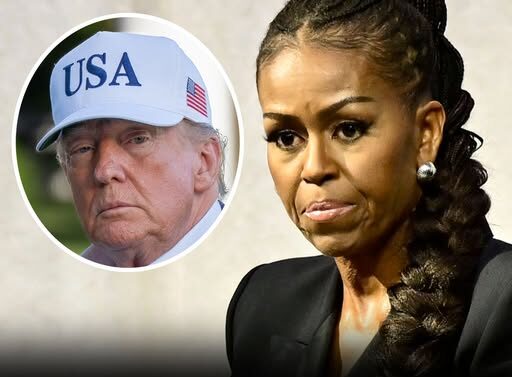
Michelle Obama Issues Stark Warning About America’s Growing Divide
A Different Perspective on Political Conflict
Michelle Obama has shared a candid assessment of the political tensions shaping the United States, offering a perspective that challenges many of the assumptions driving public debate.
Rather than focusing solely on partisan battles, she directed attention toward the deeper frustrations and anxieties affecting millions of Americans across the country.
Her remarks stood apart from the familiar political arguments that often dominate public discussion. Instead of relying on anger or condemnation, she examined the broader conditions that have fueled division and distrust.
The message carried particular weight because it addressed not only political leaders and institutions but also the attitudes citizens hold toward one another.
Recognizing Pain Beneath Political Choices
Michelle Obama made clear that she does not excuse inflammatory language or harmful behavior in politics.
She has previously spoken about the personal attacks directed at her family and the challenges that came with living under constant public scrutiny.
Among those concerns were racist attacks and offensive content that crossed lines of basic decency.
At the same time, she urged people to look beyond stereotypes when considering the motivations of voters whose political choices may differ from their own.
Her position was not rooted in approval of every action or statement connected to political movements. Instead, it focused on understanding the circumstances that lead individuals to support particular candidates or causes.
According to her view, many people are responding to feelings of uncertainty, instability, and disconnection from institutions they believe no longer represent their interests.
The Struggles Facing Many Americans
Economic pressures have become a defining reality for countless households.
Families across different regions continue to face concerns about financial security, job stability, and the rising costs associated with everyday life.
For many individuals, these pressures create a sense that opportunities are becoming harder to reach.
Michelle Obama suggested that these experiences should not be dismissed when evaluating political behavior.
She emphasized that frustration often grows when people feel ignored or overlooked by those in positions of power.
When citizens believe their concerns are not being addressed, they may become increasingly willing to support dramatic change.
In some cases, the desire for change can become stronger than loyalty to traditional political structures or established leadership.
That dynamic, she argued, helps explain why political movements can attract widespread support even during periods of intense controversy.
A Warning Against Simplistic Labels
One of the central themes of her remarks was the danger of reducing large groups of people to simple stereotypes.
She argued that treating millions of voters as if they share identical motives creates further division rather than understanding.
When political opponents are viewed only through the lens of suspicion or hostility, meaningful dialogue becomes increasingly difficult.
Michelle Obama warned that dismissing entire communities as irredeemable or morally flawed may have lasting consequences.
Such approaches can deepen resentment and reinforce feelings of exclusion.
Over time, those feelings can push individuals further away from institutions and leaders they already distrust.
Her message suggested that political disagreement does not automatically eliminate the humanity of those involved.
Behind every vote, she noted, are individuals whose experiences, fears, and hopes shape their decisions.
The Risks of Political Neglect
Another major focus of her comments involved the relationship between citizens and political institutions.
She argued that prolonged neglect of economic and social concerns can create dangerous conditions.
When people lose confidence that leaders understand their struggles, frustration often fills the void.
That frustration may eventually transform into anger, especially when individuals feel they have exhausted traditional avenues for change.
In such an environment, powerful voices promising immediate solutions can gain significant influence.
The appeal of those messages often grows when voters believe their concerns have been repeatedly ignored.
Michelle Obama suggested that addressing these underlying problems requires more than campaign slogans or partisan talking points.
It requires genuine engagement with the issues affecting working families and communities.
Without that effort, dissatisfaction can continue to spread regardless of which party holds power.
The Importance of Understanding Rather Than Condemning
A key aspect of her perspective was the belief that understanding and accountability can exist simultaneously.
Recognizing the struggles that influence political behavior does not mean approving of every action or viewpoint.
Instead, it means acknowledging that social and economic pressures often play a significant role in shaping public attitudes.
By encouraging empathy, she challenged audiences to move beyond reflexive reactions.
Her argument was that meaningful progress becomes difficult when citizens view one another only as enemies.
Democratic societies depend on the ability to coexist despite profound disagreements.
When that capacity weakens, polarization tends to intensify.
The result can be a political environment where compromise becomes nearly impossible and mutual distrust continues to grow.
A Concern for the Future of Democracy
Michelle Obama framed the nation’s challenges as larger than any single election or political figure.
She described a broader concern about the long-term health of democratic institutions and civic culture.
In her view, democracy is weakened not only by dramatic conflicts but also by the gradual accumulation of resentment and neglect.
Small divisions can become larger over time when left unresolved.
Communities that feel disconnected from one another may struggle to find common ground even on issues affecting everyone.
That process, she warned, can slowly erode trust in public institutions and democratic participation.
Addressing those problems requires leaders willing to confront difficult realities rather than relying solely on political messaging.
It also requires citizens willing to listen to perspectives that challenge their own assumptions.
A Message That Challenges Both Sides
What makes her comments notable is that they do not fit neatly into traditional political narratives.
Rather than directing criticism toward only one group, she highlighted responsibilities that extend across the political spectrum.
Her warning was aimed at anyone who contributes to cycles of division, regardless of ideological affiliation.
She argued that lasting solutions will remain out of reach if political opponents are treated merely as obstacles to defeat rather than fellow citizens.
The country’s challenges, she suggested, cannot be solved through blame alone.
They require attention to the economic and social conditions that continue to fuel frustration among large segments of the population.
Ignoring those realities may provide short-term political advantages, but it does little to resolve the underlying problems.
A Call for Reflection
At its core, Michelle Obama’s message was a call to look beyond headlines and political labels.
She urged Americans to recognize the complexity behind political choices and the human experiences that influence them.
Her remarks emphasized that fear, uncertainty, and a desire for stability often shape public behavior in powerful ways.
Whether one agrees with her conclusions or not, the central theme remains clear: understanding the roots of division is essential to overcoming it.
She argued that lasting progress depends on addressing the concerns that leave people feeling unheard and disconnected.
Until those issues receive serious attention, the cycle of anger, blame, and polarization is likely to continue.
Her assessment serves as a reminder that behind every political movement are individuals seeking answers to challenges they believe have been ignored for too long.
And unless those concerns are acknowledged, the divisions shaping the nation today may become even more difficult to bridge in the years ahead.