
These Photos Appear to Show an Angel Over Ikaria. What Do We Actually Know?
A Rainbow-Colored Shape Drew Attention, but Its Origin Remains Unverified
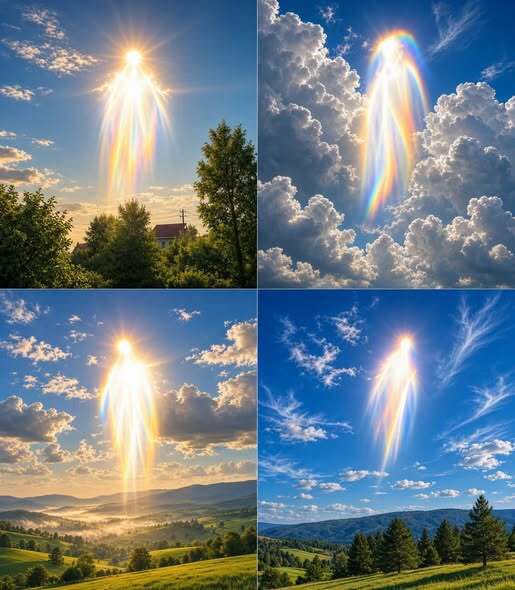
In images circulated online and linked to the Greek island of Ikaria, a bright shape appears to hang in the sky. Its upper section glows against the surrounding clouds, while bands of yellow, orange, blue, and violet stretch downward. Some viewers saw the outline of an angel. Others wondered whether they were looking at an atmospheric effect, an altered photograph, or an image made with artificial intelligence.
The images were already drawing public attention by July 27, 2024. Ikaria, an island in the eastern Aegean Sea, was identified as the setting, but the date of that coverage does not establish when the images were made. The location also remains unverified. An original file, an identified photographer, or an independently recorded view could help establish whether the formation appeared over the island.
The debate turns on two questions that are easy to confuse. The first is why the shape looks familiar to so many viewers. The second is what produced the image they are looking at. A person can see the outline of a figure immediately and still have very little information about how it came to appear on screen.
Why the Shape Reminded Viewers of an Angel
The impression comes from the way the bright areas fit together. The luminous upper section can look like a head, while the longer colors below it suggest a body or flowing clothing. The surrounding clouds and light complete a scene that some viewers associate with traditional depictions of angels.
Light has long been used in religious art to suggest a heavenly presence. A glow around a figure, a halo, or a person appearing amid illuminated clouds can carry meaning even when the image contains few other details. Someone familiar with that imagery may recognize a similar arrangement in the pictures linked to Ikaria and interpret it through their own beliefs or experiences.
The perception also illustrates pareidolia, the tendency to recognize familiar shapes in ambiguous patterns. A face may seem to appear in a shadow, or the edge of a cloud may briefly resemble an animal. Once the viewer sees that shape, it can become difficult to look at the same pattern without finding it again.
Pareidolia helps explain why one viewer might immediately pick out a figure while another sees only color and cloud. It leaves the origin of the pictures open. A recognizable outline could be perceived in a genuine sky photograph, in a picture whose colors had been altered, or in an image created entirely on a computer.
What Sunlight Can Do Around Clouds and Ice Crystals
Atmospheric optics concerns how light behaves as it moves through the atmosphere. Water droplets, ice crystals, and clouds can affect the direction and appearance of sunlight. Under the right conditions, the result can be a bright column, a patch of rainbow-like color, or beams that stand out sharply against the sky.
A sun pillar is one example of a naturally occurring vertical light effect. It can appear to extend above or below the Sun when sunlight reflects from ice crystals suspended in the air. From the ground, it may look like a luminous column. A long, bright shape in a photograph can make that comparison tempting, though the shape alone gives little basis for identifying the effect.
Cloud iridescence can also produce colors near clouds. It occurs when sunlight interacts with small water droplets or ice crystals and can appear as irregular patches of pastel or rainbow-like color. The contrast with blue sky or darker clouds can make those colors especially noticeable. That offers a natural example of how color can appear in the sky without taking the familiar form of a rainbow.
Sunlight can also create distinct beams when it passes through gaps in clouds. Known as crepuscular rays, these beams can look dramatic because the bright and shaded areas sit close together. A viewer looking only at a still image may see those areas as part of a single shape, even though each part could have a different explanation.
These effects are useful comparisons, and each would require more context to assess. The position of the Sun, the cloud conditions, and the time and place of capture could all help narrow the possibilities. Without those details, resemblance to a sun pillar or an iridescent cloud remains a visual comparison.
A Camera or Editing Software Could Change How the Scene Looks
Even when a picture starts with a real scene, the version that circulates may look different from what someone saw in person. Exposure affects how much detail is visible in the brightest parts of a photograph. Lens reflections, digital processing, and compression can also change the way bright edges and colors appear.
That matters when the main feature is a luminous shape. If detail is lost around the brightest area, it may be harder to tell where the light ends and the clouds begin. Changes to color and contrast can make nearby bands stand out more strongly. A screenshot or heavily compressed copy can obscure subtle differences that might have been easier to examine in the original.
Conventional editing adds another possibility. Brightness, sharpness, and color can be adjusted after a photograph is taken, producing a result that looks more dramatic than the starting image. Comparing early and later versions could help show whether those features were present from the beginning or became more pronounced as the picture circulated.
Could Artificial Intelligence Have Created the Images?
AI image generators can produce scenes with realistic-looking skies, detailed clouds, and unusual lighting from written descriptions. A glowing, human-shaped form among clouds is within the range of scenes such a tool can create. That capability makes digital generation a possibility, though the resemblance between a circulating picture and something AI could make does little to establish how the picture was actually produced.
Viewers sometimes look for irregular textures, unusual reflections, or lighting that appears inconsistent. These details can give investigators a place to start. Genuine photographs can contain odd-looking effects, too, especially when the image includes very bright light or has been edited and compressed. A convincing-looking sky can also be generated digitally.
There is a practical difference between a photograph that was adjusted, a photograph that was substantially altered, and a scene generated without a camera. Each could produce an image people describe as a rainbow-colored figure. Separating those possibilities would depend on tracing where the pictures came from and examining the earliest files available.
What Would Help Confirm Whether the Formation Appeared Over Ikaria?
One starting point would be to find the earliest available publication of the images and identify who supplied them. A reverse-image search could uncover earlier appearances, alternate captions, or versions with different colors and framing. The oldest copy someone can find would provide a lead, although it could still be a repost.
An original file could offer more information than a copy saved from social media. Its metadata may include a capture time, camera information, or technical settings. Those details can help an investigator understand the file’s history. They carry more weight when they agree with other evidence, since metadata can be removed or changed.
A verified location would make the atmospheric possibilities easier to assess. Recognizable landmarks could help establish where someone was standing. If the time and location were known, investigators could consider the Sun’s position and compare the picture with information about the weather and clouds. That would allow them to test whether a suggested optical effect fit the circumstances.
Independent recordings would be especially valuable. Several similar pictures posted by different accounts may all trace back to a single file. Images or videos taken by different people from different places at the same time would give investigators a better basis for comparison. They could look at where the formation appeared relative to the clouds and whether it was visible from more than one position.
Forensic analysis could help assess signs of editing or digital generation, particularly if the original files were available. Its value would come from considering those findings alongside the publication history, the capture information, and any independent views. The stronger case would be the one where several pieces of evidence pointed in the same direction.
How an Uncertain Caption Can Become Part of the Story
A striking image is often passed along with a brief description telling viewers where it was taken and what it supposedly shows. As reposts accumulate, the caption may become the most familiar part of the story. Someone encountering a screenshot days or weeks later may have no way to see how the location was first attached to it.
The Ikaria claim illustrates why tracing the image and tracing the caption are separate tasks. An early copy might show that the formation looked the same before it became widely shared. It could still leave open whether the island was the setting. Conversely, an identifiable view of Ikaria would help place the scene but would leave questions about how the unusual light was captured or processed.
Reports that discuss people’s reactions can also be mistaken for confirmation of the underlying event. An account can accurately describe the appearance of a picture and the debate it sparked while leaving the photograph’s origin unresolved. What matters is whether the account adds something that can be checked independently, such as a named photographer, a specific vantage point, or original footage.
The same distinction applies to the number of posts about the pictures. A series of reposts shows that people found the image worth sharing. Evidence that several people witnessed the event would have to come from accounts or recordings that can be traced independently.
What the Images Establish So Far
The circulating pictures contain a shape that some viewers interpret as an angel. Sun pillars, cloud iridescence, and light passing through clouds offer examples of real effects that share some of the features people have noticed. Camera processing, editing, and AI generation offer other ways such features could appear in an image. The available details do not establish which explanation applies here.
People can find the image spiritually meaningful or appreciate it as an unusual composition while leaving its origin open. Those reactions concern the figure they see in the picture. Establishing that a formation actually appeared above Ikaria would require evidence about the files, their source, and the circumstances in which they were made.
The most consequential discovery would be an original image with a traceable history or an independent recording that places the formation over the island. Until then, what can be described with confidence is the image that circulated and the discussion it prompted. Where it came from, and what produced the light and colors, remain unresolved.