
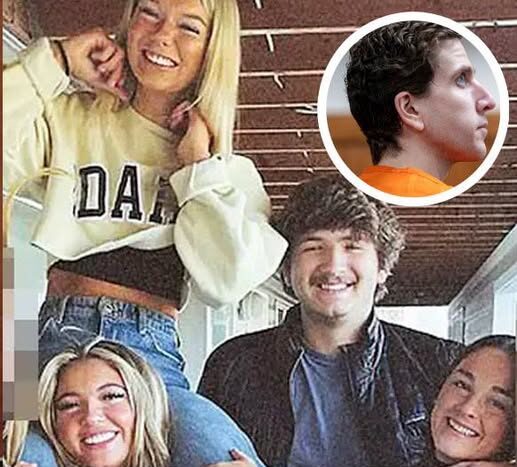
Newly Released Messages Reveal Surviving Roommates’ Fear During the University of Idaho Murders
Court Records Show the Roommates Texted Each Other as Disturbing Sounds Came From Inside the House
Newly released court documents have revealed the frightening messages exchanged by the two surviving roommates during the 2022 murders of four University of Idaho students.
The records provide a closer look at the confusion and fear experienced by Dylan Mortensen and Bethany Funke while Bryan Kohberger was inside the off-campus home in Moscow, Idaho.
Kohberger, now 31, is serving four consecutive life sentences after pleading guilty to murdering Kaylee Goncalves, Madison Mogen, Xana Kernodle, and Ethan Chapin.
The four students were fatally stabbed during the early morning hours of November 13, 2022.
Mortensen and Funke were also inside the residence but survived the attack.
The newly disclosed messages show that the two roommates became increasingly alarmed as they heard unexplained activity elsewhere in the house.
At the time, neither woman appears to have understood the full extent of what was happening.
The First Messages Reflected Confusion
The text exchange began shortly after 4:20 a.m., during the period in which investigators determined the killings occurred.
Mortensen first expressed concern that no one in the house was responding to her.
DM to BF: “No one is answering”
She then sent another message describing her confusion.
DM to BF: “I’m rlly confused rn.”
Mortensen also attempted to contact Kaylee Goncalves directly.
DM to Kaylee Goncalves: “Kaylee”
DM to Kaylee Goncalves: “What’s going on”
Funke responded with her own concern.
BF to DM: “Ya dude wtf”
At that point, both roommates were attempting to understand the noises and movement occurring inside the residence.
The messages suggest that they knew something unusual was happening, but they had not yet identified the source of the disturbance.
Mortensen Described Seeing a Masked Figure
The conversation became more urgent when Mortensen described seeing a person whose face appeared partially covered.
Funke first mentioned Xana Kernodle’s clothing.
BF to DM: “Xana was wearing all black”
Mortensen then said she was becoming extremely frightened.
DM to BF: “I’m freaking out rn”
She clarified that the person she had seen appeared to be wearing something resembling a ski mask.
DM to BF: “No it’s like ski mask almost”
Funke initially reacted with disbelief.
BF to DM: “Stfu”
BF to DM: “Actually”
Mortensen attempted to describe the covering in greater detail, although the message contained several typing errors that reflected the urgency of the moment.
DM to BF: “Like he had soemtbinf over is for head and little nd mouth”
She then emphasized that she was not joking.
DM to BF: “BF I’m not kidding o am so freaked out”
Funke replied that she was equally afraid.
BF to DM: “So am I”
The Roommates Tried to Reach One Another
As the exchange continued, Mortensen warned that her phone battery was almost dead.
DM to BF: “My phone is going to die f***”
Funke urged her to come downstairs.
BF to DM: “Come to my room”
BF to DM: “Run”
BF to DM: “Down here”
The messages were sent over a period of only several minutes.
They reveal two frightened young women attempting to communicate without fully understanding whether they were in immediate danger.
The court records do not suggest that either roommate knew their four friends had already been fatally attacked.
Instead, the texts show confusion, fear, and an effort to remain connected while unusual activity continued around them.
The Messages Add Context to the Surviving Roommates’ Experience
Public attention has long focused on what Mortensen and Funke saw and heard during the early morning hours.
The newly released exchange provides a more direct record of their reactions.
Mortensen appeared alarmed by the lack of responses from the other residents and by the masked individual she reported seeing.
Funke, located elsewhere in the house, encouraged her to reach the lower level.
Their short messages do not provide a complete account of every sound or movement inside the residence.
However, they demonstrate that both roommates recognized that something was wrong.
They also show how difficult it was for them to interpret the situation while isolated in separate parts of the house.
The Emergency Call Came Hours Later
The text exchange occurred several hours before anyone called emergency services.
A 911 call was eventually placed shortly before noon on November 13.
The delay between the killings and the emergency call has remained one of the most discussed aspects of the case.
Investigators have explained that the surviving roommates did not realize their friends had been killed.
Later that morning, friends were contacted and came to the residence.
The emergency call reported that an individual appeared to be unconscious.
When officers entered the house, they discovered the bodies of Goncalves, Mogen, Kernodle, and Chapin.
Law enforcement authorities have never accused Mortensen or Funke of participating in the crime or committing any offense connected to the delay.
Trauma Can Affect How People Respond to Danger
The surviving roommates’ behavior has been examined extensively in documentaries, interviews, and public discussions about the case.
Some people questioned why emergency services were not contacted immediately after Mortensen reportedly saw the masked figure.
Experts discussing the case have noted that people experiencing severe fear or trauma do not always respond in predictable ways.
A person may freeze, hide, become confused, or struggle to accept that a violent event is taking place.
Others may interpret disturbing sounds as an argument, party activity, or an ordinary disruption rather than a life-threatening attack.
The messages show that Mortensen and Funke were frightened, but they do not indicate that either woman knew four people had been murdered.
The full meaning of what they had heard and seen only became clear after the victims were discovered.
The Victims Were University of Idaho Students
Kaylee Goncalves, Madison Mogen, Xana Kernodle, and Ethan Chapin were all students connected to the University of Idaho.
They were killed in the off-campus residence where several of them lived.
The crime shocked the small community of Moscow and attracted attention across the United States.
For weeks after the attack, authorities did not publicly identify a suspect.
The lack of an immediate arrest increased fear among students and residents while investigators gathered evidence.
Kohberger was later taken into custody and charged with four counts of first-degree murder and one count of burglary.
The case generated years of court hearings, legal arguments, and public speculation before he ultimately entered a guilty plea.
Kohberger Pleaded Guilty in 2025
In July 2025, Kohberger pleaded guilty to all four murders and to the burglary charge.
The plea prevented the case from proceeding to a full criminal trial.
He received four consecutive life sentences without the possibility of parole for the murders.
An additional prison term was imposed for burglary.
The consecutive sentences ensure that each victim is represented by a separate life term.
The plea agreement also ended the possibility of a death sentence.
Although Kohberger admitted responsibility in court, he did not publicly explain why he selected the victims or entered the Moscow residence.
No Official Motive Has Been Established
The reason behind the murders remains unknown.
Investigators and the court have not established an official motive explaining why Kohberger carried out the attack.
Observers have offered many theories about possible connections, planning, surveillance, or personal fixation.
Documentaries and public commentators have also attempted to interpret his behavior before and after the killings.
However, none of those theories has been formally confirmed as the motive.
Kohberger’s guilty plea established his legal responsibility, but it did not answer the question of why the four students were targeted.
That unanswered question continues to trouble the victims’ families and those who followed the case.
The Newly Released Records Provide a Timeline of Fear
The text messages are significant because they record events as the roommates experienced them.
Unlike later interviews or reconstructed timelines, the messages were written during the same period in which the violence was unfolding.
They capture Mortensen’s confusion when other residents failed to respond.
They show her fear after seeing a person with a partially covered face.
They also reveal Funke’s concern and her repeated instructions for Mortensen to come downstairs.
The spelling errors, short sentences, and abrupt language reflect the panic of the exchange.
Neither roommate had the benefit of knowing what investigators would later uncover.
They were reacting only to fragments of information inside a dark and confusing environment.
The Masked Figure Became a Major Part of the Investigation
Mortensen’s description of a masked man became one of the most important elements of the early investigation.
She reported seeing a male figure inside the home during the period when the murders occurred.
The newly released text messages show that she shared that observation with Funke almost immediately.
Her reference to a ski-mask-like covering suggests that the person’s forehead and mouth were at least partly obscured.
The messages do not include a complete physical description.
However, they confirm that Mortensen was alarmed enough by the sight to tell Funke that she was seriously frightened.
That observation later formed part of the broader collection of evidence used in the case.
Attention Remains on the Delay Before Police Arrived
Even after Kohberger’s conviction, public discussion continues to return to the hours between the attack and the 911 call.
The newly released texts may help explain part of that period, but they do not answer every question.
They show that the surviving roommates were communicating during the early morning and that both were afraid.
They do not establish exactly when they fell asleep, moved between rooms, or concluded that the danger had passed.
They also do not show that either woman understood that the other residents were unable to respond because they had been killed.
Investigators have consistently treated Mortensen and Funke as surviving witnesses rather than suspects.
No charges have been brought against either roommate.
The Guilty Plea Did Not End All Legal Disputes
Although Kohberger pleaded guilty and received four life sentences, later legal filings have continued to attract attention.
He has more recently sought to withdraw his plea while claiming innocence despite his conviction.
The request has become part of continuing legal proceedings.
Any effort to withdraw a guilty plea faces substantial legal obstacles, particularly after sentencing.
The court must consider the circumstances surrounding the plea and whether it was entered knowingly and voluntarily.
For the victims’ families, renewed litigation has the potential to prolong a case that already lasted for years.
The convictions and life sentences remain in place while the legal arguments continue.
The Messages Humanize Two Survivors
Much of the public discussion surrounding Mortensen and Funke has focused on what people believe they should have done.
The messages provide a different perspective by showing two young women attempting to understand a terrifying situation in real time.
Mortensen’s repeated statements that she was confused and frightened show that she did not view the events as ordinary.
Funke’s responses show that she also felt unsafe and wanted Mortensen to reach her room.
The exchange does not erase questions about the timeline, but it demonstrates that the roommates were experiencing genuine fear.
They survived an attack that killed four of their friends and then became central figures in one of the most closely examined murder cases in recent American history.
The emotional consequences of that experience extended far beyond the early morning of November 13.
Four Lives Remain at the Center of the Case
The release of new evidence can draw renewed attention to individual details, including messages, timelines, and witness behavior.
However, the central tragedy remains the deaths of Kaylee Goncalves, Madison Mogen, Xana Kernodle, and Ethan Chapin.
Each victim had a family, friendships, ambitions, and a future that ended inside the Moscow residence.
Their loved ones spent years waiting for the criminal case to reach a conclusion.
Kohberger’s guilty plea established responsibility and ensured that he would spend the remainder of his life in prison.
It did not provide a motive or remove the pain caused by the murders.
The New Documents Reveal Fear but Not Full Understanding
The text messages released by the Latah County Prosecutor’s Office offer one of the clearest accounts of what the surviving roommates were feeling during the attack.
They show confusion when the other residents did not answer.
They record Mortensen’s fear after seeing a masked person.
They capture Funke urging her to run downstairs and remain close.
What they do not show is an awareness that four murders had taken place.
That distinction remains essential when examining the hours before the emergency call.
The roommates knew something frightening was happening, but the evidence does not indicate that they understood the true scale of the violence.
More than three years after the killings, the newly released messages have opened another painful window into the night that changed the lives of the victims’ families, the two survivors, and the University of Idaho community forever.