
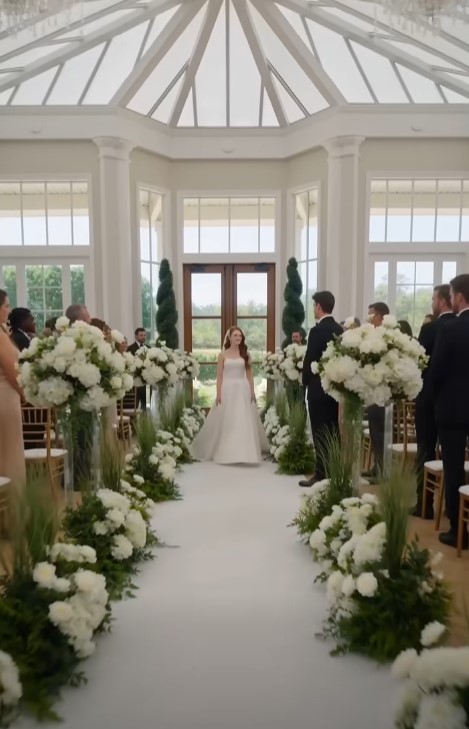
Little Girl’s Locket Turns Wedding Day Into a Shocking Family Revelation
A Wedding Hall Falls Silent
The wedding celebration was meant to be a day of joy, promise, and new beginnings. Guests had gathered to witness two families come together, and every detail seemed arranged around happiness, ceremony, and the future.
Then one small object changed the entire atmosphere in the room.
The groom’s mother stared into the open locket as if the past had just stepped into the room. Her expression shifted so suddenly that the people nearest to her understood something serious had happened before anyone said a word.
The locket was not large or dramatic. It was small enough to rest in a child’s hand, the kind of keepsake that could easily be mistaken for an ordinary piece of jewelry. But once it was opened, it carried a weight that no one in the hall could ignore.
Inside was a tiny photo of the groom holding a newborn baby.
On the other side was one engraved word.
“Mine.”
The Bride Sees the Photograph
The bride covered her mouth as the meaning of the image began to settle over the room. What had first appeared to be confusion became something far more painful.
The photograph did not look like a random memory or a misplaced keepsake. It showed the groom with a newborn, and the engraved word made the discovery feel deeply personal.
The bride’s reaction reflected the shock moving through the hall. A wedding is built around trust, but the locket introduced a hidden part of the groom’s past at the exact moment he was supposed to be stepping into a future with her.
No one rushed to explain. No one laughed it off. The silence around the bride grew heavier as everyone waited for the groom to respond.
Nearby, the little girl who had brought the locket looked down at her stuffed bunny. She seemed too young to understand the full meaning of what she had carried into the room.
Her voice was soft when she finally spoke.
“My mommy said to find him,” she whispered. “She said he would know my necklace.”
The Groom Is Forced to Face the Past
The groom took a step back, breathing hard. The image inside the locket had struck him with the force of something he had never expected to see again.
His reaction was not the reaction of someone caught in a simple misunderstanding. It was the reaction of someone staring at a memory he believed had been taken from him.
“That’s impossible,” he said. “They told me she lost the baby.”
The words changed everything.
Until that moment, the bride and the guests could only guess what the locket meant. But the groom’s response revealed that he recognized the connection immediately. There had been a baby. There had been a story. And he had believed that story ended in loss.
The little girl stood there with her bunny, unaware that her arrival had reopened something painful and buried. To her, the locket was not evidence. It was a clue given to her by her mother.
For the groom, it was proof that the truth he had lived with may never have been the truth at all.
The Mother’s Silence Becomes an Answer
The groom’s mother’s face broke.
The room turned cold.
Her reaction told its own story before she spoke. She did not look confused. She did not challenge the locket or question the little girl’s words. Instead, she lowered her eyes as the bride slowly looked at the groom.
“Who told you?”
That question brought the room to a standstill.
The bride was no longer only reacting as a shocked partner. She was trying to understand who had shaped the groom’s belief about the baby and why such a life-changing truth had remained hidden until the wedding day.
The groom’s mother lowered her eyes.
Silence filled the hall.
That silence became more devastating than an immediate confession. It suggested that the answer had been standing in the room all along, dressed for a wedding while carrying a secret from years before.
A Child Stands Among Crying Adults
The little girl clutched the bunny tighter, not understanding why adults were crying.
She had not arrived to accuse anyone. She had not come with anger or demands. She came because her mother had told her to find a man who would recognize her necklace.
That innocence made the moment even more painful.
While the adults around her began to understand betrayal, secrecy, and years of separation, the child remained focused on a simple question: whether she had done something wrong by coming.
The groom stared at his mother.
“Mom?”
It was a single word, but it carried years of trust, confusion, and disbelief. He was not only asking for an explanation. He was asking whether the person who raised him had allowed him to believe his child was gone.
His mother tried to speak, but her lips shook too badly.
Then the truth began to surface.
“I thought I was protecting your future,” she whispered.
A Confession That Changes Everything
The groom’s mother’s words landed with devastating force. They did not erase what had happened. They did not repair the years lost between father and child. But they confirmed that the silence had not been accidental.
Her explanation suggested that choices had been made for him, not with him. Someone had decided what his future should look like and removed the child from that future without allowing him to know the truth.
The bride stepped away from the groom, tears slipping down her face.
Her movement was quiet but powerful. In that moment, she was not only responding to the discovery of a child. She was reacting to the collapse of certainty on the day she was supposed to begin married life.
The groom was also shaken, but his shock carried a different burden. He had believed a baby was lost. Now a little girl stood before him holding proof that she had existed all along.
The mother’s claim that she was protecting his future only deepened the pain. The future she tried to protect had arrived at the wedding hall in the form of a child holding a stuffed bunny and asking to be recognized.
The Bride Faces an Impossible Moment
For the bride, the discovery created an emotional conflict no wedding ceremony could have prepared her for. She had come to the hall expecting vows, celebration, and commitment.
Instead, she found herself standing beside a man whose past included a child he said he never knew existed.
The groom’s words suggested that he had not knowingly hidden the girl from her. But the moment still changed everything about the wedding. Trust was no longer a simple matter between bride and groom. It now involved a family secret, a mother’s confession, and a child’s place in the groom’s life.
Her tears reflected grief, confusion, and the sudden realization that the marriage she was about to enter had become more complicated in a matter of minutes.
She stepped away not because every answer was clear, but because the truth had arrived too suddenly for anyone to process.
The hall that had been prepared for celebration had become the setting for a reckoning.
The Groom Turns to the Little Girl
The little girl looked up at him again.
“Are you mad I came?”
Her question broke through the adult silence with painful simplicity. She was not asking about the past, the lie, or the mother’s decision. She was asking whether her presence had made him angry.
The groom dropped to his knees in front of her.
That gesture shifted the focus of the room. For a moment, the wedding, the guests, the mother’s confession, and the bride’s tears all moved into the background.
He was face to face with the child whose existence had been hidden from him.
His eyes filled with shame, shock, and something deeper than fear.
“No,” he whispered. “I’m mad I didn’t know you existed.”
A Future Rewritten in One Moment
The groom’s answer did not solve the crisis, but it gave the little girl the reassurance she needed most in that moment. He was not angry at her. He was devastated that he had been kept from her.
The statement also revealed the emotional truth at the center of the scene. The child was not an interruption to his future. She was part of a past that had been hidden and a future that could no longer be ignored.
The mother’s decision, made under the belief that she was protecting him, had instead created a wound that touched every person in the hall. The bride faced the shock of discovering a child on her wedding day. The groom faced the pain of years stolen by silence. The little girl faced a room full of tears without fully understanding why.
The locket remained the symbol of everything that had been concealed. Its tiny photograph connected the groom to a newborn he believed he had lost. Its engraved word carried the emotional claim that had survived even when the truth was buried.
What began as a wedding day became a moment of revelation. The ceremony could no longer continue as if nothing had happened, because the truth had already entered the room.
The Locket Becomes the Center of the Truth
The locket’s power came from its simplicity. It did not require a long explanation to unsettle the room. The photograph and the engraved word were enough to challenge years of silence.
For the little girl, the necklace was a link to her mother’s instruction. She had been told to find the man who would know it, and she trusted that direction enough to appear before him.
For the groom, the locket reopened a chapter of his life he believed had ended in grief. The sight of the newborn in the photo forced him to confront the possibility that his loss had been manufactured by someone close to him.
For the bride, the locket raised questions about the man she was about to marry, the family she was entering, and the secrets that had shaped the day before she even stood at the altar.
For the groom’s mother, the locket exposed what she had tried to keep hidden. Her silence, her lowered eyes, and her shaken confession showed that the object had brought the past back with undeniable force.
A Wedding Changed by a Child’s Question
In the end, the most powerful moment did not come from the adults’ accusations or explanations. It came from the little girl’s fear that she had done something wrong by showing up.
Her question stripped away every layer of conflict and brought the scene back to its human center. A child had come looking for someone her mother said would recognize her necklace.
The groom’s reply made clear that his anger was not directed at her. It was directed at the lost years, the hidden truth, and the fact that he had not been allowed to know his own child existed.
The wedding hall remained filled with unanswered questions. The bride’s tears, the mother’s confession, and the groom’s shock all pointed toward consequences that would continue long after that day.
But the first step had already happened.
The little girl had been seen. The locket had been opened. And the truth, once hidden, could no longer be returned to silence.