
The Mystery Behind a Forgotten Kitchen Tool That Once Filled Homes Across Britain
An Unusual Object Sparks Curiosity Online
The internet has a way of turning ordinary discoveries into fascinating mysteries. Every day, people share photographs of unfamiliar objects, hoping someone can identify them and explain their purpose.
In many cases, the collective knowledge of online communities helps solve these puzzles within hours. What may seem strange or confusing at first often turns out to have a practical purpose rooted in history.
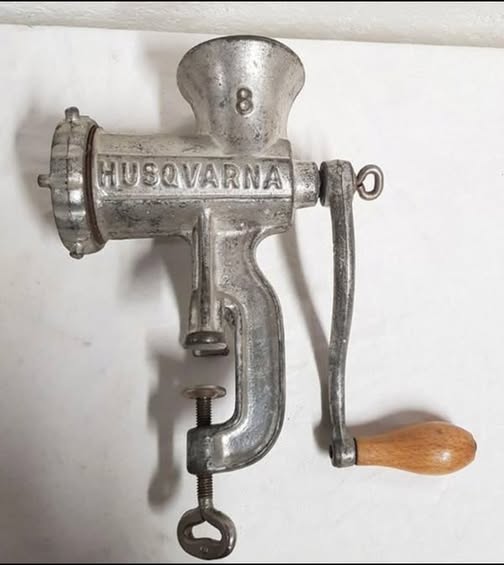
One such mystery recently centered around a heavy steel device that left many people scratching their heads. Its unusual shape and mechanical appearance made it difficult for younger generations to recognize.
While some viewers had never encountered anything like it before, others immediately knew exactly what it was and remembered seeing similar tools in family kitchens.
The Object Revealed
The mystery item was identified as a meat mincer, a once-common kitchen tool used for preparing food at home.
Before modern kitchen appliances became widespread, meat mincers played an important role in food preparation. They allowed people to process ingredients manually and create finely chopped mixtures for a variety of recipes.
The device was commonly used throughout the United Kingdom and other regions for grinding and mixing meat. It could also be used for fish, vegetables, and other ingredients depending on the needs of the household.
For many families, the meat mincer was considered a standard kitchen item. It provided a practical way to prepare food from scratch long before electric appliances simplified the process.
How Early Meat Mincers Worked
The design of the traditional meat mincer was straightforward yet effective.
Users would place ingredients into the top opening of the machine. A hand-operated crank on the side would then be turned, moving the food through an internal mechanism.
As the material passed through the device, it was forced through a metal plate containing small holes. This process transformed larger pieces into smaller strands, creating the minced texture needed for cooking.
The operation required physical effort, but it allowed households to prepare ingredients with a level of control that was difficult to achieve using knives alone.
The simple mechanical design helped make the tool reliable and durable. Many units remained functional for years, sometimes even being passed down through generations.
The Origins of the Meat Mincer
The history of the meat mincer stretches back to the nineteenth century.
Karl Drais is credited with creating the earliest version of the device. His invention introduced a practical method for processing food more efficiently than many traditional techniques available at the time.
The concept quickly proved useful in domestic kitchens. As households sought better ways to prepare meals, the meat mincer became increasingly popular.
Its ability to process ingredients into uniform pieces made it valuable for a wide range of recipes. Families could create minced meat mixtures, blend ingredients together, and prepare food with greater consistency.
The invention represented an important step in the evolution of kitchen equipment and food preparation methods.
A Household Essential for Generations
For many years, hand-cranked meat mincers were common fixtures in homes.
Before electric appliances became widespread, people relied on mechanical tools to complete many everyday kitchen tasks. The meat mincer fit perfectly into that environment.
Its sturdy construction and practical design allowed it to handle regular use. Families often depended on it when preparing meals for gatherings, celebrations, and everyday dinners.
The device offered a level of flexibility that made it especially useful. Beyond processing meat, it could also be used for vegetables and fish, helping cooks create a variety of dishes.
Because of this versatility, the meat mincer earned a place in countless kitchens and became part of daily life for many households.
The Transition to Electric Power
As technology advanced, household appliances underwent significant changes.
The arrival of electricity transformed kitchens and introduced new possibilities for food preparation. Manufacturers began adapting familiar tools into powered versions that required far less physical effort.
The meat mincer was among the many devices that evolved during this period.
Electric meat grinders gradually replaced traditional hand-operated models in many homes. These newer machines could process ingredients more quickly and efficiently while reducing the amount of manual work required.
What once demanded continuous cranking could now be accomplished with the push of a button.
Modern Meat Grinders and Expanded Capabilities
Today’s electric grinders have moved far beyond the original designs of the nineteenth century.
Modern models are capable of processing large quantities of meat in a relatively short amount of time. This increased efficiency has made them useful for both home cooks and those preparing food in larger volumes.
Manufacturers have also expanded the capabilities of these machines through specialized attachments.
Some units include components designed for sausage preparation. Others feature accessories that support kibbe production or even juicing functions.
These additional features have transformed the basic meat grinder into a more versatile kitchen appliance capable of performing multiple tasks.
While the core principle remains similar to the original design, the technology behind modern machines has significantly improved convenience and productivity.
Why the Discovery Fascinated So Many People
The online discussion surrounding the steel tool highlighted an interesting aspect of modern life.
Many objects that were once common household items have gradually disappeared from everyday use. As technology changes, younger generations often grow up without encountering tools that previous generations considered essential.
As a result, discovering an unfamiliar item can feel like uncovering a piece of history.
For some people, the meat mincer was a completely new discovery. Its appearance seemed unusual, and its purpose was not immediately obvious.
For others, however, the object triggered memories of family kitchens, home cooking, and earlier methods of food preparation.
The contrast between these perspectives helped fuel interest in the item and encouraged people to learn more about its background.
A Simple Tool With a Long History
The story of the meat mincer reflects the broader evolution of household technology.
What began as a manually operated invention in the nineteenth century eventually developed into the powerful electric machines available today.
Throughout that transformation, the underlying goal remained the same: making food preparation easier and more efficient.
Although modern appliances have largely replaced traditional hand-cranked versions, the original design remains an important part of culinary history.
The steel device that puzzled so many people online serves as a reminder that even the most ordinary household tools can carry fascinating stories from the past.
From its early beginnings to its modern electric descendants, the meat mincer has completed a remarkable journey, evolving alongside generations of cooks while continuing to perform the same essential task it was created for more than a century ago.