
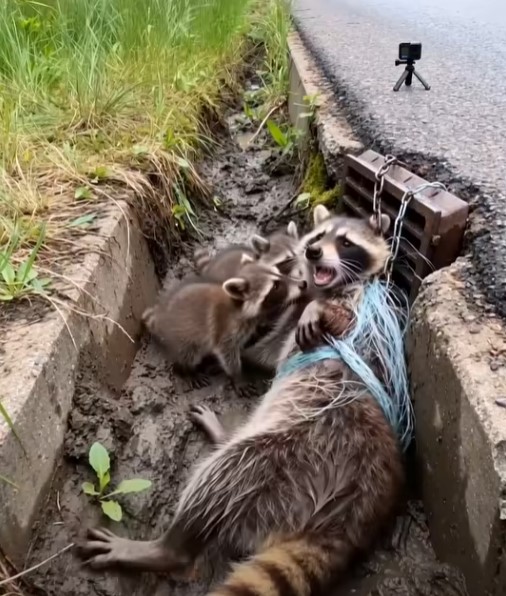
Raccoon Caught in Blue Netting Faces a Coyote in Unusual Wildlife Encounter
A Quiet Outdoor Scene Suddenly Becomes Tense
A peaceful outdoor area can change quickly when two wild animals unexpectedly cross paths, especially when one of them is already struggling with an obstacle.
That was the situation when a raccoon became tangled in bright blue netting while a wild coyote appeared nearby and began showing interest in what was happening.
The encounter created an unusual and potentially dangerous situation. The raccoon had limited movement because of the material wrapped around its body, while the approaching coyote added another level of uncertainty.
For anyone watching, the most important response was not to rush toward the animals. Both were wild, both could react unpredictably, and the raccoon was already under significant stress.
The Raccoon Struggles With the Netting
The raccoon was positioned close to the ground with sections of blue netting surrounding and restricting it.
It appeared to be attempting to move through the area, but each effort was made more difficult by the material caught around its body.
Wild animals frequently travel through fields, wooded spaces, yards and other outdoor environments without understanding the danger presented by human-made objects.
Something as ordinary as discarded netting can become a serious obstacle when an animal walks through it and becomes caught.
Once entangled, an animal may instinctively pull harder in an attempt to escape. That reaction can sometimes make the situation even more complicated if the material tightens or catches on nearby vegetation.
In this case, the vivid blue color made the netting especially noticeable against the surrounding natural landscape.
The raccoon continued adjusting its position, apparently searching for a way to move despite the restriction.
The Arrival of a Coyote Changes Everything
The situation became considerably more tense when a coyote entered the area.
Coyotes are naturally curious and adaptable animals, and they may investigate unfamiliar activity in their surroundings.
The presence of another animal can also attract their attention.
As the coyote moved closer, the raccoon had fewer options than it normally would have had during a wildlife encounter.
Because of the netting, simply moving away quickly was difficult.
The coyote watched the situation and approached cautiously while the raccoon continued trying to reposition itself.
The decreasing distance between the animals created a moment in which any sudden movement from a nearby person could potentially make the situation less predictable.
Why Keeping a Safe Distance Matters
Watching an animal struggle can create an immediate desire to intervene, but directly approaching wild animals is not always the safest response.
In this situation, there were two separate concerns.
The raccoon was stressed and restricted by the netting, while the coyote was still moving freely through the area and observing what was happening.
Approaching the raccoon while the coyote remained nearby could have caused either animal to react defensively.
A frightened raccoon may attempt to protect itself if it feels cornered, and approaching a wild coyote directly is also not responsible.
The observer therefore continued watching from a reasonable distance instead of immediately attempting to physically separate the animals.
This allowed the coyote to make its own decision about whether to remain in the area while giving the raccoon as much space as possible.
Discarded Materials Can Create Unexpected Problems for Wildlife
The encounter also drew attention to the broader problem created when netting, ropes and similar materials are left in places where wildlife can reach them.
Outdoor materials may appear harmless after being discarded, but animals moving through the environment can easily become caught.
Garden netting, fishing-related materials, fencing and loose rope can all become obstacles for animals traveling through an area.
Wildlife does not recognize these objects as potential hazards.
An animal may simply attempt to pass through an opening and become trapped before realizing what has happened.
Once the material becomes wrapped around a leg, body or neck area, continued movement can make escape more difficult.
The raccoon in this encounter demonstrated how quickly an everyday object can interfere with an animal’s ability to move normally.
Patience Becomes Important as the Coyote Watches
The coyote remained nearby for part of the encounter, continuing to observe the raccoon.
The raccoon, meanwhile, stayed focused on its immediate surroundings and attempted to change position despite the netting.
Neither animal could be expected to understand the intentions of a nearby person.
That made patience particularly important.
A quick approach might feel like the fastest way to help the raccoon, but it could also increase the stress of both animals at the same time.
Instead, the observer monitored their movements and waited for the situation to become safer.
As time passed, the coyote gradually altered its position.
The distance between the two animals began to increase, reducing some of the immediate tension.
A Safer Opportunity Begins to Develop
Once the coyote moved farther away, the raccoon’s situation became easier to evaluate.
The netting remained the primary concern, but there was less immediate pressure from the second animal.
The raccoon gained additional space and could continue trying to adjust its position without the coyote remaining as close.
For anyone witnessing a similar situation, this is the point when contacting trained wildlife professionals can become especially important.
If an animal remains trapped or cannot move freely, wildlife personnel may be better equipped to determine how the material can be removed without causing additional harm or unnecessary stress.
Simply pulling on netting is not always the best solution.
If the material is wrapped tightly, uncontrolled handling could make the entanglement worse.
Professional assistance can allow the situation to be assessed more carefully.
Both Animals Need Space
Although attention naturally centered on the trapped raccoon, the coyote also needed room to move through the area without being cornered.
A responsible response to a wildlife encounter considers the behavior and safety of every animal involved.
The coyote was not behaving unusually simply because it became interested in the raccoon.
It was responding to something happening within its environment.
Likewise, the raccoon was reacting to the immediate problem created by the netting and the presence of another animal nearby.
Allowing both animals adequate space reduced the likelihood of forcing either one into a defensive response.
The situation gradually became calmer as the coyote continued moving farther away.
Coyotes and Raccoons Often Live Close to People
Both raccoons and coyotes are highly adaptable species.
They can sometimes be encountered surprisingly close to places where people live and work.
Roads, parks, farms, yards and residential areas can all become part of the spaces these animals travel through while searching for food, shelter or safe routes.
Because of that adaptability, unusual wildlife encounters are possible even in areas that do not initially appear remote.
Seeing one of these animals does not necessarily mean immediate intervention is required.
In many situations, providing distance and allowing wildlife to continue moving naturally is the safest response.
However, an animal that is clearly trapped by human-made material presents a different problem because it may be unable to escape without assistance.
Prevention Can Reduce Future Wildlife Entanglements
The blue netting in this encounter serves as a reminder that outdoor materials should be stored and discarded carefully.
People using gardening supplies, fishing equipment, fencing, ropes or similar items can reduce risk by ensuring unused material is not left loose in areas accessible to wildlife.
Properly securing outdoor supplies can prevent animals from walking into loops, openings or tangled sections.
Removing discarded material from fields and wooded areas can also reduce the chance of future entanglements.
Even relatively small pieces of netting may create difficulties for an animal if they become wrapped around its body.
Preventing the problem before an animal becomes trapped is far easier than attempting to manage an unpredictable wildlife rescue afterward.
The Coyote Eventually Moves Away
As the encounter continued, the coyote gradually increased its distance from the raccoon.
The immediate tension began to fade.
The raccoon remained near the blue netting, but the reduced presence of the coyote created a safer environment for determining what should happen next.
If the raccoon remained unable to free itself, trained assistance could then be considered without having to manage two wild animals in the same confined space.
The moment showed why observation can sometimes be one of the most useful first responses during an unexpected wildlife situation.
Waiting does not necessarily mean ignoring an animal in difficulty.
It can mean allowing conditions to become safer before taking the next step.
The Encounter Offers a Simple Wildlife Safety Lesson
Footage of the unusual meeting was later shared online with the description “Raccoon and a Coyote Meet in an Unexpected Wildlife Encounter.”
The scene attracted attention because it brought together several wildlife concerns at once: an animal caught in discarded material, another wild animal approaching nearby and the question of when human intervention is appropriate.
The safest response begins with maintaining distance.
A person should not approach the coyote directly, particularly while it is already focused on another animal.
The raccoon should also not be handled casually because a stressed wild animal may defend itself when frightened.
If the raccoon remains caught or is unable to move normally after the coyote leaves, contacting local wildlife professionals is the more responsible option.
Should You Try to Free a Trapped Raccoon Yourself?
Direct handling should generally be avoided when a wild raccoon is tangled in netting.
The animal may already be frightened, exhausted or confused, and approaching closely can increase its stress.
Trying to remove the material without the appropriate experience can also create additional difficulties if the netting tightens or the animal begins struggling more forcefully.
Professional wildlife assistance provides a safer way to evaluate how badly the animal is trapped and what method can be used to help it.
The same caution applies to the nearby coyote.
People should avoid attempting to chase, corner or physically approach the animal.
Raccoon and a Coyote Meet in an Unexpected Wildlife Encounter pic.twitter.com/RJTICKuUJx
— Animal Rescue Stories (@AnimalStory5) August 14, 2026
A Calm Response Can Make an Unusual Encounter Safer
The raccoon and coyote encounter demonstrates how quickly an ordinary outdoor setting can become complicated.
The trapped raccoon needed room and assistance, while the coyote needed enough space to continue behaving naturally without feeling threatened.
By remaining calm and observing from a safe distance, the person nearby avoided adding unnecessary pressure to an already unpredictable situation.
The coyote eventually moved farther away, crhttps://twitter.com/i/status/2088279862834278491eating a better opportunity to focus on the raccoon and the netting restricting its movement.
The incident also provides a reminder that protecting wildlife can begin long before an emergency occurs.
Properly storing and disposing of netting, ropes, fishing materials and similar outdoor items can prevent animals from becoming trapped in the first place.
When wildlife does become entangled, patience, distance and professional assistance can help create the safest possible response for everyone involved.