
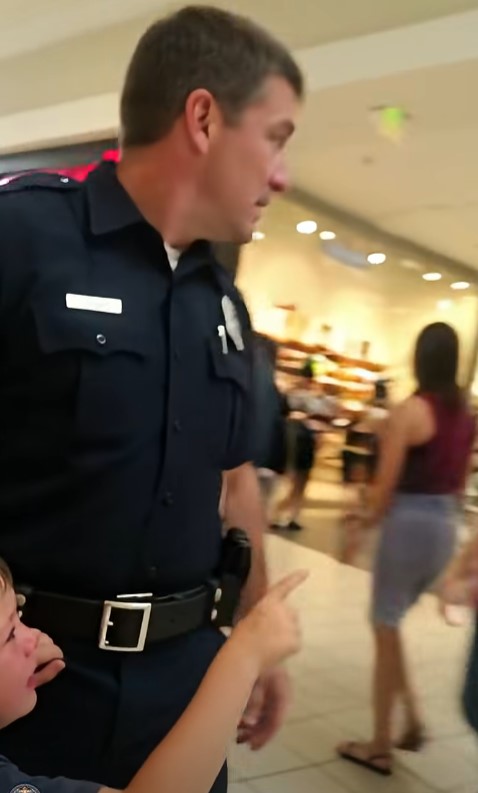
Terrified Boy Begs Mall Guard to Lock Him Up, Then One Detail Exposes a Chilling Secret
The Child Who Wanted a Cage
Arthur had spent three decades working as a police dispatcher before taking a security job at Stonewood Galleria. Years of answering emergency calls had taught him that danger rarely announced itself clearly. Sometimes it arrived smiling, dressed neatly, and prepared with a believable explanation.
That experience returned to him when a frightened boy grabbed his leg in the middle of the mall.
The child appeared to be about eight years old. Despite the warm temperature inside the building, he wore a thick winter coat. He begged Arthur to lock him up, place him in handcuffs, and put him inside a cage.
Before Arthur could understand the request, the boy secretly pointed toward a man standing behind a nearby pillar.
The stranger wore a clean grey windbreaker and watched them with a carefully controlled expression. When he realized Arthur had noticed him, he smiled and started walking toward them.
The boy immediately went limp against Arthur’s leg.
A Convincing Explanation
“There you are, Leo!” the man called.
His voice was loud enough for nearby shoppers to hear. He sounded like an exhausted parent who had finally found a wandering child.
“I am so sorry, Officer,” the man said. “He’s a runner. Turn my back to pay for a pretzel for three seconds, and he’s halfway across the concourse. Come here, Leo. Let the nice man go back to his job.”
He reached toward the boy’s shoulder.
Arthur quietly moved between them.
The child had not recoiled or attempted to escape. Instead, his entire body had become rigid. He held his breath and pressed himself against Arthur’s leg as though preparing for something unavoidable.
“It’s alright,” Arthur replied. “We get runners all the time. Malls are big places. Overwhelming.”
The stranger pulled his hand back and placed it inside his jacket pocket. He explained that the boy was on the autism spectrum and sometimes entered confused states when overwhelmed by noise or crowds.
It was an effective explanation. It accounted for the child’s silence, fear, and unusual request without requiring the man to answer difficult questions.
Arthur had heard too many lies to accept it immediately.
Truthful people often spoke messily during emergencies. They stumbled over details, asked questions, and showed concern for the person in danger. This man delivered a polished medical explanation without once asking whether the child was hurt.
Arthur Creates a Reason to Stall
Arthur told the man that mall policy required him to document any incident involving a distressed child making physical contact with security personnel. He said the paperwork would take only a few minutes.
The man’s friendly expression briefly disappeared.
“That’s really not necessary,” he said. “We’re parked right outside Dillard’s. His mother is waiting. If we don’t get out there, she’s going to panic. I’m sure you don’t want to cause a scene, Arthur.”
The stranger used Arthur’s name without glancing at his badge. He had already studied the nametag while watching from a distance.
Arthur maintained a relaxed expression and explained that surveillance cameras had recorded the encounter. Ignoring it, he claimed, could cost him his job.
He invited the boy to walk with him to the security office. The child opened his eyes and nodded.
The man had little choice but to cooperate. Running or creating a public confrontation would attract attention and damage the ordinary-parent image he had constructed.
The Shoes That Did Not Fit
The three of them entered a quiet corridor leading away from the crowded shopping area. Arthur positioned the child near the wall and kept himself close enough to intervene.
As they walked, he noticed the boy struggling to keep pace. His feet dragged, and his heels repeatedly slipped out of his expensive new sneakers.
The shoes were several sizes too large.
Pieces of paper towel had been pushed into the heels in an effort to make them fit.
Arthur’s concern deepened. The shoes did not look like something selected for a growing child. They looked like part of a disguise assembled quickly by someone who cared more about appearance than comfort.
“So,” Arthur said, “Leo, you like those shoes? They look fast.”
The child remained silent.
“I bought them for him yesterday,” the man replied. “He insisted on wearing them even though he hasn’t grown into them yet. You know how kids are.”
Arthur pretended to accept the answer.
Safety Behind a Locked Door
They soon reached the security office. Beyond its main desk was a small holding room used for aggressive shoplifters while officers waited for police to arrive.
The moment the child saw it, he walked inside without being instructed. He sat in the farthest corner, drew his knees against his chest, and made himself as small as possible.
He had not followed Arthur because he wanted water or a sticker.
He wanted the locked room.
To the frightened child, a security holding cell represented protection.
The stranger stood silently in the outer office, watching Arthur with a cold and calculating expression.
“He’s in the room, Arthur,” the man said. “You got what you wanted. Now, give me the form, let me sign it, and let me take my son home.”
Arthur placed an incident report on the desk. The document itself did not matter. Every question bought him more time.
The man identified himself as David Gregson and provided an address in Westlake. He also presented an Ohio driver’s license that appeared genuine and contained the same information.
The expensive clothing, polished behavior, and affluent address supported the identity he was presenting. The hungry-looking child, oversized shoes, dirty fingernails, and heavy coat did not.
An Order Arthur Could Not Obey
Arthur pretended that he needed to scan the license in another office. Once outside the stranger’s view, he called his supervisor and quietly described what had happened.
He explained that the child had begged to be locked away, appeared terrified of the man, and wore shoes stuffed with paper because they were far too large.
The supervisor focused on liability.
Because the man possessed identification and the boy had no obvious injuries, Arthur was ordered to let them leave. Detaining someone without clear evidence could expose the mall to a lawsuit.
Arthur understood the risk to his job, but he also remembered the emergency calls he had handled years earlier. He remembered the times when warning signs were dismissed because they did not fit neatly into official procedures.
He returned to the office and continued delaying their departure.
The Number on the Boy’s Wrist
Arthur carried a cup of water toward the child. When he accidentally touched one of the oversized shoes, the boy recoiled and pulled his knees closer.
The movement caused the sleeve of his coat to rise.
A large number had been written above his wrist in black permanent marker.
It was the number 4.
The marking did not resemble a phone number, address, or playful drawing. It looked like an inventory label.
The child noticed Arthur staring and quickly covered it. His trembling intensified.
Arthur returned to the outer office and blocked the exit.
“Mr. Gregson,” he said, “why is there a number written on your son’s arm in sharpie?”
The man denied knowing what Arthur meant.
When Arthur identified the marking as the number 4, the stranger claimed children sometimes wrote on themselves at school. He then accused Arthur of unlawful detention and threatened to call the police.
Arthur invited him to make the call.
The Stranger Turns the Story Around
The man dialed emergency services and placed the call on speaker. His voice changed instantly, becoming that of a frightened parent seeking help.
He claimed an aggressive security guard had locked him and his special-needs son inside a back office. He said the child was terrified and asked the police to intervene.
After ending the call, he warned Arthur that his career was over.
Arthur remained in front of the door.
Twelve tense minutes passed before Officer Miller arrived. Arthur knew him from his years working as a dispatcher and hoped the officer would immediately recognize that something was wrong.
Instead, Miller initially accepted the stranger’s version of events.
The man presented his identification and repeated his explanation about the child’s sensory difficulties. Miller saw a clean license, a composed adult, and a silent child whose behavior could seemingly support the story.
When Miller asked the boy whether he wanted to go home with his father, the child shook his head and pressed his face more deeply into his knees.
The stranger described the reaction as another symptom of the child’s condition.
Miller concluded that Arthur lacked a legal reason to hold them.
A Family Photograph Nearly Ends the Investigation
Arthur pointed to the oversized shoes, inappropriate coat, and number on the boy’s wrist. Miller dismissed each clue as unusual but insufficient.
The stranger then produced what appeared to be undeniable evidence: a family photograph on his phone.
The picture showed the same man standing at a zoo beside a woman and a young boy wearing a blue baseball cap. The child had similar coloring and approximately the same build as the boy inside the holding room.
Miller believed the photograph settled the matter.
Arthur examined it more carefully.
The image appeared slightly degraded, as though it had been copied from a social media account instead of captured directly on the phone. More importantly, the smiling child in the photograph had a pale scar running through his left eyebrow.
The frightened boy in the security office did not.
“That’s not him,” Arthur said.
Miller tried to move Arthur away from the door, but Arthur insisted that the photograph showed a different child. He believed the stranger had stolen a family’s identity and was using the image to support a false story.
Miller finally studied the man’s reaction.
The stranger had become rigid. His carefully maintained expression disappeared, and his hand closed tightly around the phone.
Miller asked to inspect the photograph again.
“I’m leaving,” the man replied.
The Mask Finally Falls
The stranger stepped toward the exit. When Miller raised a hand to stop him, the man suddenly drove his shoulder into the officer.
Miller fell backward and crashed into the desk, knocking a computer monitor onto the floor.
The man lunged toward the door.
Arthur had no weapon and suffered from a bad knee, but he threw himself forward and wrapped both arms around the stranger’s waist.
They slammed against the wooden door. The man struck Arthur repeatedly, driving an elbow into his back and a knee into his ribs.
Arthur heard something crack inside his chest, yet he refused to release his grip.
Miller recovered and joined the struggle. Together, the two men forced the stranger to the floor and secured his wrists with handcuffs.
Arthur rolled onto his back, struggling to breathe through the pain in his ribs.
The child slowly crawled out of the holding room.
He removed the blue baseball cap. Beneath it, his hair had been unevenly shaved close to his scalp.
He looked at Arthur and finally spoke clearly.
“Are you keeping him in the cage?” the boy asked.
Arthur assured him that the man would be locked away.
“I’m not Leo,” the child whispered. “Leo was number three. He left yesterday.”
The Boy Reveals His Real Name
Miller took the suspect outside to meet arriving officers. Arthur remained on the office floor with the child.
The boy exposed the number on his wrist and desperately tried to rub it away with saliva. Arthur moved closer without crowding him and promised they would remove it with soap and warm water.
He then asked for the child’s real name.
“Julian,” he replied.
Julian explained that the man had transported him to the mall inside a white van. They had parked in the dark lower level of the garage and walked through the shopping center toward another exit.
A blue car was waiting on the opposite side. Julian had been told to enter it while the man received money.
The new shoes had been given to him inside the van because his own pair looked too dirty. The blue baseball cap and heavy coat were also part of the appearance created for the walk through the mall.
The coat concealed his thin body, while the carefully selected clothes helped him resemble the boy shown in the stolen family photograph.
Julian said the man had threatened to place him inside a metal compartment beneath the van’s floor if he cried out or attempted to run.
When Julian saw Arthur’s badge and discovered that the security office contained a locked room, he formed the only escape plan he could imagine.
He did not believe someone would rescue him. He simply hoped Arthur’s cage would be safer than the compartment in the van.
Police Discover the White Van
State troopers, local officers, and paramedics soon filled the service corridor. Medical workers wrapped Julian in a thermal blanket and carefully examined him.
Arthur told investigators about the white van in the lower garage. Officers immediately searched the area and discovered it parked in a poorly lit corner with stolen license plates.
Inside, they found a concealed compartment beneath a false floor.
They also discovered additional winter coats, blue baseball caps, restraints, sedatives, and records hidden inside the vehicle.
No other children were present, but the recovered material provided investigators with information about a larger criminal operation.
The evidence suggested that the suspect had been using stolen identities, false documents, rehearsed medical explanations, and busy public locations to move abducted children without attracting attention.
The mall functioned as a transfer point. A child could enter through one parking area with one adult and leave through another exit in a different vehicle. To ordinary shoppers, the movement appeared to be nothing more than a parent walking with a tired or distressed child.
The Search for Number Three
Investigators used the recovered records to identify additional suspects and locations connected with the operation.
Within two days, authorities arrested several other people and recovered two more children.
Among those found alive was Leo, the child identified as number three. He was discovered frightened inside a basement in Indiana.
The boy in the stolen family photograph had been used to build a convincing identity around the name Leo Gregson. Julian had been dressed to resemble him closely enough that busy adults would accept the connection without looking carefully.
The large coat hid Julian’s physical condition. The cap concealed his uneven haircut. The oversized new shoes made the rest of the outfit appear intentionally expensive and respectable.
Each part of the disguise was designed to support the same dangerous assumption: a clean, confident adult with proper identification must be telling the truth.
The Warning Signs Everyone Nearly Ignored
The suspect’s plan almost worked because every individual clue appeared explainable when viewed alone.
A child might wear oversized shoes. A child might draw a number on his wrist. A child with sensory difficulties might remain silent or resist leaving a room. A parent might become frustrated with a security guard who delayed the family.
Together, however, the details formed a disturbing pattern.
The man never comforted the child. He spoke for him constantly. His explanation sounded rehearsed, and the family photograph did not match the boy standing in the office.
Most importantly, Julian’s behavior changed whenever the stranger moved closer. His fear was not general confusion caused by a crowded mall. It was directed at one specific person.
Arthur recognized the difference because he had spent years listening to frightened people communicate danger without being able to state it openly.
Corporate Recognition Is Rejected
Stonewood Galleria later offered Arthur a formal commendation. Management wanted to photograph him shaking hands with mall executives and present the rescue as a victory for the property’s security operation.
Arthur refused.
He warned management that he would publicly reveal how his supervisor had ordered him to release Julian to the suspect because the company feared a lawsuit.
The proposed ceremony disappeared, and the supervisor was eventually transferred to another property.
Arthur remained at the mall.
His injured ribs healed, although they left him with a persistent ache. His damaged knee continued to trouble him, but he did not regret standing in front of the office door.
The Open Holding-Room Door
Six months later, Arthur worked another late shift at the nearly empty mall.
The storefront gates were closed, and emergency lighting illuminated the silent corridors. He followed his regular patrol route past the food court and the pillar where the suspect had watched Julian approach him.
At the end of the shift, Arthur entered the security office.
He walked beyond the desk and stopped outside the holding room.
The concrete floor had been cleaned. The metal door Julian once begged him to lock was held open by a rubber wedge.
Without a terrified child hiding inside, it was simply an empty room.
Arthur had spent years remembering emergency calls that ended before he could send help. He carried the weight of moments when procedures, incomplete information, or hesitation prevented him from doing more.
Julian’s rescue could not erase that history. It did, however, remind Arthur why listening mattered.
The child had communicated the truth before speaking a complete sentence. He expressed it through his desperate grip, rigid posture, oversized clothing, silent refusal to leave, and determination to hide inside a locked room.
Arthur noticed because he refused to accept the easiest explanation.
He touched the cold metal frame of the open doorway and switched off the hallway light.
The room returned to darkness, but its door remained open.