
The Tiny Ear Mark That Tells a Bigger Story
A Small Detail That Often Goes Unnoticed
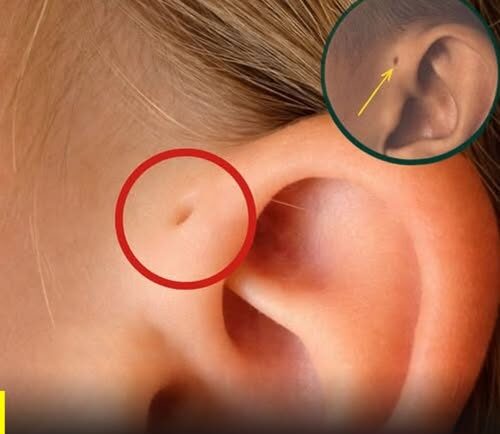
Some individuals have a tiny opening or subtle mark just in front of the ear, near where it meets the side of the head. At first glance, it can resemble a healed piercing or a minor scar.
In reality, this feature is present from birth. It is not the result of injury, and it does not develop later in life.
For many people, it remains unnoticed for years unless someone happens to observe it closely.
What It Is Called
This small anatomical feature is known as a preauricular sinus. It is a naturally occurring variation that forms during early development before birth.
In most cases, it has no impact on a person’s hearing, comfort, or daily functioning. It exists quietly without drawing attention or requiring care.
Many individuals who have it may not even be aware of its presence until it is pointed out.
How It Develops
During the earliest stages of fetal growth, the structures that form the external ear come together through a precise and complex process.
Occasionally, as these structures merge, a small opening or narrow tract remains near the front of the ear. This results in what is seen as a preauricular sinus.
It is not considered damage or an error in the usual sense. Instead, it reflects the natural variation that can occur during human development.
A Natural Variation in Human Biology
The human body is not identical from person to person. Small differences are common and often have no effect on health or function.
The presence of a preauricular sinus is one such variation. It does not signal a problem or a condition in the vast majority of cases.
Like other minor physical differences, it simply reflects the diversity found in human biology.
Connections to Developmental History
Some scientists have explored the idea that certain small features in the human body may reflect very early stages of development.
There is a theory suggesting that structures like this could be linked to patterns that existed in much earlier forms of life. These comparisons are often described as echoes of ancient biological stages.
While such ideas offer an interesting perspective, they remain theoretical and are not considered confirmed functions of the feature.
Why Some Features Remain
Not every part of the human body serves a clear purpose today. Some elements persist simply because they were once part of earlier developmental processes.
Over time, these features remain even if they no longer have a defined role. They become part of the body’s structure without affecting its performance.
The preauricular sinus can be viewed in this way, as a small detail that reflects how complex and layered development can be.
How Common It Is
The occurrence of a preauricular sinus varies depending on geographic and genetic factors. It is not evenly distributed across populations.
Higher rates have been observed in certain regions of Africa, where the feature appears more frequently.
In some parts of Asia, it is present at moderate levels, while in Europe, it is less common.
In the United States, it is considered relatively rare and appears in only a small portion of the population.
Even in areas where it is more frequently seen, it still represents a minority trait rather than a widespread characteristic.
When It Requires Attention
For most individuals, a preauricular sinus does not require any form of treatment or monitoring. It remains stable and causes no discomfort.
In rare cases, it can become irritated or develop an infection. When this happens, it may cause mild swelling or sensitivity in the area.
Such situations are uncommon and are generally manageable without long-term issues.
Outside of these occasional cases, it remains a harmless feature that does not interfere with daily life.
Understanding It as a Feature, Not a Problem
It is important to recognize that a preauricular sinus is not a condition that needs to be corrected. It is simply part of how some individuals are formed.
Labeling it as unusual does not make it harmful. It is one of many small differences that exist naturally among people.
Understanding this helps shift the perspective from concern to acceptance of natural variation.
A Reflection of Complexity
The human body is the result of an intricate and highly coordinated process that unfolds over time. Even the smallest details can reflect this complexity.
A tiny mark near the ear may seem insignificant, but it represents the many layers involved in development.
Each variation, no matter how small, contributes to the uniqueness of an individual.
Why Small Details Matter
Features like a preauricular sinus remind us that not everything in the body needs a clear explanation or function to exist.
Some details are simply part of the broader story of human formation, shaped by countless biological processes working together.
They highlight how much remains beneath the surface, often unnoticed but still meaningful in understanding the body.
A Quiet Presence
For those who have it, the preauricular sinus often remains a quiet and unobtrusive feature. It does not demand attention or affect everyday experiences.
It becomes just another part of a person’s physical makeup, no different from other small and harmless traits.
In many cases, it is only discovered by chance or casual observation.
Final Thought
The human body carries a history that is both complex and subtle. Some aspects are visible and well understood, while others appear in small, easily overlooked ways.
A tiny mark near the ear may not seem significant at first glance, but it reflects the intricate nature of development and variation.
Not every difference signals a problem. Sometimes, it simply reveals how diverse and layered human biology truly is.
Even the smallest features can tell a story, quietly reminding us of the depth and complexity beneath the surface.