
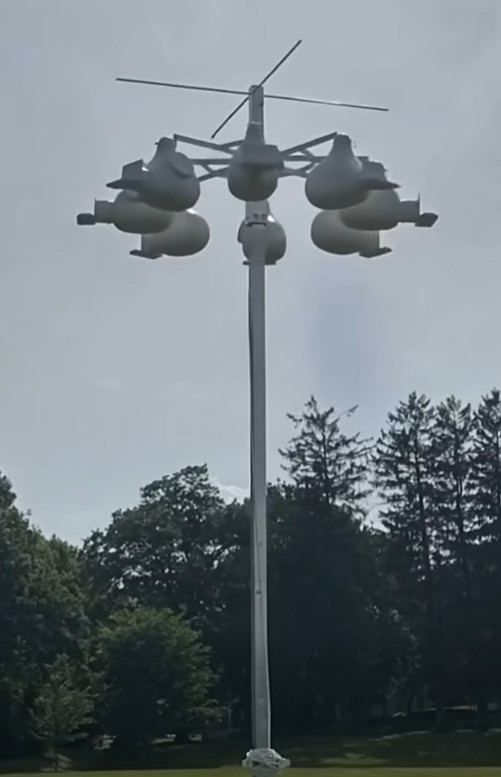
What Are Those White Pods on Tall Poles in Parks? They’re Homes for Purple Martins
The Round Structures Give Migratory Swallows a Place to Raise Their Young
From a park path, a cluster of white pods mounted high on a pole can look like surveillance equipment or part of a weather station. Then a bird swoops in and disappears through an opening in one of the pods. The structure is a purple martin nesting station, and each of those rounded compartments is a birdhouse.
Some of these installations stand more than 12 feet high. The pods are commonly called gourd houses because their shape resembles the hollowed-out gourds traditionally offered to the birds. A single pole can hold several nesting cavities, giving pairs of purple martins room to raise their young close to one another.
Purple Martins Spend Much of Their Time in the Air
The purple martin is North America’s largest swallow. It measures roughly seven to eight inches long, and its wingspan can reach about 16 inches. The dark, glossy plumage associated with the bird can show blue or purple tones as the light changes. In flight, the birds are often easiest to notice when they sweep across an open area and turn sharply in pursuit of insects.
Purple martins catch flying prey such as dragonflies, moths and beetles. That hunting behavior explains why someone watching a nesting station may see birds cross the same stretch of open air repeatedly. A martin can disappear from view as it follows an insect, then return to the pole from a direction a visitor wasn’t expecting.
The birds also travel much farther than the boundaries of any park. They spend the winter in South America and return to North America for the breeding season, covering thousands of miles on migration. A park’s nesting station may stand in the same place year-round, even though the birds it was built for use it during only part of the year.
Why Several Birdhouses Hang From the Same Pole
Purple martins nest in colonies, so a cluster of gourds suits the way they breed. Each pair can use its own compartment while other martins come and go nearby. From the path, the whole rack may look like one piece of equipment. For the birds, it offers a collection of separate entrances and nesting spaces.
The arrangement becomes easier to understand once the colony is active. A bird may head directly into one opening while another passes the same pod on its way to a different one. What looks from below like a mass of identical white shells contains individual nests, each with its own activity during the breeding season.
The entrances also offer a clue when the pole is quiet. Look for a small opening on the side of each pod, leading into the rounded chamber. That repeating feature makes sense once you know the structures are individual houses. On a busy day, following one bird all the way to its entrance is an even quicker way to see how the station works.
People Have Provided Nesting Gourds for Generations
Purple martins use enclosed cavities to nest. Natural openings in trees can provide that kind of shelter, and people have also made nesting spaces available by hanging hollow gourds. Indigenous communities and early settlers in North America helped establish that long-standing practice.
In the eastern United States, purple martins now rely heavily on nesting sites supplied by people. The modern park rack continues that tradition with durable, gourd-shaped housings. Its materials may look more like something from a municipal equipment catalog than something grown in a garden, but the rounded chamber still serves the same purpose.
The rows of evenly spaced white pods are what make the installations look so unfamiliar to some visitors. A wooden birdhouse hanging from a tree is easy to recognize because it matches a familiar picture of a nest box. The resemblance becomes clearer when you consider what’s inside each gourd. There’s a sheltered space where the birds can build a nest from materials such as twigs and grass.
The Pole Helps Caretakers Protect and Maintain the Nests
The gourds are only one part of the installation. You may also see a smooth guard around the pole below the rack. That guard, called a predator baffle, is intended to make it harder for climbing animals to reach the nests. It serves a different purpose from the pods themselves, which provide the enclosed space the birds need.
Modern gourd houses can also have drainage and ventilation openings. Those features help manage moisture and airflow inside a compartment exposed to rain and summer heat. They’re easy to miss from ground level, where the overall shape and color of the housing tend to draw the eye first.
Height presents a practical question for caretakers. Many systems have a winch or a telescoping pole that lets them bring the rack down when it needs attention. This gives them access to check nesting activity, clean out old material and maintain the houses. Much of that work is invisible to visitors who see the gourds only when they are raised.
What a Nesting Station Adds to a Public Park
For a park, putting up a gourd rack creates a place where purple martins can breed. The park offers sheltered cavities in a group, and caretakers can keep those cavities usable from season to season. Visitors get a chance to watch migratory birds using a structure they might otherwise have walked past without understanding.
The birds’ insect hunting is part of that experience. An open view can make it possible to follow the martins as they circle, change direction and swoop after prey. The nesting rack gives those movements a point of reference. A bird seen crossing the park may return to one of the round openings, making the connection between the fast movement overhead and the quiet-looking pods on the pole.
There can be plenty to notice even on a short visit. Some birds may head straight for the rack, while others stay in the air long enough to show the turns and dives that make swallows so engaging to watch. When the rack is empty, its shape still tells a story about what the park has made room for and which birds may return when the breeding season comes around.
The next time a tall pole topped with white pods catches your eye, look for the little entrances and watch the air around them. The quickest explanation may come from a purple martin banking toward the rack and slipping inside a gourd that’s just large enough to hold its nest.