
Wheel of Fortune Contestant Loses $40,000 After a Split-Second Decision — Viewers Say She Deserved the Prize
Amanda Brown Was Having an Incredible Night on Wheel of Fortune. But When She Finally Said the Correct Bonus Round Answer, the Buzzer Sounded — and One Decision Turned Her Celebration Into a Controversy.
It was supposed to be the perfect ending to an unforgettable night.
Amanda Brown, a contestant from San Diego, California, had already impressed viewers with her performance on Wheel of Fortune.
She had solved multiple puzzles, taken a successful gamble during the game, and earned a vacation along with thousands of dollars in winnings.
By the time she reached the Bonus Round, she had accumulated $22,878 in cash and prizes.
But one final puzzle offered the possibility of something even bigger.
An additional $40,000.
All she needed was the correct answer before the clock ran out.
And she came extraordinarily close.
In fact, Brown eventually said the exact words the judges were looking for.
There was just one problem.
The buzzer had sounded.
What happened next sparked a heated debate among viewers, with some insisting she had answered in time and others arguing that the judges had correctly enforced the rules.
An Impressive Performance Before the Controversy
The dramatic moment occurred during the December 5, 2025, episode of Wheel of Fortune, hosted by Ryan Seacrest.
Brown, a dancer and mother from San Diego, competed against Kristopher Oliviera of College Park, Maryland, and Sammie Anderson of Plymouth, Massachusetts.
From the beginning, Brown demonstrated that she was a strong competitor.
She successfully solved the toss-up puzzle “High School Reunion,” earning $2,000.
Later, she solved “Buying an Engagement Ring,” increasing her winnings.
But one of her most significant moments came during the prize puzzle round.
That was when she decided to take a chance on one of the show’s more demanding features.
The Express Train.
Her decision paid off.
The Risk That Helped Her Build a Winning Total
Wheel of Fortune’s Express Train feature allows contestants to continue calling consonants without repeatedly spinning the wheel.
Correct guesses can quickly increase a contestant’s winnings.
However, the feature also carries a risk.
An incorrect consonant can bring the attempt to an abrupt end.
Brown decided to continue.
She successfully navigated the round and solved the puzzle “Sensational Rides.”
Her performance earned her $8,400 in that round, along with a trip to Walt Disney World.
By the end of the prize puzzle, her total had climbed to $20,878.
And she wasn’t finished.
Further success during the game brought her final main-game winnings to $22,878.
It was an impressive result.
But the biggest opportunity was still waiting.
The Bonus Round That Changed Everything
After winning the main game, Brown advanced to the Bonus Round.
Her family was there to support her, including her husband, mother, and daughters.
It was the kind of moment contestants dream about.
She had already secured a substantial prize package.
Now she had the chance to add another major cash award.
Brown selected the category “Food & Drink.”
As usual, the show automatically revealed the letters R, S, T, L, N, and E wherever they appeared in the puzzle.
She then selected her additional letters.
P, M, H, and A.
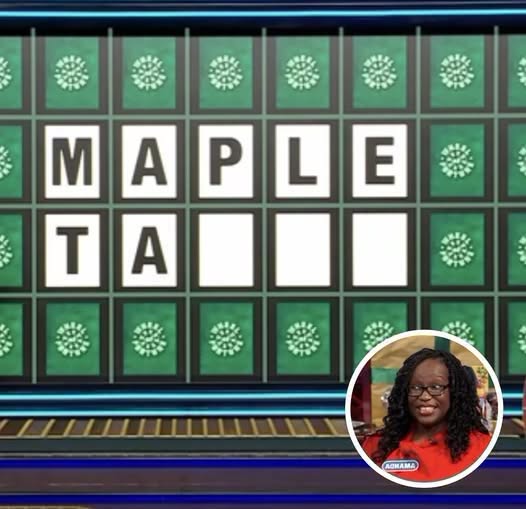
When those letters appeared, the puzzle became:
MAPLE TA_ _ _
For viewers watching at home, the answer may have seemed obvious.
But inside the studio, with the countdown running and a major prize at stake, Brown had only seconds to work it out.
She Was So Close to the Correct Answer
As the timer began, Brown started testing possible solutions aloud.
She tried variations including “Maple Takes” and “Maple Tazzy.”
Neither was correct.
She continued searching for the missing letters.
Then she approached the right answer.
“Maple Taffy.”
It was the correct solution.
But the timing created a problem.
As Brown reached the answer, the buzzer sounded, signaling the end of the allotted time.
For a brief moment, it was unclear whether her response would count.
And the uncertainty was obvious to host Ryan Seacrest.
Ryan Seacrest Turned to the Judges
Instead of immediately celebrating, Seacrest sought clarification.
He asked the judges whether Brown had completed the answer before time expired.
The response was unfavorable.
Her complete correct solution had not been accepted within the time limit.
Seacrest informed Brown of the decision.
She had not won the Bonus Round.
It was an especially painful result because the correct answer had been so close.
The difference between success and disappointment appeared to come down to a fraction of a second.
And the contents of the prize envelope made the moment even harder.
The Envelope Contained $40,000
After the unsuccessful solve, the Bonus Round envelope revealed what Brown could have won.
Inside was a $40,000 cash prize.
Had her answer been accepted, her total winnings would have risen from $22,878 to $62,878.
Instead, she left with the cash and prizes she had already secured during the main game.
It was still a significant achievement.
Many contestants never reach the Bonus Round, much less finish the main game with more than $20,000 in winnings.
But the possibility of an additional $40,000 made the ending particularly memorable.
And once viewers began discussing the footage, the controversy grew.
Viewers Questioned Whether the Judges Got It Right
After the episode aired, fans began sharing their reactions online.
Some believed Brown had said the correct answer before the buzzer.
Others thought the timing was too close to justify rejecting her response.
Several viewers suggested that the production team should have examined the footage more closely before making a final decision.
One commenter argued that the answer should have counted because Brown appeared to begin saying it as time expired.
Another believed the judges should have reviewed the moment during a commercial break.
The reactions reflected a familiar source of frustration in televised competitions.
When a contestant comes extremely close to winning a major prize, viewers often focus on whether the rules were applied fairly.
But there was an important detail in this case that complicated the debate.
Did She Say the Correct Answer Before the Buzzer?
The controversy was not simply about whether Brown had figured out the missing word.
It was about whether she had completed the full correct puzzle response before the time limit.
Detailed fan recaps of the episode noted that Brown appeared to say the word “Taffy” shortly before the buzzer.
However, her complete response of “Maple Taffy” came after the buzzer, according to those recaps.
That distinction matters.
Correctly identifying one word in a two-word puzzle is not necessarily equivalent to completing the entire solution.
Some viewers argued that her earlier attempt demonstrated she had already figured it out.
Others maintained that the judges were right to require the full phrase within the allotted time.
The show’s ruling was that Brown had not completed the correct response soon enough.
There is no verified evidence that the judges subsequently reversed that decision.
Why a Fraction of a Second Can Matter So Much
Game shows depend on consistent rules.
Contestants must operate within time limits, follow the required procedures, and provide answers in the form the game accepts.
Those requirements can sometimes produce frustrating results.
A player may know an answer but fail to say it clearly.
Another may solve a puzzle just as the timer expires.
And occasionally, the difference between a large prize and no additional winnings is so small that viewers disagree about what they heard.
Brown’s Bonus Round became a particularly memorable example.
She was not struggling with an impossible puzzle.
She had reached the correct answer.
But the timing of her complete response determined the outcome.
That is what made the moment so disappointing for many fans.
Some Fans Examined the Footage More Closely
The debate continued after viewers began examining recordings of the final seconds.
Some fans slowed down the footage to compare Brown’s speech with the buzzer.
Discussions on Reddit focused on the timing of individual words and whether a partial response could qualify as a completed solution.
One analysis suggested the timing difference was extremely small.
However, such viewer-created examinations are not the same as an official technical ruling.
Different recordings, playback methods, and interpretations can produce different impressions of the sequence.
The important established fact is that the judges did not accept Brown’s final answer.
Whether viewers personally agreed with the decision became the central controversy.
Why Some Viewers Believed She Deserved the Money
Those who supported Brown’s position generally focused on how close she came to the correct answer.
She had already demonstrated strong puzzle-solving ability throughout the episode.
She had selected useful letters.
And she had worked her way toward the solution before time expired.
For some viewers, those circumstances made the result feel especially harsh.
They believed that the answer and buzzer were close enough that she should have received the benefit of the doubt.
Others felt that a more detailed review might have produced a different outcome.
These were opinions expressed by viewers, not findings that the show’s rules had been violated.
And another group of fans saw the situation differently.
Why Other Viewers Defended the Ruling
Not everyone believed Brown had been treated unfairly.
Some fans argued that the rules needed to be applied consistently, regardless of the amount of money involved.
They pointed out that the correct full phrase was the requirement, not simply recognizing the missing word.
Under that interpretation, Brown’s response was too late.
Others emphasized that making exceptions in close cases could create questions about how future contestants would be treated.
A game show must be able to explain why one answer is accepted and another is rejected.
Even a sympathetic contestant cannot automatically receive a prize if the conditions for winning have not been met.
That argument does not make the moment any less disappointing.
But it helps explain why some viewers believed the judges’ decision was defensible.
The Puzzle Itself Was Surprisingly Simple
Another detail made the controversy especially interesting.
The correct answer was “Maple Taffy.”
Maple taffy is a traditional sweet treat associated particularly with Canada.
It is commonly prepared by pouring heated maple syrup onto snow or another cold surface, allowing it to cool into a chewy candy-like consistency.
For people familiar with the treat, the partially revealed puzzle might have been relatively easy to solve.
But familiarity varies.
Someone who has never encountered maple taffy may not immediately recognize the phrase.
And the pressure of appearing on national television can make even a straightforward puzzle more challenging.
Brown’s series of guesses illustrated how quickly the mind can move between possibilities when time is running out.
Her Family Watched the Dramatic Finish
Brown’s family had joined her for the Bonus Round, adding an emotional dimension to the final moments.
Her husband, mother, and daughters were there as she attempted to win the additional cash prize.
For a contestant, reaching that stage of Wheel of Fortune can be a once-in-a-lifetime experience.
It is an opportunity to celebrate with loved ones while competing for an amount of money that could make a meaningful difference.
Brown had already earned a vacation and a substantial prize total.
But the possibility of leaving with more than $62,000 made the stakes even higher.
When the judges rejected the final answer, the dream of that additional prize ended immediately.
The outcome became one of the most discussed moments of the episode.
She Still Left With an Impressive Prize Package
Despite the Bonus Round disappointment, Brown’s appearance was far from unsuccessful.
She finished the game with $22,878 in cash and prizes.
Her winnings included a trip to Walt Disney World.
She also demonstrated confidence during the main game, successfully solved multiple puzzles, and took advantage of the Express Train feature.
Her performance earned her a place in the Bonus Round ahead of the other contestants.
Those accomplishments remained unchanged by the judges’ final ruling.
Although the $40,000 opportunity was lost, the winnings she had already accumulated were hers to keep under the show’s prize arrangements.
That distinction is important when describing what happened.
Brown did not have $40,000 removed from an existing prize total.
She missed the opportunity to win an additional $40,000 because her final answer was ruled too late.
Why Wheel of Fortune Moments Like This Attract So Much Attention
Wheel of Fortune has entertained audiences for decades by combining word puzzles, chance, and time pressure.
Part of its appeal comes from the fact that viewers can play along from home.
People watching on television often try to solve the puzzle before the contestant.
When they recognize an answer, they may feel as though they are participating in the competition themselves.
That connection can make close calls particularly emotional.
Viewers may believe they heard a correct answer.
They may disagree with a host’s interpretation or a judge’s decision.
And when a substantial cash prize is involved, the stakes can feel even more dramatic.
Brown’s episode contained all the elements of a memorable television moment.
A strong contestant.
A major prize.
A recognizable puzzle.
And a final answer delivered almost simultaneously with the buzzer.
The Difference Between Knowing the Answer and Winning
One of the most frustrating aspects of competitive games is that recognizing the correct answer does not always guarantee success.
Contestants must also satisfy the rules of the competition.
They may need to respond before a timer expires.
They may have to pronounce a phrase clearly.
And they may need to provide the complete solution rather than a partial guess.
Brown’s experience highlighted that distinction.
By the end of the Bonus Round, she had arrived at the correct answer.
But according to the judges, she had not delivered the complete solution in time.
For viewers who felt she deserved the prize, the result was disappointing.
For those who supported the ruling, it was an example of why timing requirements must remain consistent.
Both reactions helped turn a brief television moment into a much larger conversation.
Was the $40,000 Decision Ever Reversed?
Following the December 2025 broadcast, reports focused on the disagreement among viewers and the judges’ original decision.
There has been no verified public announcement establishing that Brown was subsequently awarded the additional $40,000.
Her reported winnings from the episode therefore remain $22,878 in cash and prizes.
Claims that the show admitted an error or officially overturned the result should not be treated as fact without reliable confirmation.
The controversy was primarily a dispute among viewers about the timing and interpretation of the final answer.
One Buzzer, One Answer, and a Moment Fans Remember
For Amanda Brown, the December 5 episode of Wheel of Fortune was both a major success and a frustrating near miss.
She played an impressive main game.
She won a vacation.
She secured more than $22,000 in cash and prizes.
And she advanced to the final puzzle with the chance to win another $40,000.
But as the timer expired, her correct answer came too late to satisfy the judges.
The resulting decision divided viewers and inspired close examination of the final seconds.
Some believed she had been denied a prize she deserved.
Others felt the rules had been applied correctly.
What everyone could agree on was how close she came.
Because after an impressive night of solving puzzles, Brown’s opportunity to turn $22,878 into $62,878 ended with a single buzzer.
And that was enough to make her final round one of the most talked-about Wheel of Fortune moments of December 2025.
Do you think Amanda Brown’s answer should have counted, or were the judges right to enforce the time limit? Share your opinion in the comments.