
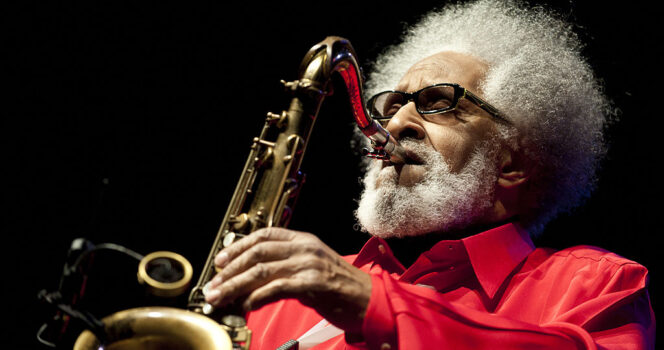
Sonny Rollins, Jazz Saxophone Legend, Dies at 95
A Towering Figure in Jazz History
Sonny Rollins, one of the most influential jazz musicians of all time, has died at the age of 95.
The legendary saxophonist passed away Monday afternoon at his home in Woodstock, New York. No official cause of death was revealed.
Known worldwide as the “Saxophone Colossus,” Rollins helped reshape modern jazz with a sound that was bold, inventive, emotional, and unmistakably his own.
Early Life and Musical Beginnings
Born Walter Theodore Rollins in Harlem in 1930 to parents of Virgin Islands heritage, Rollins grew up surrounded by music, rhythm, and Caribbean cultural influence.
His connection to the saxophone began at a very young age.
“My mother gave me my first saxophone, an alto saxophone, when I was 7 years old. I got the saxophone and I went into the bedroom and I started playing — that was it,” Rollins once recalled. “I was in seventh heaven.”
By his teenage years, Rollins was already performing with musicians who would later become central figures in jazz.
Rise During the Bebop Era
Rollins emerged during the bebop movement and quickly became known as one of its brightest young voices.
He performed and recorded alongside major names including Miles Davis, Thelonious Monk, John Coltrane, Dizzy Gillespie, and Max Roach.
His playing stood out for its confidence, imagination, and ability to turn a solo into a complete musical story.
For listeners and fellow musicians, Rollins was not only technically brilliant, but deeply expressive.
A Difficult Chapter and a Powerful Comeback
Rollins’ path was not without hardship.
In the early 1950s, he struggled with heroin addiction and spent time in jail after committing armed robbery to support his habit.
He later spoke openly about the shame and isolation connected to that period of his life.
“I alienated everybody except my mother.”
After getting clean in 1955, Rollins entered one of the most celebrated creative periods of his career.
Albums such as Saxophone Colossus, Way Out West, Freedom Suite, and The Bridge helped establish him as a defining artist of modern jazz.
The Sound That Changed Jazz
Rollins’ improvisation was fearless and constantly evolving.
His solos could be playful, searching, intense, spiritual, and deeply human within the same performance.
Fellow saxophonist Branford Marsalis once called him “The greatest improviser in the history of jazz.”
President Barack Obama also honored Rollins with the National Medal of the Arts, saying the musician inspired him “to take risks that I might not otherwise have taken.”
The Williamsburg Bridge Years
One of the most famous chapters of Rollins’ life began in 1959, when he stepped away from public performance at the height of his fame.
Dissatisfied with his own playing, he withdrew from the spotlight and practiced for hours on New York’s Williamsburg Bridge so he would not disturb neighbors.
“What made me withdraw and go to the bridge was how I felt about my own playing,” he later explained. “I knew I was dissatisfied.”
That period of intense personal discipline later inspired his comeback album, The Bridge.
A Career of Constant Reinvention
Across the decades, Rollins refused to remain fixed in one style.
He explored Latin jazz, avant-garde improvisation, funk, R&B, and other musical directions while keeping his own voice at the center.
He also collaborated with The Rolling Stones on “Waiting on a Friend.”
Drummer Charlie Watts once said, “When he stands and plays, there isn’t a saxophone player who doesn’t look on in awe.”
Surviving 9/11 and Continuing Through Music
Rollins also endured deeply painful moments away from the stage.
During the September 11 attacks, he escaped his New York apartment near the World Trade Center carrying only his saxophone.
Days later, he performed a powerful concert in Boston that became the Grammy-winning album Without a Song: The 9/11 Concert.
“I lost many prized possessions in 9/11 and learned a lesson – possessions are not where it’s at,” he later reflected.
Final Years and Lasting Legacy
Rollins officially retired in 2014 after being diagnosed with pulmonary fibrosis, a lung disease that made it impossible for him to continue playing.
“My main problem is that I can’t blow my horn anymore,” he said during the pandemic years.
Even after retirement, his devotion to music remained alive.
“Hope burns eternal,” he said in 2020. “I still have hopes of improving and sounding better and making a better record.”
Rollins also left behind words that reflected his spiritual view of life and creativity.
“I think when the creative person ends, he continues in the next existence. I’m a person who believes this life isn’t the be-all and end-all of everything. A spiritual person doesn’t feel like that.”
For generations of musicians and listeners, Sonny Rollins was more than a performer. He represented the restless, searching spirit of jazz itself.
His horn may now be silent, but the sound he created will continue to echo for generations.