
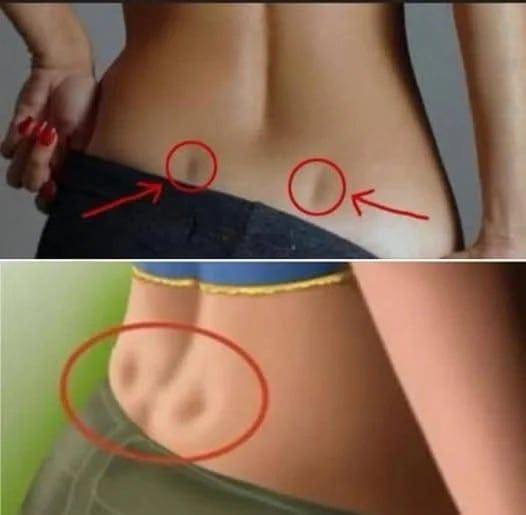
What Lower Back Dimples Really Mean
A Common Feature That Draws Attention
Small indentations on the lower back are often referred to as Venus dimples or Apollo dimples. They tend to stand out visually, which is why they often attract attention and curiosity.
Despite the interest surrounding them, their meaning is much simpler than many assume. They are not a marker of attractiveness, fitness level, or overall health on their own.
They are simply a natural variation in human anatomy, present in some individuals and absent in others.
Understanding the Anatomy Behind Them
These dimples are located over a specific bony point in the pelvis. In certain individuals, the skin in this area is more tightly connected to underlying ligaments and bone structures.
This tighter connection creates a slight indentation that becomes visible on the surface of the skin. In others, the same region may appear completely smooth.
The difference comes down to structural factors such as bone shape, ligament placement, and how the body distributes fat in that region.
These elements are largely determined by genetics and natural body composition, which means they are not something a person can fully control.
Why Not Everyone Has Them
The presence or absence of lower back dimples is not a reflection of effort, discipline, or lifestyle choices. It is primarily influenced by how the body is built.
Two individuals with similar fitness levels may look very different in this area. One may have visible dimples, while the other may not, even with similar routines and habits.
This reinforces the idea that these features are not something to be “earned” but rather something that either naturally appears or does not.
What Can Influence Their Visibility
While the underlying structure cannot be changed, certain factors may influence how noticeable these dimples appear.
Lower body fat levels can make natural contours more defined. When there is less fat covering the area, subtle features may become easier to see.
Muscle development can also play a role. Strengthening the muscles of the lower back and glutes can create clearer lines and improved definition around the pelvis.
However, these changes do not guarantee the appearance of dimples. If the anatomical structure is not present, they may remain invisible regardless of fitness progress.
The Misconception of “Achieving” Them
There is a common tendency to treat certain physical features as goals. Lower back dimples are sometimes included in that category, often viewed as something desirable to work toward.
In reality, they do not function like measurable fitness outcomes such as strength, endurance, or mobility. They are not a reliable indicator of progress.
Focusing too much on a single visual detail can lead to unrealistic expectations and unnecessary comparison with others.
Understanding their true nature helps shift attention toward more meaningful and achievable health goals.
A More Balanced Approach to Fitness
Instead of focusing on small visual traits, a more effective approach is to build overall strength and stability. The posterior chain, which includes the glutes, lower back, and core, plays a major role in daily movement and long-term health.
Strengthening these areas can improve posture, reduce strain on the spine, and support better balance and coordination.
Exercises such as glute bridges, back extensions, and core stability work contribute to these outcomes. Deadlifts, when performed with proper form, can also help build strength across multiple muscle groups.
These benefits are practical and long-lasting, regardless of whether visible dimples appear.
Why Function Matters More Than Appearance
The body is designed to move, adapt, and support everyday activity. While appearance can change over time, functional strength has a direct impact on quality of life.
Improved posture can reduce discomfort, while stronger muscles can lower the risk of injury. These outcomes matter far more than small surface-level details.
When fitness is approached with a focus on function, the results tend to be more sustainable and meaningful.
Individual Differences Should Be Expected
Every body is built differently. Variations in structure, shape, and composition are part of what makes human anatomy diverse.
Lower back dimples are just one example of these natural differences. Some people have them prominently, others faintly, and many not at all.
None of these variations indicate anything better or worse. They simply reflect how the body is naturally formed.
Letting Go of Unnecessary Standards
It is easy for small features to become exaggerated into standards, especially when they are frequently highlighted or discussed.
However, not every visible trait carries deeper meaning. Lower back dimples are a reminder that not all physical characteristics need to be evaluated or pursued.
Letting go of these expectations allows for a more realistic and positive view of the body.
Final Perspective
Lower back dimples are a natural anatomical feature that may or may not be present. They are shaped by factors that are mostly outside personal control.
While certain lifestyle choices can influence overall body composition and muscle definition, they cannot guarantee the appearance of these indentations.
The most effective approach is to focus on strength, consistency, and overall well-being.
When attention is placed on how the body functions rather than how it looks, the results are more balanced and sustainable.
In the end, whether these dimples are visible or not, the body settles into its own natural form—and that is exactly where it is meant to be.