
Tiny Stick Insect Eggs Resembling Miniature Watermelons Fascinate Social Media Users
A striking macro photograph reveals how camouflage, seed-like shapes, and cooperation with ants help these delicate insect eggs survive on the forest floor.
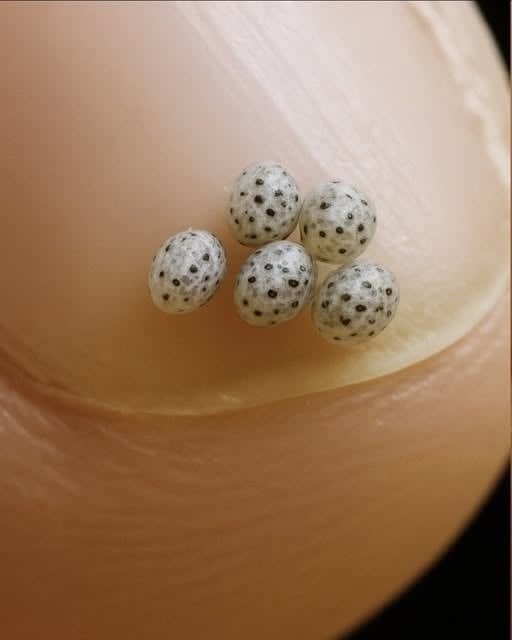
A remarkable close-up image circulating on social media has drawn widespread attention by showing five tiny objects balanced on the tip of a human finger. Their rounded shape, greenish appearance, and dark spots make them look surprisingly similar to miniature watermelons.
At first glance, many viewers may assume the objects are unusual seeds, tiny fruits, or decorative beads. Their polished surfaces and carefully patterned markings appear almost too detailed to belong to something found naturally in the insect world.
The objects are actually the eggs of stick insects, members of the insect group known as Phasmida. These insects are famous for their ability to blend into branches, twigs, leaves, and other parts of their natural surroundings.
The macro photograph provides an unusually detailed look at an early stage of the stick insect life cycle. Although the eggs are extremely small, their complex structure demonstrates how even the tiniest features can play an important role in survival.
Why the Eggs Look Like Tiny Seeds
The resemblance between stick insect eggs and plant seeds is not simply an attractive coincidence. Their appearance functions as a form of protection in environments where small, exposed objects can easily become food for birds and other foraging animals.
Stick insects commonly release their eggs loosely onto the forest floor. Instead of placing them in a visible nest or keeping them attached to a branch, the insects allow the eggs to fall among leaves, soil, seeds, and small stones.
Once the eggs reach the ground, their unusual shape becomes an important defense. An egg that resembles a seed or speckled pebble is less likely to be recognized immediately as something edible.
The dark markings on the shell strengthen the disguise. Rather than appearing smooth and uniform, the spotted surface helps each egg blend into the scattered natural material covering the ground.
For a bird searching quickly for food, the egg may appear no different from the countless seeds and fragments lying nearby. This visual confusion can give the developing insect a greater chance of remaining undisturbed.
Camouflage Begins Before Hatching
Stick insects are widely recognized for their extraordinary camouflage after they hatch. Their long bodies, narrow legs, and carefully matched coloring allow them to resemble the vegetation around them.
Some can remain almost motionless against branches, making it difficult for predators to distinguish the insect from the plant itself. The egg stage shows that this reliance on disguise begins long before the young insect emerges.
While adult stick insects may imitate twigs or leaves, their eggs imitate small objects commonly found on the forest floor. The form of the disguise changes with the insect’s stage of life, but the purpose remains the same.
Remaining unnoticed can be more effective than attempting to escape. An egg cannot run, fly, or defend itself physically, so its outer appearance becomes one of its most valuable protections.
The tiny shell therefore serves more than one purpose. It protects the developing embryo while also helping conceal it within a complex natural environment filled with potential predators.
A Survival Strategy Shaped Over Time
The seed-like design of stick insect eggs reflects a survival strategy developed over millions of years of evolution. Eggs with features that improved concealment were more likely to remain safe long enough for the insects inside them to hatch.
Across many generations, these protective characteristics became increasingly refined. Shape, texture, color, and surface markings combined to produce eggs that fit naturally among seeds, pebbles, and forest debris.
The result is visible in the circulating macro image. What appears to be a playful miniature fruit is actually a carefully developed biological structure adapted to a dangerous environment.
The photograph also shows how scale can hide complexity. From a distance, a stick insect egg might look like an ordinary grain or tiny piece of soil, but magnification reveals patterns and shapes that are difficult to notice with the unaided eye.
These details demonstrate that natural defenses do not always depend on strength, speed, or aggression. For some organisms, survival depends on being overlooked entirely.
Why Stick Insects Drop Their Eggs
Dropping eggs onto the ground may initially seem risky because it leaves them separated and exposed. However, scattering the eggs can prevent them from being concentrated in one easily discovered location.
If all the eggs remained together in a visible cluster, a single predator could potentially find and consume many of them at once. Loose distribution allows individual eggs to settle in different hiding places.
Leaves, small stones, soil, and plant material create a naturally uneven surface. The scattered eggs can disappear into this background, where their seed-like appearance provides additional protection.
The strategy does not require the parent insect to build or guard a nest. The egg’s shape and outer structure perform much of the protective work after it reaches the ground.
This method highlights the close relationship between an organism and its habitat. The forest floor is not merely the place where the eggs land; it is an essential part of the camouflage system that helps keep them hidden.
The Surprising Role of Ants
The relationship between some stick insect eggs and ants adds another remarkable layer to their survival strategy. Certain eggs possess a nutrient-rich structure at one end known as a capitulum.
This small feature attracts ants searching for food. To the ants, the capitulum offers a valuable fatty reward attached to an object that can be carried back to the colony.
After discovering an egg, ants may transport it into their underground nest. The movement might appear dangerous for the developing stick insect, but it can provide the egg with substantial protection.
Inside the colony, the ants consume the nutrient-rich knob without destroying the embryo. The main portion of the egg remains intact while the ants receive the food that attracted them.
This exchange benefits both sides. The ants gain nourishment, while the stick insect egg is moved away from many of the predators searching across the exposed forest floor.
An Underground Natural Incubator
Once carried below ground, the egg enters an environment that can function like a protected natural incubator. The underground colony shields it from birds and other animals that might otherwise detect it.
The nest also offers a more stable setting than the open surface. The egg remains surrounded by the protected interior of the ant colony until the young insect is prepared to hatch.
The ants do not need to recognize that they are helping a future stick insect. Their behavior is driven by the appealing capitulum, while the egg benefits from the transportation and shelter that follow.
This kind of interaction demonstrates how one species can take advantage of another species’ ordinary behavior without causing direct harm. The ants collect the food they want, and the embryo continues developing inside its protected shell.
The relationship is especially impressive because it depends on a tiny structure attached to an already tiny egg. A feature that could easily be missed by human eyes can influence the egg’s location and chance of survival.
Protection From Birds and Other Foragers
Birds and other animals regularly search through forest debris for insects, larvae, seeds, and other small sources of food. An exposed egg could be vulnerable if it were easily recognized.
The stick insect egg’s appearance creates the first level of defense. By looking like an ordinary seed or speckled stone, it may escape the attention of a predator scanning the ground.
If ants carry the egg underground, a second protective layer is added. The egg is no longer lying openly where visual hunters can find it.
These defenses work without movement or active resistance. The egg survives by misleading predators and, in some cases, encouraging another insect to transport it to safety.
The combination of camouflage and ant assistance shows how multiple small adaptations can support the same goal. Each feature increases the possibility that the embryo will remain protected until hatching.
Why the Image Captured So Much Attention
The social media photograph became popular partly because its subject is so unexpected. Most people are familiar with ordinary insect eggs as pale, smooth, or nearly invisible objects, but these examples appear colorful and carefully decorated.
The comparison with tiny watermelons makes the image instantly understandable and visually memorable. Viewers can recognize the resemblance even before learning what the objects truly are.
The human finger in the photograph also provides a clear sense of scale. Without that familiar reference, the eggs might appear much larger than they actually are.
Seeing five of them arranged together makes their shared pattern especially noticeable. Their similar shapes and spotted surfaces create the impression of a miniature collection of fruits resting on the fingertip.
The surprise comes from the difference between appearance and identity. Objects that seem playful or decorative are actually part of a sophisticated reproductive and survival system.
A Closer Look at the Hidden Insect World
Many important processes in nature occur at a scale that people rarely notice. Tiny eggs, microscopic structures, and subtle relationships between species often remain hidden beneath leaves or soil.
Macro photography brings these details into view. By enlarging a subject that would normally be overlooked, it allows people to see patterns that are essential to the organism’s survival.
The stick insect eggs demonstrate that biological complexity is not limited to large animals or dramatic landscapes. A structure small enough to rest several times on one fingertip can contain highly effective defenses.
Their shells combine physical protection with visual deception. Their capitula can influence ant behavior, and their placement on the forest floor allows them to blend into surrounding material.
Every part of the strategy works at a miniature scale, yet the final result supports the continuation of an entire species.
Nature’s Design Is Both Beautiful and Practical
The patterned appearance of the eggs may look artistic, but each detail serves a practical purpose. Their shapes help them resemble seeds, their markings make them less noticeable, and their specialized tips may attract ants.
This combination creates an example of natural beauty that is inseparable from function. What humans admire as an unusual design is also a tool that improves the egg’s chance of surviving.
The image reminds viewers that the most visually impressive structures in nature are not always created for display. Some patterns exist because concealment, deception, or cooperation can determine whether an organism lives long enough to reproduce.
Stick insect eggs do not need to announce their presence. Their success depends on appearing ordinary within the environment, even though a magnified view reveals how extraordinary they truly are.
A Tiny Masterpiece of Biological Engineering
The viral close-up offers more than an amusing comparison with miniature watermelons. It presents a detailed example of how life can adapt to danger through shape, texture, and interaction with other species.
By dropping their eggs onto the forest floor, stick insects place them in an environment where their seed-like disguise can work effectively. Birds and other foragers may overlook them, mistaking them for inedible natural debris.
The capitulum adds another possible route to safety by encouraging ants to move the eggs underground. There, the developing insects can remain protected while the ants consume only the nutrient-rich outer structure.
These features make the eggs far more than simple containers for embryos. They are specialized survival tools shaped to function within a complex ecosystem.
As the photograph continues circulating online, it gives viewers a reason to pause and examine forms of life that are usually ignored. The objects may fit easily on the tip of a finger, but the strategies contained within them reflect an enormous history of adaptation.
The image ultimately serves as a reminder that nature’s hidden wonders are often found in the smallest places. What appears to be a handful of miniature fruits is actually a remarkable collection of stick insect eggs, each equipped with an intricate design intended to protect the life developing inside.