
The Dog at the Fence Exposed the Terrifying Truth Behind Ruby’s Adoption
The Woman in the Rusted Blue Car
The rain had already soaked through my sweater when the rusted blue sedan disappeared around the corner. I remained on the sidewalk, staring at the empty road as a memory from the county courthouse returned with sudden, painful clarity.
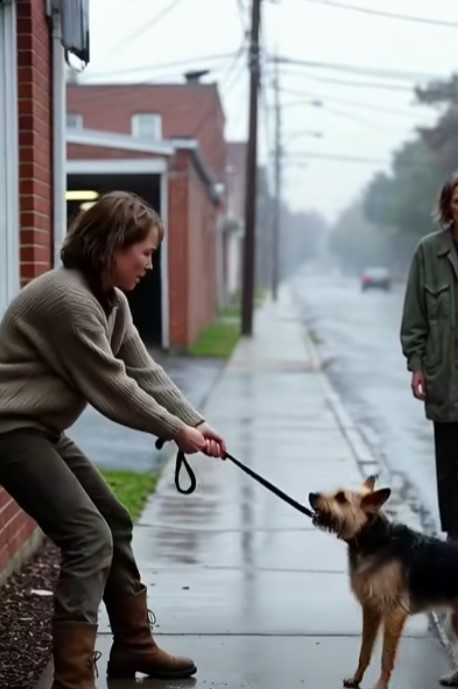
Barnaby stood beside me at the end of his leash. The old terrier had stopped barking, but his entire body trembled beneath his wet coat. A low, repeated cry escaped his throat, sounding less like an animal’s whimper and more like grief.
I crouched on the pavement and pulled him against me. “Okay,” I whispered. “Okay, buddy. Let’s go home.”
He resisted every step. His claws dragged across the wet concrete while he twisted his head toward the corner where the car had vanished.
By the time I managed to get him inside, the house no longer felt comforting. The rooms seemed sealed and unnaturally quiet, as though the walls were holding something I had not yet discovered.
I found a towel in the hall closet and began drying Barnaby on the entryway rug. Ruby came out of the living room wearing oversized fuzzy socks and looked down at him.
“Did he go potty?” she asked.
“He did,” I answered, hiding the shaking in my hands by rubbing the towel over Barnaby’s ears. “But he got very wet, so we came right back.”
Ruby watched me for another moment. “Did you see the other mom?”
The question seemed to stop the room around us.
I kept my eyes on the dog. “No, sweetie. No one was out there. Just us.”
Ruby accepted the answer with the easy trust of a child. She asked for a juice box, then disappeared into the kitchen.
I walked into Tom’s downstairs study and closed the door. With my forehead resting against the wood, I finally admitted what I had recognized the moment the driver turned toward me.
I knew the woman’s face.
A Memory From Family Court
Three years earlier, I had sat outside a courtroom on a cold Tuesday in November. The fluorescent lights above the hallway buzzed steadily while Tom held my hand and assured me that the hearing was only a formality.
He said Ruby’s biological mother was transient and had failed to attend any of the proceedings. He told me she was entirely out of the picture and that the judge would finalize the termination of her parental rights by default.
Then Tom entered the judge’s chambers alone.
While I waited, a woman in a faded green coat rushed down the corridor. Her hair had been pulled tightly away from her face, and her eyes were swollen and red. She approached a bailiff and began pleading with him in a quiet but desperate voice.
The bailiff shook his head. After a brief exchange, he pointed toward the elevators and escorted her away.
At the time, I assumed she was connected to another case. Family court hallways were filled with frightened parents, exhausted children and people whose lives had been reduced to folders and hearing schedules.
Now I understood that she had been there for Ruby.
Tom had seen her. Tom had known she came to the courthouse. Yet he had looked into my eyes and told me she had never appeared.
He was not expected home for another two hours. Whatever had been hidden from me, I had only a small window in which to find it.
I put an animated movie on for Ruby and settled her on the living room rug. Barnaby curled beside her, resting his chin on her knee.
Then I went upstairs.
The Lockbox in the Attic
The attic entrance was built into the ceiling of our master closet. I pulled the cord, and the folding wooden stairs lowered with a groan.
Cold, stale air met me as I climbed into the unfinished space. Dust covered the plywood floor, and the exposed insulation gave off a faint chemical smell. A single yellow bulb hung between the rafters.
Tom stored our holiday decorations and winter blankets near the entrance. Everything was labeled and arranged with the precision he brought to every part of his life.
I moved past the plastic containers toward the brick chimney at the rear of the attic.
Behind an unused humidifier sat a dark green metal box. Rust marked its corners, and a heavy brass padlock secured the latch.
Tom had carried it into the attic during our first week in the house. He described its contents as old property records, inactive client ledgers and documents that had to be retained for tax purposes.
I had never questioned him.
I dragged the lockbox into the light and examined the padlock. Searching for a key would take too long, so I returned to the garage and opened Tom’s carefully organized tool chest.
I selected a steel pry bar and a framing hammer.
Back in the attic, I wedged the pry bar against the lock and struck it. The impact echoed through the house.
I hit it twice more.
The brass casing split apart, releasing the shackle.
Inside the box were old passports, thick envelopes, financial papers and a black ledger. Beneath them rested a legal-sized manila folder marked with a handwritten sequence.
Case No. 448-R.
I recognized it immediately as Ruby’s case number.
The first pages appeared ordinary. They included foster-placement documents, medical forms and the final adoption decree carrying Tom’s name and mine.
Several pages later, the official state forms ended. In their place were documents printed on the watermarked stationery of Tom’s real estate law firm.
The document at the top was titled Settlement and Non-Disclosure Agreement.
It identified Thomas Vance, Esq., as the principal acting for Northgate Holdings LLC.
The second name was Maya Lin.
The Eviction That Was Never an Accident
The contract was not part of an ordinary adoption proceeding. It concerned an eviction.
Tom had told me that Ruby entered foster care after dangerous black mold and structural damage made Maya’s apartment uninhabitable. He portrayed the situation as the tragic result of severe poverty and neglect.
The papers revealed a very different chain of events.
Northgate Holdings had purchased Maya’s apartment building shortly before the condemnation. Tom owned the company through a corporate structure that concealed his direct involvement.
Within days of acquiring the property, the company began forcing tenants out. It declined to complete necessary repairs and used a municipal procedure to have the building declared unsafe.
Maya had not simply lost her home because a neglected building deteriorated.
Tom had obtained control of the building and accelerated the conditions that removed her from it.
The financial records showed what happened next. While Maya fought to secure housing and regain custody of Ruby, Tom’s firm delayed the return of her security deposit, prolonged the eviction dispute and increased the legal pressure against her.
Every step made her poorer. Every delay made it harder for her to satisfy the family court’s requirements.
Then, on the day scheduled for the final termination hearing, Tom offered her a choice.
The final pages showed that Maya agreed to abandon her appeal and leave the courthouse. In exchange, Tom authorized a payment of fifty thousand dollars into a trust account described as relocation assistance.
The agreement also contained a severe non-contact provision.
If Maya approached Ruby or either adoptive parent, Northgate Holdings could demand repayment of the money. Tom could also accuse her of harassment or extortion and seek criminal charges.
The arrangement was presented as a settlement, but it had functioned like a threat. Maya had been pushed into homelessness, deprived of the resources needed to fight and then offered money only after agreeing to disappear from her daughter’s life.
At the bottom of the folder, I found a handwritten note attached to an inventory of Maya’s surrendered belongings.
“I am doing this because you broke me. I have nothing left to fight you with. Take care of my little girl. And please, please let her keep the dog. Barnaby is the only piece of home she has left. Tell her I love her.”
A tear fell onto the page and blurred part of the ink.
Barnaby had never belonged to Ruby’s foster family. He had belonged to Maya and Ruby.
That explained why he waited near the fence. It explained why he recognized the rusted sedan and why the sight of the woman inside transformed his usual bark into a cry.
Maya had not casually abandoned her child or her dog. She had given Barnaby up because he was the last familiar piece of home Ruby could carry into a new life.
The house around me seemed to fracture.
Tom had comforted me through years of failed fertility treatment. He had held me while I cried and told him that I wanted a child more than anything.
His answer had been to destroy another mother’s stability and present her daughter to me as a child who had been left behind.
Tom Came Home Early
The front door opened downstairs.
A leather briefcase landed on the hall table, followed by Tom’s voice.
“Jenna? I’m home early. The bridge was clear.”
I remained frozen beside the open lockbox. The broken padlock lay near my knee.
His shoes struck the staircase.
“Jenna? Are you upstairs?”
I pulled out my phone and opened the camera. My hands shook so badly that I dropped it onto the plywood before managing to pick it up again.
I photographed the agreement, the payment ledger and Maya’s note. I made sure Tom’s name, the company information and the important clauses were clearly visible.
The attic ladder creaked beneath his weight.
I returned the folder to the lockbox and pushed it behind the humidifier. Then I hid the hammer, the pry bar and the pieces of the padlock beneath the blankets in a nearby storage bin.
“I’m up here!” I called.
Tom’s head appeared through the opening.
He had removed his jacket and tie, but his white dress shirt remained perfectly pressed. His gaze traveled through the attic, examining the boxes and the floor.
“What are you doing up here in the dark?” he asked.
I told him I was searching for a space heater because Ruby’s bedroom felt cold. He studied the attic for another moment, then suggested that the heater was probably in the basement.
I climbed down and pushed the attic stairs back into the ceiling.
Tom stood close enough for me to smell his sandalwood cologne. For ten years, that scent had meant comfort. Now it made me feel trapped.
He said Barnaby had been behaving strangely near the door and asked whether I had taken him outside.
I admitted taking him on a short walk but said nothing about the woman in the car.
Tom reminded me that he wanted the dog kept in the backyard because of coyotes. When I explained that Barnaby refused to use the yard, Tom became silent.
He stared through the bedroom window toward the road.
“Okay,” he finally said. “Just keep him inside tomorrow.”
The Address Hidden in the Contract
Tom slept beside me that night while I examined the photographs beneath the covers.
The contract listed a mailing address connected to Maya’s trust account. It belonged to a property management operation in Haarlem Noord, a working-class district about twenty minutes away.
I memorized the location and reread the penalty clause.
The money had never been a gift intended to help Maya rebuild. It was a mechanism for controlling her. As long as she depended on the remaining funds, she had to stay silent and away from Ruby.
The next morning, Tom left for his law office at seven-thirty. I watched his silver Audi disappear before preparing Ruby for school.
At eight-fifteen, she boarded the bus.
Once she was gone, I picked up my car keys and called Barnaby.
The old dog immediately left his place near the kitchen vent and sat at the front door.
I fastened the leash to his collar. “Let’s go find her.”
Unit 12
The address led to a deteriorating single-story motel that had been converted into long-term efficiency units. Paint peeled from the cinderblock walls, and rainwater filled the potholes across the parking lot.
I parked near a chain-link fence.
Three spaces away sat the same rusted blue sedan.
When Barnaby stepped out of the car, he lowered his nose and moved toward a green door at the far end of the building. He did not pull wildly. He walked with quiet certainty.
The number attached to the door was 12.
I knocked three times.
No one answered at first. Barnaby whimpered and scratched at the threshold.
A deadbolt turned. The door opened slightly, stopped by a security chain.
Maya’s face appeared in the narrow space. Her gaze moved from me to Barnaby.
“Barnaby,” she breathed.
The dog pressed his nose into the opening. Maya reached down and touched his head with trembling fingers.
When I said her name, fear overtook her expression. She tried to close the door, but Barnaby placed his paws against the frame.
“Please,” she whispered. “Please, Mrs. Vance. I didn’t break the contract. I swear to God. I never spoke to her. I never stepped on your property. I just stayed in the alley. I just wanted to see how big she was getting. Don’t let him take the money. If he takes the money, I’ll be back on the street. Please.”
I quickly told her Tom did not know I was there.
Then I told her about the lockbox, Northgate Holdings and the eviction documents.
Maya stared at me for several seconds before removing the security chain.
The room behind her was painfully small. It smelled of damp fabric and inexpensive coffee. Her faded green coat rested on a plastic chair.
She dropped to the floor and wrapped her arms around Barnaby.
Her face disappeared into his wiry coat as her shoulders shook. Barnaby licked her face and pressed himself against her as though trying to recover three lost years in a single moment.
Maya’s Version of the Story
When Maya finally stood, she remained cautious.
I told her that Tom had described her as a drug addict who destroyed her own apartment. I admitted believing she had abandoned Ruby.
Maya’s answer was immediate.
“I would never leave my daughter,” she said.
She had worked long shifts at a laundry and earned little money, but she and Ruby had survived. Their problems began when pipes above their apartment leaked and the owner refused to make repairs.
Moisture spread through the unit. Mold followed.
Then Tom’s company acquired the building.
I told Maya I believed Tom had forced the tenants out for financial reasons.
She looked at me with an expression I could not understand at first. It was not anger. It was pity.
She explained that Tom had not discovered Ruby while reviewing property documents.
A month before the sale, Maya regularly took Ruby to Nelson Park. The park was only a few blocks from Tom’s law firm.
Maya saw Tom sitting near the swings on three separate weekends. He wore an expensive suit, held a cup of coffee and watched Ruby play.
He showed little interest in the other children.
Four weeks later, eviction notices carrying the name of his company appeared on Maya’s door.
The conclusion was inescapable.
Tom had not adopted Ruby after unexpectedly finding a vulnerable child in the foster system.
He had selected her first.
The Machinery Used Against a Mother
I remained in the motel room while Maya prepared coffee on a hot plate. Barnaby followed her from one side of the kitchenette to the other, keeping his body close to her legs.
Over the next hour, Maya described how completely Tom had controlled the process.
The inspector who condemned the apartment building arrived in a vehicle leased through Northgate Holdings. After the eviction, Maya applied for every affordable apartment she could find.
Each application was rejected within a day. Landlords referred vaguely to liability concerns and damaging information provided by a corporate legal contact.
Tom had not only removed Maya from one apartment. He had made it nearly impossible for her to obtain another.
Without stable housing, she could not satisfy the family court. Without custody of Ruby, she struggled to qualify for some forms of assistance. Without money, she could not hire an attorney capable of confronting Tom’s firm.
Every system pushed her toward the settlement he had prepared.
By the time she signed, she had not eaten for three days. Ruby was ill, and Maya believed entering a shelter would guarantee that her daughter became a permanent ward of the state.
Tom presented the agreement as an act of compassion.
“He said he was offering me a mercy,” Maya told me.
“It wasn’t mercy,” I replied. “It was a ransom.”
A Decision That Could Not Be Reversed
I opened the photographs on my phone and examined Tom’s signature.
Then I told Maya to pack a bag.
She refused at first. The motel property manager communicated with Tom’s firm, and she believed leaving the registered address would trigger the contract’s repayment provision.
I told her the agreement was evidence of what Tom had done, not a legitimate instrument she should continue obeying.
His plan depended on two assumptions: that I would never find the lockbox and that Maya would remain too frightened and poor to challenge him.
Both assumptions were now wrong.
I asked Maya to stay inside with the door locked until I contacted her later that afternoon. Then I placed Barnaby in my car.
He looked back toward Unit 12 but did not resist. For the first time since the woman appeared near our home, he seemed calmer.
I drove directly to a downtown office building.
The Attorney Who Could Bring Down the Wall
Diane Miller was an experienced family law attorney whom I had met while treating her mother at my physical therapy clinic. After months of rehabilitation helped her mother walk again, Diane made me a promise.
“If you ever need a wall kicked down, Jenna, you call me.”
I entered Diane’s conference room and placed my phone on the polished table.
She silently reviewed each photograph. Her expression hardened as she read the payment records and the non-contact clause.
Diane identified several serious conflicts. Tom had acted for the company that purchased the building, directed the eviction process, participated in the adoption and drafted the financial agreement that removed Maya from the case.
His actions potentially involved fraud upon the court, coercion and extreme violations of legal ethics.
I asked whether he could reclaim the fifty thousand dollars.
Diane said the contract was an illegal instrument and could not legitimately be enforced. Tom relied on Maya’s inability to afford a challenge, not on the strength of the agreement.
She also warned me that taking action would destroy my marriage and probably end Tom’s career.
I had already accepted that.
I instructed Diane to seek an emergency order granting me temporary sole physical custody of Ruby. I also asked her to deliver the evidence to the state ethics board and the district attorney before Tom returned home.
Diane began preparing the filings.
I went to get my daughter.
Leaving the House Tom Built
At one-thirty, I signed Ruby out of school and told the office she had an unexpected dental appointment.
When she reached the hallway wearing her backpack, I helped fasten her coat and explained that we were going to stay in a hotel.
Ruby treated the plan like an adventure.
We arrived home shortly after two o’clock. I sent her upstairs to collect books, clothes and her favorite stuffed animals.
In the master bedroom, I pulled a suitcase from the closet and filled it quickly. I believed I had at least ten minutes before Tom’s usual schedule brought him home.
Then the front door closed downstairs.
“Jenna?”
His voice carried through the house, flat and controlled.
I gripped the suitcase and stepped onto the landing.
Tom stood in the foyer wearing his charcoal suit with his tie loosened. The shattered pieces of the brass padlock rested in his right hand.
He had found the lockbox.
He said a neighborhood notification informed him that school had ended early. After seeing my car in the driveway, he returned home.
Then he asked why Ruby was there.
I pulled the suitcase down the stairs and stopped near the bottom.
“You stalked them at Nelson Park,” I said.
Tom did not deny it. His face settled into the emotionless expression he used during difficult legal negotiations.
He accused me of searching his private files.
I told him I had found Northgate Holdings, the settlement and the records showing how he forced Maya out of her home.
“You didn’t adopt a child who needed a home,” I said. “You destroyed a family to steal one.”
Tom’s Justification
Tom released a frustrated breath, behaving as though I had misunderstood a reasonable business transaction.
He reminded me of the year before Ruby entered our lives. I had struggled to enter stores where baby products were displayed. The fertility specialists had given us no realistic chance of having a biological child, and the foster process appeared endless.
He claimed Maya had been raising Ruby in squalor and could barely provide food.
He insisted that the fifty-thousand-dollar payment gave Maya an opportunity to begin again.
In Tom’s mind, he had solved several problems at once. He gave Maya money, gave Ruby a wealthy home and gave me the child I desperately wanted.
He called it building a family.
I called it a crime scene.
When I reached the foyer, Tom looked toward the second floor and told me I would not be taking Ruby.
He reminded me that his name appeared on the adoption decree and that he was a partner at one of the county’s most powerful real estate firms.
If I left, he threatened to drag me through litigation until I had no money left. He said he would make certain I never saw Ruby again.
The Evidence Was Already Gone
Tom expected his position and resources to frighten me into surrendering.
Instead, I told him Diane Miller had already filed for emergency relief.
The state ethics board had copies of the agreement and financial ledger. The district attorney had evidence connecting him to Northgate Holdings.
The contract that had controlled Maya for years was no longer his weapon.
The color disappeared from Tom’s face.
The fragments of the padlock slipped from his hand and struck the floor.
For the first time, I watched him confront a problem that he could not manage with paperwork, money or intimidation. He knew Diane’s reputation. He understood how prosecutors would interpret a secret agreement forcing a poor mother to surrender contact with her child.
His voice softened.
“Jenna,” he whispered. “Jenna, I did it for us.”
I called Ruby downstairs.
She appeared with her bright pink backpack and immediately sensed that something was wrong.
“Are you coming to the hotel, Daddy?” she asked.
Tom looked at her but could not answer.
I took Ruby’s hand and told her that he was staying behind.
Barnaby emerged from the kitchen. He kept his distance from Tom and pressed himself against my leg as we crossed the foyer.
I closed the oak door without looking back.
Six Months of Legal Consequences
Six months later, the spring air carried the scent of tulips through Nelson Park.
The consequences for Tom had unfolded publicly and rapidly. His law firm ended its relationship with him on the day prosecutors issued an indictment involving wire fraud and extortion.
His license to practice law was taken away while he awaited trial.
The carefully ordered life he had constructed was dismantled through court filings, financial examinations and public proceedings.
The custody case was more complicated.
The court had to consider both the unlawful way Maya lost her rights and the emotional damage Ruby could suffer if she were suddenly removed from the only daily home she remembered.
Because I exposed Tom’s actions, separated from him and cooperated with the investigation, the court did not remove Ruby from my care.
At the same time, the coerced termination of Maya’s parental rights could not be allowed to stand.
With Diane’s advocacy, the judge approved a transitional joint-custody arrangement. It was not a simple solution, but it gave Maya the opportunity to rebuild her relationship with Ruby while protecting the child from another abrupt separation.
A Family Rebuilt Through Honesty
I stood at the edge of the playground holding a warm cup of coffee.
Maya sat on a bench near the swings. She wore a new wool coat purchased after Tom’s former partners agreed to release early settlement funds.
The exhaustion that once hollowed her face had begun to fade.
Ruby climbed across the monkey bars, then hung upside down and laughed.
“Look at me, Mom!” she shouted.
Maya and I both turned toward her.
Our eyes met across the playground, and we exchanged a quiet smile.
Sharing motherhood was unfamiliar and occasionally uncomfortable. There were difficult conversations, complicated emotions and years of lost time that could never be restored.
But unlike the family Tom constructed through manipulation, the relationship we were building rested on truth.
We were learning that loving Ruby did not require either of us to erase the other.
Barnaby slept in the grass beside Maya’s feet. Every few minutes, she dropped a fresh sugar snap pea near his nose.
The old dog opened one eye, ate the vegetable with a satisfied crunch and settled back into the sunlight.
After years of waiting at fences and listening for a familiar car, he no longer had to choose between the people he loved.
He was safe beside Maya, close to Ruby and surrounded by a family that had finally become whole.
The Courage to Expose a Hidden Wrong
The most important act in the story was not dramatic or violent. It was the decision to stop protecting a comfortable lie.
Jenna had believed her home, marriage and motherhood were built on compassion. Discovering the truth meant accepting that the person she trusted most had exploited another family’s poverty and pain.
Remaining silent might have protected her house, her finances and the appearance of a stable life. Speaking up placed all of those things at risk.
Yet silence would have allowed Tom’s control over Maya to continue.
By preserving the documents, contacting an independent attorney and acting before Tom could destroy the evidence, Jenna transformed a secret contract into a record of accountability.
Maya also found the opportunity to step out of the fear that had governed her life for three years. The agreement had convinced her that any attempt to see Ruby would cost her the small amount of security she had left.
Once the contract’s power was challenged, the truth became stronger than the threat.
Ruby could not recover the years she lost with Maya, and no court order could instantly repair the damage. However, she could grow up knowing that she had never been unwanted.
Her biological mother had not abandoned her. Her adoptive mother had not knowingly taken her. Both women had been deceived by the same man, and both ultimately chose Ruby’s well-being over possession and pride.
True family was not created by a signature, a payment or the destruction of someone else’s rights.
It was created in the park, through honesty, patience and the shared decision to place a child’s needs above the wounds of the adults around her.
Thank you for reading Jenna, Maya, Ruby and Barnaby’s journey. Their story is a reminder that confronting a hidden wrong can be costly, but refusing to expose it can cost far more.