
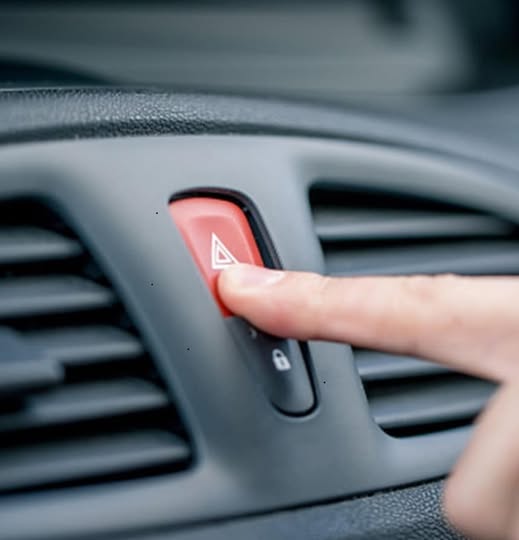
That Red Triangle on Your Dashboard Does Not Give You Permission to Park Anywhere
The unofficial “park anywhere” button drivers love to use
Drivers around the world seem to have discovered a mysterious piece of automotive technology capable of transforming almost any inconvenient stopping place into a temporary parking space.
Need to grab takeout? Press the glowing red triangle.
Stopping beside a busy curb for a few minutes? Red triangle.
Blocking part of a traffic lane while someone runs into a shop? Apparently, the same button comes to the rescue.
There is just one problem: the button does not actually provide any special parking privileges.
It is the vehicle’s hazard warning light switch.
What the red triangle actually controls
The triangular dashboard button activates the vehicle’s hazard warning lights, commonly called hazard lights, emergency flashers, or four-way flashers.
When switched on, the vehicle’s direction indicators flash simultaneously.
The purpose is straightforward. The lights make the vehicle more noticeable and warn other road users that something unusual or potentially hazardous is happening.
They do not transform a prohibited stopping area into a legal parking space.
They do not create a temporary loading zone.
And they certainly do not grant a driver several minutes of diplomatic immunity while collecting coffee, pizza, groceries, or a passenger who is supposedly coming outside any second.
Why drivers use hazard lights when stopping illegally
Despite their real purpose, hazard lights have developed an entirely different unofficial meaning in everyday driving culture.
To many motorists, switching them on seems to communicate something like, “Yes, I know I should not be stopped here, but I will only be a minute.”
It is almost an automotive apology.
The driver knows the location is questionable. Other drivers know it. Pedestrians know it. Yet once those four amber lights start blinking, the person behind the wheel somehow feels that the situation has been formally acknowledged.
The hazard lights do not solve the problem, but they make the driver feel slightly more responsible while creating it.
The classic takeout stop
Few situations demonstrate this habit better than the quick food pickup.
A driver approaches a restaurant and discovers that every legitimate parking space is occupied.
There is, however, a perfectly convenient piece of roadway directly outside the entrance.
The driver stops, presses the hazard button and disappears inside.
The car is now partially obstructing traffic, but the flashing lights apparently announce that this should not be interpreted as ordinary bad parking.
This is special bad parking.
There is takeout involved.
Somehow, the glowing lights seem to communicate that the driver’s fries are getting cold and everyone else should demonstrate patience.
Bus stops are another favorite location
The same imaginary privilege frequently appears at bus stops.
A driver sees a large open section of curb and decides it would be ideal for a brief stop.
The fact that the space exists specifically so a bus can safely pull alongside the curb becomes temporarily irrelevant.
Hazard lights go on, and the driver begins waiting.
When the bus arrives, it may have to stop farther into the roadway because the designated area is occupied.
That can make boarding more difficult and disrupt traffic behind the bus.
The blinking lights do not remove the obstruction. They simply make it easier for everyone to identify which vehicle is causing it.
The double-parking illusion
Another popular interpretation of the red triangle is that it can temporarily create an additional parking lane.
A driver pulls alongside legally parked cars, stops in an active traffic lane and switches on the flashers.
From inside the vehicle, the logic can feel almost reasonable.
The driver is visible. The car is clearly stopped. Everyone can simply drive around.
Unfortunately, every other road user now has to react to a vehicle occupying space intended for moving traffic.
Cars may have to merge unexpectedly. Cyclists can be forced away from their normal path, and visibility around the stopped vehicle may be reduced.
Again, the hazard lights announce the problem. They do not eliminate it.
Why the habit feels strangely legitimate
Part of the reason drivers rely on hazard lights in these situations is psychological.
Parking somewhere questionable without any signal can feel obviously wrong.
Pressing a button creates the impression that an official procedure has been followed.
There is a satisfying click. Multiple lights begin flashing. A dashboard indicator appears.
Suddenly, an ordinary illegally stopped car looks like a vehicle dealing with an important situation.
The driver may even feel responsible for warning everyone else.
But warning other drivers that a vehicle is creating an obstruction is not the same thing as gaining permission to create the obstruction.
Hazard lights have a legitimate safety purpose
The humor surrounding the unofficial “park anywhere” button should not obscure the fact that hazard lights are an important vehicle safety feature.
They exist to draw attention to unusual circumstances.
A stationary or disabled vehicle can be difficult for approaching motorists to recognize quickly, particularly in poor visibility or unexpected locations.
Flashing multiple indicators makes that vehicle more conspicuous.
That is very different from using the lights because a driver prefers not to walk an extra block from a legal parking space.
Hazard lights communicate a warning, not an exemption
The easiest way to understand the difference is to think about the message the lights actually send.
Hazard lights say, “Pay attention to this vehicle.”
They do not say, “Traffic rules surrounding this vehicle are temporarily suspended.”
If a car is creating a genuine hazard because of an unexpected problem, making it more visible is useful.
If a driver voluntarily creates the hazard for convenience and then activates the warning lights, the lights have not changed the underlying situation.
They have merely advertised it.
The mythical five-minute exception
Another common belief is that questionable parking becomes acceptable if the driver intends to stay only briefly.
The exact imaginary time limit varies dramatically.
For some people, it is two minutes.
For others, five minutes.
For the especially optimistic, it apparently lasts until the person they are waiting for finally appears carrying three bags and talking on the phone.
The problem is that an obstruction can affect traffic immediately.
A bus does not care whether the car in its stop has been there for 30 seconds or five minutes. It still needs the space when it arrives.
A vehicle forced to merge around a double-parked car experiences the obstruction the moment it encounters it.
“I’m still in the car” is another popular defense
Some motorists also distinguish between parking and simply sitting behind the wheel.
If the engine remains running and the driver stays inside, the situation somehow feels temporary enough not to count.
Add flashing hazard lights and the illusion becomes even stronger.
But from the perspective of everyone trying to move around the vehicle, the important issue is where the vehicle is located and whether it is obstructing the space.
The fact that the driver is sitting inside checking a phone does not make the car physically disappear.
The red triangle has become a universal automotive joke
The habit is so recognizable that the hazard light button has become the subject of countless jokes among drivers.
Its real function may be emergency visibility, but its unofficial reputation is much broader.
It has become the “I’ll just be a second” button.
The “someone is coming down right now” button.
The “there were no spaces” button.
The “I’m picking up food” button.
And, most famously, the imaginary “park anywhere” button.
Other drivers still have to deal with the consequences
The problem with convenience parking is that the convenience usually belongs to only one person.
The driver saves a short walk.
Everyone else receives the inconvenience.
Traffic may slow. Sightlines can become restricted. Larger vehicles can have difficulty maneuvering, and pedestrians or cyclists may face additional obstacles.
What feels like a harmless 60-second stop from inside one vehicle may affect dozens of other road users during that same minute.
Flashing lights can even make the situation more confusing
Hazard lights also use the same exterior lamps involved in signaling turns on many vehicles.
That means a stopped vehicle with all indicators flashing can sometimes create uncertainty about what its driver intends to do next.
Is the vehicle disabled?
Is it about to pull away?
Is someone entering or leaving?
Other road users must interpret the situation while continuing to navigate around the obstruction.
Using hazard lights unnecessarily can therefore create a very different environment from simply parking properly and walking to the destination.
Convenience does not turn into an emergency
The difference ultimately comes down to why the vehicle is stopped.
An unexpected mechanical problem is fundamentally different from deciding that the legal parking space 100 yards away is inconvenient.
An emergency is not created simply because the restaurant says an order is ready.
A passenger taking longer than expected to leave a building does not create a special traffic exemption.
Neither does bad weather, heavy shopping bags, or the sincere promise that the driver will move immediately if someone needs the space.
Driving culture created the joke because everyone recognizes the behavior
The reason the “park anywhere” joke works is that almost everyone who spends time on busy roads has seen the same scene.
A vehicle appears in an obviously inconvenient location.
Then the red triangle begins flashing.
The message seems almost ceremonial.
The driver is not pretending the car is correctly parked.
Instead, the hazard lights appear to say, “I acknowledge what I am doing, and therefore it is somehow less wrong.”
That shared understanding has turned a genuine safety feature into one of the most recognizable running jokes in modern driving.
The button is useful—just not magical
Hazard lights are valuable when used for the purpose they were designed to serve.
They make a vehicle more noticeable when there is an unusual or hazardous situation requiring other motorists to exercise additional caution.
What they cannot do is rewrite parking rules, move a bus stop, create a new traffic lane, or transform convenience into necessity.
The red triangle contains no legal force field.
It provides no diplomatic plates.
It does not activate a secret timer during which parking restrictions disappear.
So what happens when you press the red triangle?
Your vehicle’s hazard warning lights begin flashing.
That is the entire superpower.
Other people can see your vehicle more easily and recognize that they should pay attention.
Whether the place where you stopped was appropriate remains a completely separate question.
So the next time someone abandons a vehicle beside a red curb, blocks part of a lane, switches on the flashers and runs into a restaurant, remember what those glowing lights actually mean.
They are not saying, “I can legally park here.”
They are mostly telling everyone, with remarkable efficiency, exactly where to find the car that should probably not be there.