
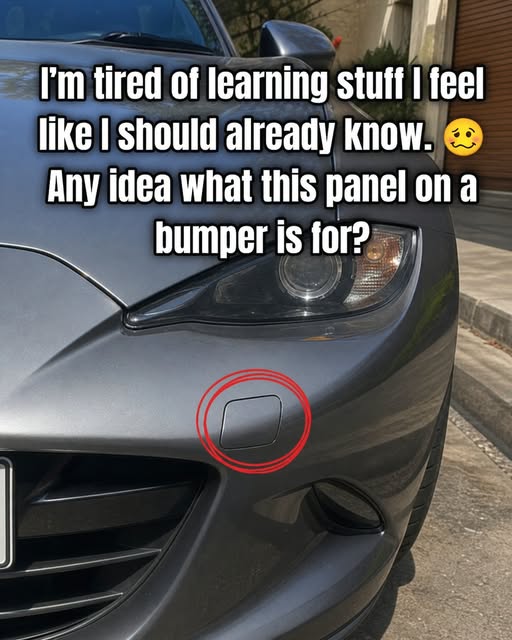
That Small Square on Your Car Bumper Has a Purpose — And It Could Save You During a Breakdown
The Detail Most Drivers Never Notice
Most people walk past their cars every day without giving much thought to the small square or rectangular panel built into the front or rear bumper.
It looks almost decorative, as though it were simply part of the bumper design.
But that tiny panel has a practical purpose.
Behind it is often a threaded mounting point designed to accept a removable tow hook.
In normal driving, the opening stays hidden behind a painted plastic cover that blends into the bumper.
But during a breakdown, recovery or emergency, that small panel can suddenly become one of the most useful parts of the vehicle.
It Is Known as a Tow Hook Cover
The small removable piece is commonly called a tow hook cover.
When removed, it reveals a threaded socket built into the vehicle.
A detachable metal towing eye can then be screwed into that opening.
The result is a strong point where recovery equipment can be attached without simply hooking onto random parts beneath the vehicle.
That distinction matters because modern vehicles have bumpers, suspension components and underbody panels that can be damaged if recovery equipment is attached incorrectly.
The Tow Hook Is Usually Stored Somewhere Else
The actual metal hook is typically not left permanently attached to the bumper.
Instead, it is commonly stored with the vehicle’s emergency tools.
Depending on the model, it may be located near the spare tire, underneath the cargo floor or inside a small tool compartment.
It generally looks like a thick metal shaft with a threaded end and a loop on the opposite side.
The threaded section is designed to fit the hidden socket behind the bumper panel.
Why Manufacturers Hide the Recovery Point
A permanently exposed tow hook would change the appearance of the vehicle and could stick out unnecessarily during everyday driving.
The cover allows manufacturers to keep the bumper smooth while still providing access to a recovery point when it is needed.
The panel is usually painted to match the surrounding bodywork.
That is why many drivers never realize it is removable.
Unless someone has experienced a breakdown or looked closely through the owner’s manual, the little square can remain a mystery for years.
It Can Become Important When a Car Cannot Move
The tow hook can be useful when a vehicle needs to be moved from a difficult location.
A dead battery, mechanical problem or other failure can leave a car stopped somewhere unsafe.
In other situations, a vehicle might become stuck in mud, snow or another surface where the wheels cannot regain traction.
The factory recovery point gives towing or recovery professionals a designated place to attach appropriate equipment.
That can make moving the vehicle simpler while reducing the risk of unnecessary damage.
Using Random Parts of the Car Can Cause Damage
One reason the proper recovery point exists is that not every metal component underneath a vehicle is designed to carry pulling forces.
Attaching a tow strap to the wrong suspension arm, bumper support or other component can bend or damage it.
Plastic bumper sections can also tear if they are used as attachment points.
The threaded tow hook socket is designed specifically to provide a more appropriate connection point.
That does not mean every towing situation should be handled by the vehicle owner, but it explains why engineers included the hidden mounting point.
How the Cover Comes Off
The bumper cover is generally clipped into place.
On many vehicles, pressing one side or carefully using the appropriate tool allows it to pop free.
The exact method can vary by make and model.
Some covers have a small notch designed to make removal easier.
Because the panel is painted and relatively small, forcing it aggressively can scratch the bumper or break the retaining clips.
The vehicle’s instructions can show the intended removal method.
The Tow Eye Screws Into the Hidden Socket
Once the panel is removed, the threaded mounting point becomes visible.
The metal tow eye is inserted and screwed firmly into position.
It must be threaded properly and tightened securely before being used.
Once installed, the metal loop extends outside the bumper and provides a clear point where recovery equipment can be connected.
After the vehicle has been moved, the tow eye can be removed and placed back with the emergency tools.
The small cover can then be snapped back into the bumper.
Not Every Tow Hook Is Meant for Every Type of Recovery
The presence of a towing eye does not mean the vehicle can safely be pulled in every possible situation.
Different vehicles have different limitations, and the recovery point may be intended for particular uses.
For example, moving a disabled vehicle onto a flatbed is very different from attempting a hard recovery from deep mud.
The forces involved can be significantly different.
That is why knowing where the recovery point is located is helpful, while also recognizing that professional towing equipment and proper procedures still matter.
A Breakdown on the Road Can Make the Feature Suddenly Important
Imagine a vehicle losing power in a place where it cannot easily be pushed.
Perhaps it is blocking traffic or stopped in a dangerous location.
Once a recovery vehicle arrives, the hidden towing point can provide a practical way to help position or load the car.
A feature that looked meaningless during everyday driving suddenly has a very clear purpose.
That is one reason drivers benefit from knowing where the tow hook and its mounting point are located before an emergency happens.
Snow and Mud Are Other Common Situations
A vehicle can also become immobilized even when nothing mechanical is wrong.
Snowbanks, deep mud and slippery surfaces can leave the driven wheels unable to move the car.
In those situations, a proper recovery point may be used as part of a carefully managed extraction.
The important part is avoiding improvised attachment points that were never designed for pulling loads.
The little square on the bumper helps reveal where one intended connection may be available.
It Can Also Be Seen on Performance Cars
Tow hooks are not limited to roadside breakdowns.
Vehicles used at race tracks often use easily accessible recovery points as well.
If a car becomes disabled during an event, workers need a fast way to move it away from the racing surface.
That is why some track cars have tow loops already installed or use the same type of threaded mounting location hidden behind the bumper on road cars.
Quick recovery helps reduce delays and avoids attaching equipment to fragile exterior components.
Race Track Use Makes the Function Easier to Understand
At a racing event, the need for a designated towing point is obvious.
A disabled vehicle cannot remain sitting on the circuit while other cars are moving at high speed.
Recovery workers need to know exactly where they can attach a line safely and quickly.
Road cars generally hide the same idea behind a small bumper panel because they do not need the hook visible every day.
The concept is simple: create a known place where pulling forces can be applied when the vehicle needs assistance.
The Cover Itself Can Sometimes Go Missing
Because the bumper panel is removable, it can occasionally be lost.
It may disappear after towing, repairs or an earlier recovery.
Sometimes the retaining clips can also break.
A missing tow hook cover usually leaves a visible opening in the bumper.
Replacement covers are available for many vehicles and can generally be installed by snapping them back into the opening.
Because bumpers are painted, the replacement may need to match the vehicle’s color.
Why Drivers Often Mistake It for a Sensor
Modern bumpers contain many different technologies, including parking sensors, cameras and radar components.
That makes it easy to assume the small square is another electronic feature.
But the tow hook cover is usually much simpler.
It is essentially a removable access door.
Behind it sits a mechanical mounting point rather than a button or secret control.
Its importance only becomes obvious when the vehicle needs to be moved.
The Location Can Vary From One Car to Another
Not every bumper places the access panel in exactly the same position.
It might be located toward one side of the front bumper, while another vehicle may have it on the rear.
Some vehicles have access points at both ends.
The shape can also vary.
Although many are square or rectangular, others are more rounded or shaped to follow the styling of the bumper.
The same basic function can therefore look slightly different from vehicle to vehicle.
The Tow Eye Should Be Kept With the Vehicle
Because the metal hook may spend years unused, it can be easy to forget that it exists.
But removing it from the vehicle and storing it somewhere else could create a problem during an emergency.
The threaded socket behind the bumper is not very useful without the matching towing eye.
Keeping the factory tool kit complete means the equipment will be available if the car eventually needs recovery assistance.
It Is Worth Checking Before You Need It
Drivers often learn about emergency equipment only after something has gone wrong.
A better approach is to become familiar with basic recovery tools in advance.
Finding the tow eye takes only a short time.
So does locating the bumper cover.
Once those two pieces are understood, there is less confusion during a stressful breakdown.
That small amount of preparation can make an unpleasant roadside situation easier to manage.
Modern Car Design Hides Many Practical Features
The tow hook cover is a good example of how modern vehicles hide functional equipment behind clean exterior styling.
Drivers see a smooth bumper.
Engineers see an access point to an important structural attachment.
Most of the time, the hidden feature is completely unnecessary.
But vehicles are designed for the moments when ordinary conditions stop being ordinary.
A Tiny Panel With a Serious Job
The next time you walk past a car and notice that small painted square on the bumper, it may no longer look meaningless.
Behind it can be the threaded socket for a removable tow hook.
The metal eye stored with the vehicle’s tools can screw into that opening, creating a designated connection point when the car must be moved.
It may help during a breakdown, roadside recovery or another situation where the vehicle cannot move under its own power.
One Detail Can Change How You Look at Every Bumper
Before knowing its purpose, the small bumper cover looks like an odd piece of plastic.
Afterward, it becomes difficult not to notice them everywhere.
Cars parked at supermarkets, sedans sitting in traffic and vehicles outside homes all seem to carry the same quiet little clue.
Most will never need to use it.
But behind that unremarkable panel is a feature designed specifically for the day when something does go wrong.
And in that moment, the tiny square that seemed to do absolutely nothing can suddenly become one of the most practical details on the entire car.