
This Strange Red Oval Object Once Had a Simple Everyday Purpose — and Its Design Was Surprisingly Clever
The Vintage Rubber Squeeze Coin Purse Used Flexible Material and Simple Physics Instead of Zippers, Snaps, or Buttons
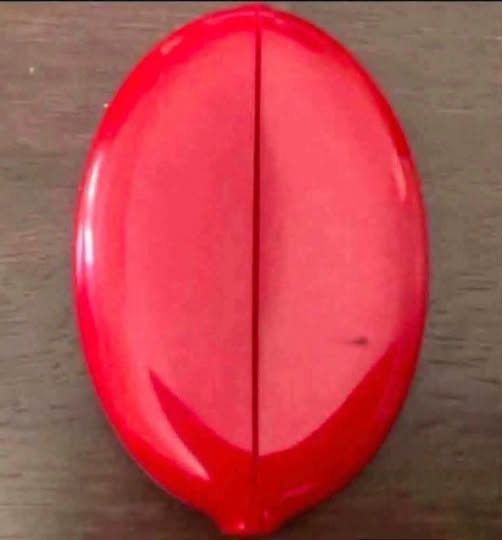
At first glance, the bright-red oval object can be surprisingly difficult to identify.
Its smooth shape and compact size can make it resemble a modern earbud case, a vintage makeup compact, a fidget toy, or even a small lens holder.
In reality, the object is something much simpler and much older: a vintage rubber squeeze coin purse, sometimes known as a Quikey or Oval Squeeze Purse.
Its purpose was straightforward, but the way it worked made it an especially clever example of everyday design.
There Were No Zippers, Snaps, or Buttons
Unlike many small purses or containers, the squeeze coin purse did not rely on any mechanical fastener.
There was no zipper to pull.
There was no snap to close.
There was no button, clasp, or strip of Velcro.
Instead, the purse used the flexibility of its rubber or vinyl body to keep its contents secure.
A narrow slit ran through the center of the oval-shaped object.
When the purse was resting normally, the slit stayed tightly closed.
The Opening Mechanism Was Remarkably Simple
To open the purse, the user squeezed both narrow ends at the same time.
That pressure caused the flexible sides to bend outward.
As the body arched, the center slit widened enough to allow coins or other small objects to be removed.
When the user stopped squeezing, the material returned to its original shape.
The opening then closed automatically.
The entire design depended on the natural flexibility of the material rather than on moving hardware.
Simple Physics Made the Purse Self-Sealing
The cleverness of the design came from the way pressure changed the shape of the purse.
Squeezing the ends transferred force through the flexible walls.
Those walls bowed outward, temporarily changing the shape of the center opening.
Once the pressure disappeared, the rubber or vinyl naturally returned to its resting position.
The slit closed again without requiring the user to fasten anything manually.
This made the purse quick to open and equally quick to close.
The Design Was Practical for Everyday Use
For people carrying loose change, the squeeze purse offered several advantages.
It was compact.
It did not contain parts that could easily break.
It could be opened with one hand.
It also reduced the risk of coins spilling out unexpectedly because the slit stayed closed when the purse was not being squeezed.
That combination of simplicity and convenience helped make the design useful for decades.
Squeeze Coin Purses Became Popular in the Mid-20th Century
The purses became especially common from the 1950s through the 1980s in North America and Europe.
During that period, carrying coins was much more important than it is for many people today.
Small change was needed for a wide range of everyday activities.
Public telephones required coins.
Buses often required exact fare.
Parking meters, vending machines, and laundromats also depended heavily on loose change.
A small coin purse that could be opened quickly with one hand was therefore genuinely useful.
They Were Also Popular Advertising Giveaways
The squeeze purse was not only a household item.
It also became a common promotional product.
Banks, gas stations, insurance companies, hardware stores, and other businesses often printed their names directly onto the surface.
Some versions also included addresses or telephone numbers.
Because the purses were inexpensive and practical, they worked well as advertising giveaways.
A customer might carry one for years, keeping the business name visible every time the purse was used.
The Bright Colors Made Them Easy to Remember
Many vintage squeeze purses were produced in bold colors.
Red was common, but other bright shades were also used.
The strong colors helped make the objects visually memorable and gave businesses a convenient surface for logos and promotional text.
For collectors today, those colors and printed graphics are part of the appeal.
A simple coin holder can become a small piece of advertising history.
Their Use Declined as Payment Habits Changed
The rise of credit cards, debit cards, digital payments, and mobile transactions gradually reduced the need to carry large amounts of loose change.
Public telephones became less common.
Many buses adopted electronic payment systems.
Parking meters increasingly accepted cards or mobile payments.
As a result, the squeeze coin purse became less essential in daily life.
Its original purpose may have become less important, but the object itself did not become useless.
They Can Still Be Used for Small Everyday Items
The same self-closing design that once made these purses ideal for coins still works well for many modern objects.
They can hold tokens.
They can store guitar picks.
They can keep small pieces of hardware together.
Some people use them for earbuds, short cables, keys, or other tiny items that are easy to lose.
The flexible opening makes them especially useful when a person wants quick access without dealing with a zipper or latch.
The Design Has Lasted Because It Is So Simple
Many everyday objects become outdated because they depend on technology that eventually changes.
The squeeze coin purse is different.
Its mechanism is almost entirely based on shape and material.
There is very little to wear out beyond the rubber or vinyl itself.
No metal fastener has to remain aligned.
No hinge has to keep working.
No spring is required.
That simplicity helped many examples survive for decades.
Vintage Examples Can Trigger Strong Nostalgia
For people who remember using them, squeeze coin purses can instantly bring back memories of an earlier period.
They may recall searching for coins at a public phone, feeding a parking meter, carrying bus fare, or receiving one of the purses from a local business.
Because so many were distributed as promotional items, the objects can also remind people of stores, banks, service stations, and other businesses that may no longer exist.
The purse becomes more than a container.
It becomes a small reminder of everyday routines that have changed dramatically over time.
The Object Can Be Confusing Without Context
One reason the squeeze purse still creates curiosity is that its purpose is not obvious when someone encounters it for the first time.
A closed version can appear almost seamless.
The central slit may be difficult to notice unless the object is squeezed.
Without knowing how it works, someone could easily assume it is part of another device.
That explains why it may be mistaken for a case, compact, toy, or holder.
The mystery disappears as soon as pressure is applied to the ends.
A Clever Design Hidden Inside a Very Ordinary Object
The vintage squeeze coin purse is a good example of how thoughtful design does not always require complicated engineering.
Its usefulness comes from a simple relationship between flexible material and pressure.
Squeeze the ends and the opening appears.
Release them and the purse closes itself.
That is the entire mechanism.
Yet that mechanism was useful enough to remain popular for decades.
Why Collectors Still Appreciate Them Today
Modern interest in these purses is often driven by more than practical use.
Collectors may value the advertising printed on them, the colors, the shape, or the connection to mid-century everyday life.
Some examples are especially appealing because they preserve the names and contact information of long-forgotten businesses.
Others attract attention simply because the design looks unusual to people who grew up after the era when loose change was essential.
The object’s modest size also makes it easy to store, display, or add to a collection of vintage promotional items.
A Small Object From an Era of Practical Design
What initially looks mysterious is ultimately a very practical object from another time.
The bright-red oval was designed to hold coins securely while remaining easy to open with one hand.
Its self-sealing slit eliminated the need for zippers, snaps, buttons, or other hardware.
That simplicity made it durable, inexpensive, and convenient.
From the 1950s through the 1980s, objects like this fit naturally into daily life because people regularly needed coins for transportation, telephone calls, vending machines, laundry, and parking.
The Mystery Has a Surprisingly Simple Answer
Today, someone finding one of these objects without knowing its history could easily mistake it for something much newer.
Its compact shape still looks surprisingly modern.
But the answer is not an earbud case, cosmetic accessory, lens holder, or unusual toy.
It is a vintage squeeze coin purse.
And its appeal comes from exactly what made it useful decades ago: a simple, durable design that does one small job remarkably well.