
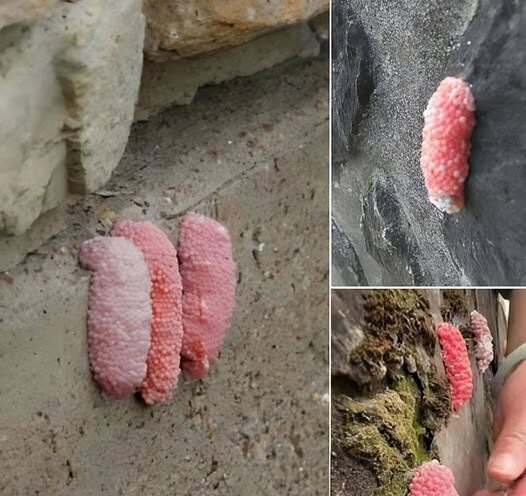
If You See Bright Pink Egg Clusters Near Water, They Could Belong to Invasive Apple Snails
The Eye-Catching Eggs May Signal a Growing Infestation That Can Threaten Crops, Aquatic Plants, and Local Ecosystems
Bright pink egg clusters can look unusual enough to stop almost anyone in their tracks.
They may appear on rocks, plants, walls, garden structures, or other surfaces close to ponds, canals, drainage areas, or other sources of water.
At first glance, the vivid color can make them seem decorative or harmless.
But in some areas, those pink clusters may belong to invasive apple snails.
Because these freshwater snails can reproduce quickly, discovering the eggs may be an early warning that a population is already becoming established nearby.
The Bright Pink Color Makes the Eggs Easy to Notice
Apple snail egg clusters are distinctive because of their intense pink appearance.
Instead of blending into soil or vegetation, they can stand out clearly against natural surfaces.
A cluster may contain a large number of individual eggs packed closely together.
That appearance can make the eggs look almost artificial.
For people unfamiliar with them, the first reaction may be curiosity rather than concern.
However, the unusual color is exactly why learning to recognize the clusters can be useful.
A Single Cluster Can Contain Hundreds of Eggs
One reason invasive apple snails can become difficult to control is their reproductive capacity.
A single egg cluster can contain hundreds of eggs.
That means one visible cluster may represent far more than a small number of future snails.
If several clusters begin appearing around the same area, the number of potential hatchlings can increase rapidly.
This reproductive pattern allows populations to expand when conditions are favorable.
That is why even a relatively small number of visible egg masses can deserve attention.
The Snails Are Closely Associated With Freshwater Areas
Apple snails are freshwater snails.
That means their presence is especially relevant around places where water remains available.
Gardens near ponds, drainage channels, wetlands, canals, or similar environments may be more likely to encounter signs of them.
The eggs themselves are often easier to notice than the snails.
A person may see a pink cluster before realizing that adult snails are already living nearby.
For that reason, the eggs can act as a visible sign of activity that might otherwise go unnoticed.
The Main Concern Is Rapid Population Growth
One snail or one cluster may not seem significant.
The larger concern is how quickly populations can multiply.
When large numbers of eggs hatch successfully, the number of snails in a local area can rise rapidly.
Once established, the population may become more difficult to manage.
That is particularly important in places where the snails are considered invasive.
An invasive species can spread beyond the environment where people first notice it and begin affecting surrounding habitats.
Apple Snails Can Damage Aquatic Plants
Aquatic plants can be especially vulnerable when invasive apple snail populations grow.
These plants play an important role in freshwater environments.
When large numbers of snails feed on them, the damage can alter the appearance and condition of those areas.
The effects may become more noticeable as the population increases.
What begins as a few egg clusters can therefore become part of a much larger ecological problem if the snails continue reproducing unchecked.
Crops Can Also Be Affected
The impact is not limited to natural aquatic vegetation.
Apple snails can also create problems for agriculture.
When populations become established in areas where susceptible crops are grown, feeding activity can damage plants.
This can turn what initially appears to be a small wildlife issue into an agricultural concern.
That is one reason invasive snail populations are monitored carefully in some regions.
The more quickly an infestation is recognized, the easier it may be for local authorities or land managers to respond appropriately.
The Eggs Can Signal a Wider Infestation
Seeing a pink egg cluster does not necessarily mean there are only a few snails nearby.
The cluster may be evidence of adults that have already established themselves in the area.
Additional clusters may also be present in places that are less visible.
If the same type of egg mass begins appearing repeatedly, that can indicate continuing reproduction.
For homeowners and gardeners, the discovery is therefore worth taking seriously rather than simply brushing the eggs away without identifying them.
Avoid Handling the Eggs With Bare Hands
If you encounter a suspected apple snail egg cluster, avoid touching it directly with bare hands.
Even if the eggs look harmless, direct handling is unnecessary.
Keeping your hands away from the cluster also reduces the chance of accidentally spreading or disturbing it in a way that makes proper removal more difficult.
Children and pets should also be kept away from unknown egg masses.
The safest approach is to identify what you are seeing before deciding what to do next.
Local Guidance Matters
The correct response can depend on where you live.
Different regions may have different rules for invasive species reporting, removal, or disposal.
That is why local guidance is important.
In some places, authorities may want residents to report suspected invasive apple snails or their egg clusters.
In other areas, specific removal methods may be recommended.
Following local instructions helps avoid accidentally spreading the species or handling the eggs in an unsuitable way.
Do Not Assume Every Pink Cluster Is the Same
Although invasive apple snail eggs can be brightly colored and distinctive, identification still matters.
A colorful object near water should not automatically be destroyed simply because it looks unusual.
Look closely at where the cluster is located and whether its appearance matches known apple snail egg masses.
If there is uncertainty, checking local wildlife or invasive-species information can help.
The goal is to respond carefully rather than impulsively.
Gardens Near Water Deserve Extra Attention
People with gardens close to freshwater may want to pay particular attention to hard surfaces, plant stems, walls, and other structures near the waterline.
The bright color of the eggs makes them easier to spot than many other signs of invasive animals.
Regular observation can help residents notice a new problem before it becomes widespread.
This does not require constant monitoring.
Simply being familiar with the appearance of the clusters can make a difference.
The Eggs Are More Than an Unusual Garden Discovery
It is easy to treat something strange in the garden as nothing more than a curiosity.
But invasive species often become difficult to manage because they are ignored when their numbers are still relatively small.
A bright pink egg mass can therefore represent more than an interesting object.
It can be a sign that a fast-reproducing freshwater snail is already nearby.
Recognizing that possibility is the first step toward responding appropriately.
Rapid Reproduction Is What Makes the Situation Serious
The large number of eggs inside each cluster explains much of the concern.
Hundreds of eggs can potentially be concentrated in one small area.
If conditions allow many of them to hatch, a local snail population can increase significantly.
More adults can later produce additional egg clusters.
This creates a cycle in which population growth becomes increasingly difficult to control.
Early detection therefore has practical value.
Invasive Species Can Change Local Ecosystems
The effects of an invasive species are not always immediately visible.
At first, the change may seem limited to a few unusual animals or damaged plants.
Over time, however, a rapidly growing population can place pressure on the surrounding environment.
Aquatic vegetation may decline.
Food relationships can change.
Other species may be affected indirectly.
This is why local ecosystem protection often depends on identifying invasive organisms before their numbers become overwhelming.
Homeowners Can Play an Important Role
People who live near affected waterways may be among the first to notice unusual egg clusters.
That gives ordinary homeowners and gardeners an important role in early detection.
A report from someone who recognizes a suspicious cluster may help local officials understand where the snails are spreading.
Even when formal reporting is not required, awareness can prevent the eggs from being unknowingly moved or ignored.
Do Not Move Egg Clusters to Another Location
If the eggs are suspected to belong to an invasive apple snail, moving them somewhere else is not a good solution.
Relocation could potentially spread the problem.
The same principle applies to adult snails.
An invasive species that is already established in one place should not be transported into another environment.
Local instructions should determine how suspected eggs or snails are handled.
The Bright Color Is a Useful Warning Sign
Many invasive species are difficult to recognize.
Apple snail egg clusters have one advantage from a monitoring perspective: they can be highly visible.
The bright pink coloration can make them stand out clearly against rocks, vegetation, concrete, or other nearby surfaces.
That visibility gives people an opportunity to notice the problem early.
Recognizing the eggs can turn an unusual garden discovery into useful information.
Awareness Can Help Prevent a Small Problem From Growing
No single homeowner can control an invasive species across an entire region.
But individual observations still matter.
Spotting a cluster, avoiding unnecessary contact, and following local guidance are simple actions.
Together, those actions can help slow accidental spread and improve awareness of where populations are appearing.
The earlier an infestation is recognized, the more options may be available for dealing with it.
What Looks Harmless Can Have a Larger Impact
The unusual appearance of apple snail eggs can make them seem almost decorative.
That impression is misleading.
The real significance lies in what the cluster can become.
Hundreds of eggs may develop into a rapidly expanding population capable of affecting crops and freshwater vegetation.
The cluster is therefore best viewed as a possible warning rather than a harmless curiosity.
The Safest Response Is Simple
If you find a cluster of bright pink eggs near water, do not immediately handle it with your bare hands.
Take note of where it is located.
Check whether invasive apple snails are a concern in your region.
Then follow the reporting or removal guidance provided by local authorities.
A careful response protects both you and the surrounding environment.
One Small Cluster Can Be an Important Clue
The most important thing to remember is that apple snail eggs can represent much more than a few future snails.
A single cluster may contain hundreds of eggs.
Several clusters can indicate active reproduction.
Active reproduction can lead to a rapidly growing population.
And a large invasive population can damage aquatic plants, crops, and local ecosystems.
That is why recognizing the bright pink clusters matters.
If you see them around your garden or near freshwater, treat them as something worth identifying rather than ignoring.
A little awareness at the right time can help prevent a small infestation from becoming a much larger problem.