
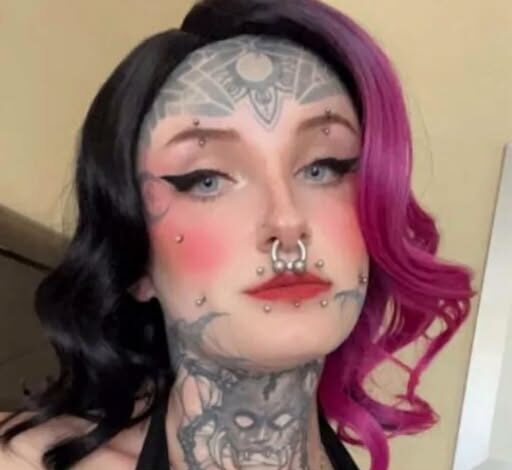
Woman With Extensive Face Tattoos Says TJ Maxx Rejected Her Retail Job Application
A Rejected Job Application Sparked a Viral Debate
A 24-year-old woman with extensive tattoos and facial piercings became the center of a heated online discussion after saying she was rejected for a retail job at TJ Maxx.
Ash Putnam, who uses the online handle ashxobrien, shared her experience on TikTok after receiving an automated rejection message from the retailer.
Her video quickly attracted widespread attention, with millions of views and a large number of comments about appearance, hiring standards, tattoos, piercings, and customer-facing jobs.
What began as one applicant asking why she had not been hired turned into a broader debate about whether visible body art can still affect employment opportunities.
Putnam Said She Wanted an Explanation
Putnam explained that she had applied to TJ Maxx several weeks earlier and later received a rejection.
“I applied to TJ Maxx a few weeks ago and they denied my application,” she said in the video.
She was frustrated that the rejection came through an automated email rather than a personal call.
“They couldn’t even call me. They just sent me some automated email.”
Wanting more information, Putnam decided to visit the store and ask why she had not been selected.
The Hiring Manager Cited Experience
Putnam said she spoke directly with the hiring manager and asked why her application had been denied.
She described the response in her video.
“So, I went in today, and I was like, ‘What was the reason I didn’t get hired?’ And she was like, ‘Oh, you just don’t have enough experience. There [were] candidates with more experience than you,’” Putnam explained.
The answer did not fully satisfy her.
Because of the amount and placement of her tattoos, she wondered whether her appearance had influenced the decision.
She Directly Asked About Her Tattoos
Putnam said she asked the manager whether the rejection was connected to her tattoos.
“I asked her if it was because of my tattoos. Obviously, a lot of places don’t like tattoos. She said that [it] wasn’t the reason. I don’t feel like that’s true, but whatever. I’ll leave it at that.”
The manager, as described by Putnam, maintained that experience was the deciding factor.
Putnam remained skeptical.
Her visible body art includes tattoos across her face and body as well as numerous facial piercings.
That led her to question whether appearance was playing a larger role in her job search than employers were willing to acknowledge.
She Questioned How Young People Are Supposed to Gain Experience
Putnam then turned her attention to the explanation that more experienced candidates had been selected.
She asked how teenagers and young adults are expected to enter the workforce if entry-level employers continue prioritizing applicants who already have experience.
“I’m just wondering how teenagers and young adults who haven’t had a job before are supposed to get employed.”
She continued:
“How are they supposed to get a job if these places are only hiring people based on experience? It just doesn’t make any sense to me.”
Her frustration was not limited to one rejection.
She suggested that visible tattoos had repeatedly affected how employers viewed her.
Putnam Said Tattoos Should Not Define Her Work Ability
Before ending the video, Putnam encouraged viewers to share their own experiences with finding work.
She wanted to know whether other people had encountered similar barriers.
“I want to see if I’m the only person experiencing this right now. I hate that my tattoos have been such a defining factor for me getting a job or not,” Putnam said.
She added:
“Just because I have [tattoos] doesn’t mean that I’m not going to be a good worker.”
Her point was straightforward: she believed appearance should not automatically be treated as evidence of poor performance or weak work ethic.
The Online Reaction Was Not Entirely Supportive
Although Putnam appeared to be looking for understanding and similar experiences, many viewers responded critically.
Some argued that the issue was not simply having tattoos, but the placement and extent of the tattoos.
One commenter focused on a large tattoo extending from Putnam’s neck toward her lower cheeks.
“Maybe it’s the demon spider??” the user wrote.
Another commenter joked about possible jobs they believed might be more accepting of her appearance.
“[You] can be a bartender, tattoo artist, an extra in a prison movie, bassist for Motley Crue,” the person wrote.
Another response was far shorter.
“Unemployable.”
Some Viewers Said Face Tattoos Were the Main Issue
Several commenters distinguished between tattoos in general and tattoos placed on the face.
One person wrote:
“There’s a reason that tattoo artists refer to face tattoos as career enders.”
Another argued that having tattoos was not necessarily the problem.
“I don’t think it’s because you have tattoos…I think it’s WHERE you have tattoos.”
A third commenter made a similar point based on personal experience.
“I have tattoos everywhere but my face…but I can get a job anywhere. Be [for real].”
These responses reflected a common theme in the discussion: many viewers believed employers may tolerate visible tattoos up to a point, but face tattoos can be viewed differently in customer-facing environments.
A Person Identifying as an HR Supervisor Weighed In
One commenter described themselves as an HR supervisor and suggested that a retailer like TJ Maxx would be unlikely to place someone with Putnam’s appearance directly in front of customers.
“HR supervisor here. There is no way any company would put you in front of [customers] like TJ Maxx.”
The comment presented a blunt interpretation of how appearance standards can affect hiring decisions in retail.
It also reinforced the divide between Putnam’s view of professionalism and the expectations some employers or customers may have in a public-facing workplace.
A Former TJ Maxx Hiring Manager Also Commented
Another person who said they had previously worked as a hiring manager for TJ Maxx gave an even more direct opinion.
“I used to be a hiring manager for TJ Maxx and I will tell you it’s the facial piercings and tattoos.”
That comment aligned with Putnam’s suspicion, although the manager she personally spoke with had told her that experience was the reason she was not selected.
The contrast became one of the central tensions in the discussion.
Putnam had been given one explanation officially, while many people online believed her appearance was likely influencing employers regardless of what was said directly.
Tattoos Have Become More Common in Workplaces
Visible tattoos have become much more common over the past decade.
Many workplaces that once maintained strict appearance standards have become more accepting of body art, piercings, colored hair, and other forms of personal expression.
However, Putnam’s experience highlights that acceptance may not be equal across all types of tattoos or all jobs.
Customer-facing retail positions can still involve appearance expectations that differ from workplaces where employees have less direct contact with the public.
Extensive facial tattoos and multiple facial piercings may therefore remain more controversial in some hiring environments than tattoos on arms, legs, or other areas.
Putnam Believes Employers Need to Rethink Their Standards
Putnam argued that employers should focus more on qualifications and job performance than personal appearance.
If tattoos were influencing hiring decisions, she believed businesses needed to reconsider how they define professionalism.
She expressed that view clearly.
“If they think tattoos determine job skill and qualifications they really need to rethink. Tattoos, piercings and colored hair are not unprofessional. It shows creativity and uniqueness…people need to get over not liking tattoos.”
Her position was that personal style does not determine whether someone can be reliable, capable, or hardworking.
The Debate Became Larger Than One TJ Maxx Application
The reaction to Putnam’s video showed that the issue extended far beyond one rejected retail application.
Viewers began debating what employers should be allowed to consider when hiring.
Some supported the idea that tattoos and piercings should have little or no effect on employment opportunities.
Others argued that companies have the right to consider how employees present themselves, especially in jobs involving direct interaction with customers.
Many comments suggested that body art becomes more controversial when it covers the face.
The discussion therefore centered not only on discrimination or fairness, but also on the continuing question of what society considers professional.
Putnam’s Experience Exposed a Gap Between Social Acceptance and Workplace Acceptance
Tattoos may be widely accepted socially, but workplace expectations do not always change at the same speed.
A person can receive positive reactions to tattoos in everyday life while still encountering difficulty when applying for certain jobs.
Putnam’s appearance is highly distinctive, which may make those differences more visible.
Her frustration came from feeling that her body art could overshadow everything else she might bring to a workplace.
Critics, meanwhile, argued that choosing highly visible tattoos can come with consequences in industries that maintain traditional appearance expectations.
Experience Was the Official Explanation She Received
One fact remained central to Putnam’s story.
The manager she approached did not tell her she had been rejected because of tattoos or piercings.
She was told that other applicants had more experience.
Putnam did not believe that explanation fully reflected the situation.
But without a direct statement from the employer linking the rejection to her appearance, the precise reason remained disputed.
The online comments represented individual opinions, even when some commenters said they had experience in human resources or hiring.
The Question of Entry-Level Experience Remained Important
Putnam also raised a separate issue that often concerns younger job seekers.
If entry-level positions favor people who already have experience, how does someone without a work history get started?
That question can become especially frustrating for applicants who repeatedly hear that another candidate was more experienced.
For Putnam, the explanation seemed particularly unsatisfying because she suspected another factor was involved.
Her video combined both frustrations: difficulty entering the workforce and concern that her appearance was limiting opportunities before employers had a chance to judge her work ability.
Customer-Facing Jobs Remain at the Center of the Debate
Much of the criticism focused specifically on retail.
Retail employees often represent a company directly to customers, which can make appearance standards more prominent during hiring.
Some businesses prefer a more traditional presentation, while others place greater emphasis on individuality.
That variation means the same applicant can be viewed very differently from one workplace to another.
Putnam’s experience shows how difficult it can be to separate personal expression from professional expectations when the job itself involves constant public interaction.
She Maintained That Appearance Does Not Determine Work Ethic
Despite the criticism, Putnam continued to emphasize one central point.
She did not believe tattoos or piercings made her less capable of being a good employee.
Her frustration was based on the possibility that she could be dismissed because of appearance before being given the opportunity to prove herself.
For her, tattoos represented creativity and individuality rather than a lack of professionalism.
Many of her critics clearly disagreed.
That disagreement is why a simple retail rejection generated such a large online debate.
@ashxobrien I want to know who is also having a hard time finding a job right now! #jobs #jobmarket ♬ original sound – Ash O’Brien🖤
The Viral Response Revealed How Divided Opinions Still Are
Putnam’s video received millions of views because it touched on a subject many people have encountered in different forms.
How much should appearance matter when someone applies for a job?
Should face tattoos be treated differently from tattoos elsewhere on the body?
Should employers focus only on qualifications, or should customer expectations also influence hiring?
The responses showed that there is still no broad agreement.
Some people saw Putnam as someone facing unfair judgment.
Others believed she had made personal choices that naturally reduced the number of traditional workplaces willing to hire her.
A Rejection Turned Into a Wider Conversation About Work and Appearance
Putnam originally shared her story because she wanted to understand why getting hired had become so difficult.
Instead, the video became a public argument about tattoos, piercings, professionalism, and personal responsibility.
The official explanation she received was that more experienced candidates had applied.
Putnam suspected her appearance had also played a role.
Many commenters agreed with that suspicion, while others criticized her choices rather than the employer.
Her experience ultimately illustrates how visible body art remains a complicated issue in the workplace.
Tattoos may be far more socially accepted than they once were, but extensive facial tattoos and piercings can still influence how job applicants are perceived, particularly in customer-facing roles.
For Putnam, however, the principle remained unchanged: a person’s appearance should not automatically determine whether they are capable of doing a job well.