
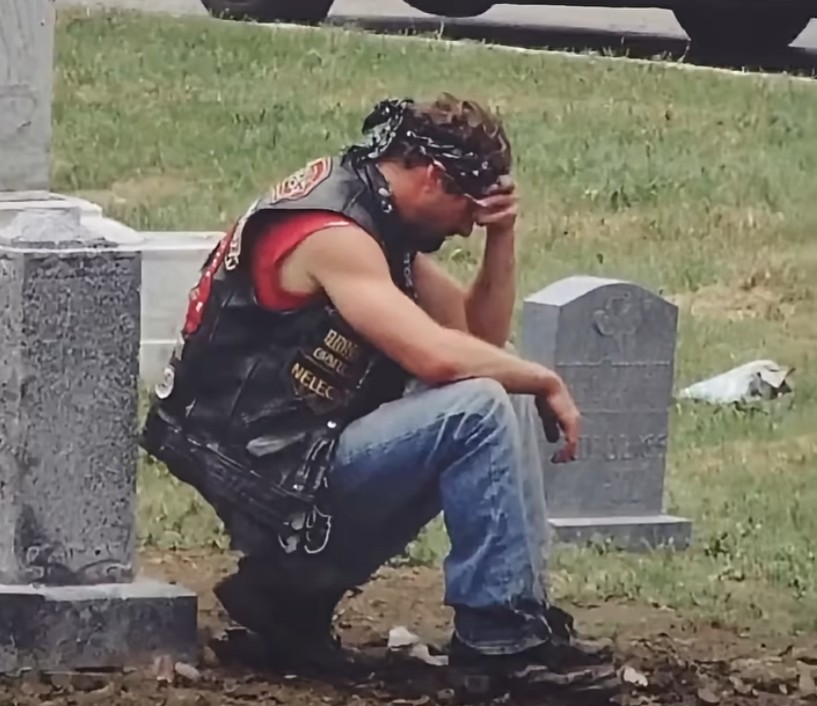
A Biker Visited My Wife’s Grave Every Saturday—Then I Learned Why He Never Missed a Week
Fiction: An Unfamiliar Visitor Becomes Part of My Grief
For six months, I watched a stranger visit my wife’s grave every Saturday afternoon. He arrived on a Harley-Davidson, parked nearby, and walked directly to Sarah’s headstone as though he had followed that same path for years.
I had never met him. I could not remember seeing him among Sarah’s friends, and nothing about his appearance helped me place him within the life we had shared.
At first, I considered the simplest explanation: perhaps he had confused her grave with someone else’s. But the certainty of his movements made that seem unlikely, and his repeated visits eventually removed any doubt.
He knew exactly where he was going. What I could not understand was why.
Every week, he spent an hour beside her headstone. He brought no flowers, left no objects, and made no attempt to attract attention.
Then he returned to his motorcycle and rode away. I remained behind with the same questions, increasingly aware that this stranger carried a connection to Sarah I knew nothing about.
Grief had already left me struggling with her absence. Now I found myself wondering whether there were parts of her life I had never understood while she was here.
The Same Arrival at Two O’Clock
The visits followed such a consistent pattern that I began expecting the sound of the motorcycle. At exactly two o’clock, its engine would interrupt the cemetery’s quiet, announcing his arrival before I saw him.
He would remove his helmet and approach Sarah’s grave without hesitation. Once there, he settled beside the headstone and lowered his head.
He never appeared impatient. There was no hurried glance at a phone, no obvious effort to finish a duty and move on.
Watching him, I had the impression that the hour belonged to Sarah. Whatever else his Saturday contained, he had made room for this visit.
That dedication unsettled me precisely because I could not explain it. A passing acquaintance might have visited once, but this man kept returning.
I began searching my memories for a mention of a motorcycle accident, a friend I had forgotten, or a conversation that might connect them. Nothing gave me an answer.
Eventually, my uncertainty became harder to bear than the prospect of approaching him. I realized that watching from a distance was allowing my imagination to fill a silence only he could explain.
The following Saturday, I arrived early. When the familiar motorcycle appeared, I waited until he reached the headstone before walking toward him.
The Question I Had Avoided for Months
He heard my footsteps and stood. One hand rested gently against the stone as he turned to face me.
I introduced myself as Sarah’s husband. Saying those words in front of her grave still felt strange, but they explained why I needed to speak to him.
“Who are you, and how did you know my wife?”
For a moment, he looked at me without answering. His expression held an emotion I could not immediately identify.
Then he began describing a period of his life that had taken place years earlier. He had been seriously injured in a motorcycle accident, and his recovery had left him frightened about the future.
He remembered feeling physically vulnerable and uncertain about what would happen next. Things he had previously taken for granted no longer felt dependable.
Sarah had been one of the nurses caring for him during that time.
As soon as he explained that connection, the encounter changed. I was no longer searching for a place he might have occupied in our private life; I was listening to someone who had known her through her work.
But his gratitude went beyond the care he had received as a patient. What he remembered most was how she had treated him when he felt overwhelmed.
The Nurse Who Made Him Feel Less Alone
He told me Sarah listened when he needed to speak. When recovery felt impossibly difficult, she encouraged him without making him feel ashamed of his fear.
Her patience had mattered. So had the way she reminded him that a painful period did not have to determine everything that followed.
He had been living through one of the darkest stretches of his life, and she had helped make it less lonely. Years later, he could still remember the reassurance of being treated as a person whose worries deserved attention.
I listened, recognizing Sarah in everything he described. The kindness was familiar, even though the circumstances were entirely new to me.
At home, her thoughtfulness had often appeared in ordinary gestures. She noticed when someone needed patience, and she had a way of making everyday life feel warmer.
This man had experienced those same qualities from a different place. He had not known her as a wife or a member of our family, but he had carried the memory of her compassion long after leaving her care.
What surprised me was that Sarah had never mentioned him. I could not recall a conversation about this patient or any indication that she believed she had done something remarkable.
That absence began to make sense. She had not needed to bring every kindness home as a story about herself.
Understanding What His Visits Meant
The biker explained that returning to the cemetery was his way of expressing gratitude. He could no longer thank Sarah directly, but he could continue remembering what she had done.
There was no secret relationship behind his visits. The connection I had spent months trying to understand came from a period when he had needed help and she had offered it with patience.
His hour beside the headstone was not evidence that I had misunderstood my marriage. It was evidence that Sarah’s life had reached people beyond the circle I knew.
I had known her closely, but I had not witnessed every working day. There were conversations I had never heard, difficult moments she had helped someone through, and people who remembered her for reasons I might never discover.
Realizing that brought a different kind of sadness. There was more of her to learn about, yet she was no longer here to share it herself.
At the same time, his story gave me something precious. Through his memories, I could recognize her again in a setting I had never seen.
Before leaving, he touched the headstone once more. He told me he would stop visiting if his presence made me uncomfortable.
By then, discomfort was no longer what I felt. I thanked him for telling me and for continuing to remember her.
The Next Saturday, I Joined Him
I returned to the cemetery the following week at two o’clock. This time, I did not remain in my car, watching for an explanation from a distance.
I walked toward Sarah’s headstone and joined him. The place was familiar, but the silence between us no longer felt uncertain.
We began sharing memories. He spoke about the nurse who had helped him find hope during recovery, while I remembered the woman whose laughter and warmth had shaped our life together.
Neither account replaced the other. His memories added something to mine, allowing me to understand more of the person we were both there to honor.
Our visits gradually became a shared routine. The motorcycle still arrived on Saturday afternoons, but its sound no longer brought a rush of unanswered questions.
Instead, it reminded me that someone else had made time to remember Sarah. I was not the only person carrying the effects of her kindness.
I had once believed that understanding the stranger would settle a troubling mystery. I had not expected it to change the way I thought about my wife’s legacy.
She had not sought recognition from him, and she had never told me that her care had made such a lasting difference. Yet he remembered, and his gratitude had endured.
Now, when we sit beside her headstone, I think less about the months I spent wondering who he was. I listen to what he remembers, share what I can, and feel grateful that another part of Sarah’s life has found its way back to me.