
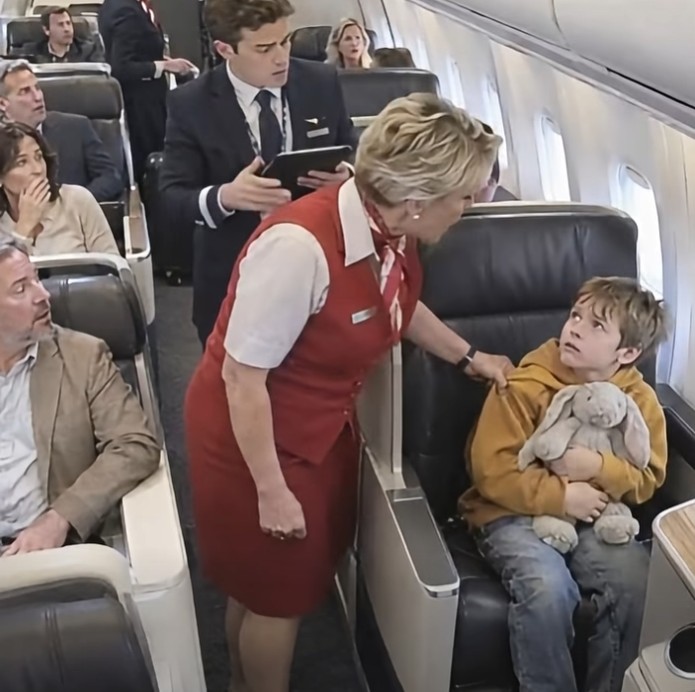
A Boy Was Told to Leave First Class—Then I Scanned His Boarding Pass
The Answer Was Already in His Hand
Linda’s grip on Noah’s sleeve loosened, but she remained beside his seat. Uncertainty crossed her face, followed by a familiar look of frustration—the expression of someone who believed a situation should already have been resolved.
I stepped closer and took out the small tablet we used to check passenger records. Before anyone asked the boy to move again, we needed to confirm where he belonged.
“Noah, can I see your boarding pass, please?” I asked gently.
He looked up at me, then slowly extended the crumpled paper. He held it carefully, as though surrendering it might mean giving up his only way to explain himself.
I scanned the barcode and waited for the passenger details to appear. His name came up first: Noah Parker.
Below it was the information that settled the immediate question. Seat 2A. First Class.
In this fictional story, a routine check brought an uncomfortable confrontation to a halt. The boy was sitting exactly where his boarding pass said he should be.
Checking Before Making Another Assumption
I read the details once more before turning the screen toward Linda. There was no reason to continue debating the seat assignment.
“Linda, it says here that Noah is indeed in the right seat. His ticket was purchased with a premium membership.”
Her eyes widened briefly. She looked from the tablet to Noah, then stepped back.
“Well, I must have missed something,” she murmured.
I lowered the tablet. Confirming the booking had taken only a moment, yet the effect on the boy was immediate.
He no longer appeared to be bracing himself to leave. Still, the worry had not entirely disappeared from his face.
Linda folded her arms more loosely and moved out of the aisle. Around us, passengers began returning their attention to the small tasks of boarding.
For them, the interruption seemed to be ending. For Noah, another question mattered more than the seat.
Waiting for His Father
“Is my dad coming soon?” he asked.
I crouched beside him so we could speak without his having to look up at another adult standing over his chair.
“Yes, I’m sure he’ll be here any moment. You did the right thing by staying put.”
His fingers relaxed around the boarding pass when I returned it. He kept it close, but he stopped holding it out as though he expected to be challenged again.
I stayed nearby while checking what I could about the situation. His father had not yet reached the seat, and I wanted to understand why the boy was waiting alone.
At the same time, I entered a brief note about the incident for review. The record needed to reflect what had happened and what the passenger information had confirmed.
The seating question was straightforward. Understanding how it had become a confrontation would require attention after the immediate boarding work was finished.
A Familiar Face Appears
A tall man appeared at the front of the cabin carrying a briefcase. His business suit was rumpled, and his eyes moved quickly across the seats.
When he saw Noah, his expression changed. He came down the aisle toward us, visibly relieved.
“Noah! There you are,” he said.
The boy’s response was immediate. His face brightened, and the tension he had been carrying seemed to ease.
“Dad! I stayed right here like you said!”
His father leaned down and gave him a quick hug. For a moment, their attention stayed entirely on one another.
Then the man turned toward Linda and me. He appeared concerned that his delayed arrival had created a problem.
“I’m so sorry for any confusion. There was an issue with my boarding and they sent me through another gate. I told Noah to wait here.”
His explanation accounted for the separation. Noah had followed his father’s instruction and remained in his assigned seat while waiting for him to arrive.
Letting Them Settle In
“Everything’s all sorted now. Thank you for clarifying,” I said.
There was no need to keep the family standing in the aisle. The booking had been checked, Noah’s father was present, and they could prepare for the flight together.
Linda had regained her professional composure. She offered a polite smile as the man turned toward the seats.
“We’re glad you’re both settled. Let us know if you need anything during the flight.”
Noah stayed close to his father while they arranged their belongings. His earlier question had finally been answered by something more reassuring than anything I could have said: his dad was beside him.
Nearby passengers resumed reading, checking their phones or settling back into their chairs. The cabin returned to the ordinary rhythm of departure preparations.
I stepped away to give father and son room. The immediate difficulty had ended without requiring Noah to leave the place where he had been told to wait.
What Stayed With Me in the Galley
Back in the galley, I thought about how little information had been needed to resolve the dispute. The boy’s name and seat assignment were available on the document he had been holding throughout the encounter.
The record had not changed while we stood there. What changed was that someone checked it.
I also remembered the way Noah had extended the paper. He had been trying to cooperate while remaining where his father expected to find him.
From an adult’s perspective, the interruption had lasted only part of the boarding process. From his position, several important things had been uncertain at once: whether he could stay, whether anyone believed him and when his father would arrive.
That difference was easy to overlook while working through a busy cabin. It was also precisely why a calm question and a moment of patience mattered.
Linda’s experience had not prevented a misjudgment. My responsibility was to help correct it and make sure the incident was recorded, rather than assume that a quiet ending meant there was nothing to learn.
A Small Resolution Before Departure
I felt relieved that the situation had been resolved, but I did not know much about Noah and his father beyond what they had shared.
A briefcase and a business suit did not explain the man’s life. A first-class boarding pass did not explain the family’s journey. Neither detail needed to become a larger mystery.
What I did know was enough for the moment. Noah had a valid seat assignment, he had followed an instruction to wait there, and his father had reached him.
The record of the confrontation would remain for review. Any further conversation about how it had been handled could take place without making the boy the center of attention again.
Before returning to my other duties, I looked toward their seats. They were together now, absorbed in the ordinary business of getting comfortable before a flight.
I carried that image with me as I continued working: a child no longer waiting for someone to believe his boarding pass, and a father who had finally found the seat where his son had stayed.