
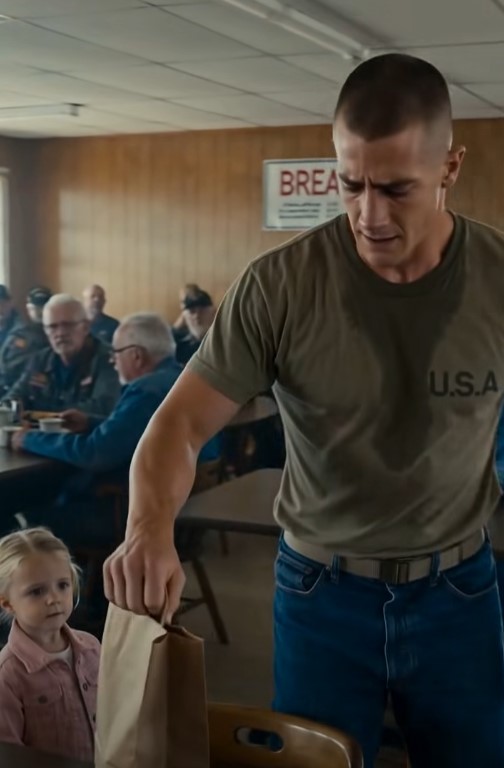
The Lunch Bag At VFW Post 419
A Rainy Afternoon At The Veterans Hall
For five years, the bartender at VFW Post 419 had kept the room in order with a quiet routine. Each morning, the brass memorial plaques behind the bar were polished until the engraved names, dates, and signatures caught the light.
That familiarity made the sight on the bar even more alarming. A worn brown paper lunch bag, creased from age and stained by time, rested in front of an empty stool. The handwriting on it was not just recognizable. It belonged to David James Macintyre, a young soldier the town believed had died years earlier.
The moment began when Luke, a tired-looking former medic, entered the hall during a rainy Tuesday afternoon. He carried a small girl named Maya, dressed in a yellow raincoat, and placed her on the final stool at the bar.
Luke then left one stool empty between them and placed the old lunch bag in front of it. When Maya touched the empty chair and called it “Daddy’s chair,” the veterans in the room understood the emotional weight of the gesture before they understood the mystery behind it.
The Name That Should Not Have Been There
The bag carried a short message written in thick black marker: “For my sunshine. Eat your carrots.” Beneath those words was the signature of David Macintyre, a man whose death had been mourned at the same post years before.
David had been believed killed in 2018 during military service overseas. His funeral had been held with a closed casket, and the town had honored him as one of its fallen sons.
Luke explained that he had been part of David’s platoon. He had also been the medic who helped recover him after the attack that supposedly ended his life. Yet Luke had come to the post because a child in his care had arrived with documents and memories that did not fit the official story.
Maya had been surrendered at a fire station in Luke’s county. A woman left the toddler with a backpack and disappeared. Because Luke was registered as an emergency foster parent, child services placed the girl with him while they tried to identify her mother.
Inside the backpack was a birth certificate listing Maya Grace as the child’s name. Her date of birth was August 14, 2022. The father’s name was typed as David James Macintyre, along with identifying information that matched the soldier the town had buried.
A Photograph From After The Funeral
At first, Luke believed the document might have involved identity theft. The dates seemed impossible. David was believed to have died in 2018, years before Maya was born.
Then Luke found a photograph hidden in the backpack. The image showed David alive, older, gray at the temples, and holding baby Maya in a carrier against his chest. A calendar in the background showed the year 2023.
The room fell into shock. The man in the photograph was not a stranger who resembled David. It showed the same face the veterans remembered: the crooked nose, the uneven eyebrow, and the familiar expression of someone carrying too much pain.
On the border of the photograph was another instruction written in David’s handwriting. It directed whoever found the message to bring Maya to Post 419 and ask for an envelope hidden under the third stool.
Chief, an older Army veteran and longtime fixture at the post, knelt down and reached beneath the exact stool Maya had identified. Taped inside the hollow space below the seat was a yellowed manila envelope, sealed against moisture and grime.
The envelope was not addressed to Luke. It was addressed to the bartender who had polished David’s plaque every morning for years.
The Letter Inside The Envelope
Inside the envelope were three items: a stack of handwritten pages, a small black ledger, and an old brass key stamped with the number 419. The key appeared to belong to one of the old basement lockers beneath the VFW hall.
The handwritten letter was dated October 12, 2023. It began with the chilling line, “If you are reading this, I am dead. Truly dead this time.”
David’s letter explained that the funeral years earlier had not marked his real death. He wrote that he had remained hidden because returning home would have put his mother, the post, and others in danger.
He described what he had seen overseas before the explosion that supposedly killed him. While on duty near an airstrip, David had witnessed private contractors loading pallets of American hundred-dollar bills. The money, he claimed, came from emergency reconstruction funds being removed off the books.
David believed he had made a fatal mistake by reporting what he saw through the chain of command. Soon afterward, his patrol route was changed. His unit was sent into a vulnerable area without proper support.
According to the letter, David survived only because he had stepped away from the vehicle moments before the blast. He watched the vehicle burn and saw men in unmarked tactical gear confirm the attack before leaving.
The Benefactor Behind The Plaques
David wrote that he became a ghost because he believed returning to base would make him another loose end. He eventually made it back to the United States under a false identity, met Jane, and became Maya’s father.
For a time, he thought the danger had passed. But later, he traced the stolen money through shell companies, real estate holdings, and charity trusts. The trail led back to the town that had mourned him.
The letter identified Richard Grayson as the man behind the financial scheme. Grayson was a wealthy local developer and benefactor who had donated money to the VFW, helped fund renovations, and paid for the brass memorial plaques on the wall.
David’s letter claimed Grayson had also paid for the closed casket that allowed the false funeral to proceed without closer questions. The ledger in the envelope documented the movement of the money.
The brass key opened Locker 419 in the basement. David wrote that the original contractor manifests and a hard drive with convoy orders were hidden there. He instructed the bartender to take the evidence to the state attorney general, not to local authorities.
The urgency of the letter became immediate when a black utility Suburban pulled up outside the VFW. Three men in rain gear arrived, and the veterans realized they had been followed.
The Basement Discovery
Chief ordered the bartender to get the drive from the basement while the others secured the building. Luke took Maya into the windowless storage pantry for safety.
Downstairs, the bartender found the old row of rusted footlockers near the boiler. Locker 419 still carried faint painted numbers, and the brass key fit the lock perfectly.
Inside the locker was a waterproof Pelican case containing the hard drive and documents David had described. But beneath the case was another note taped to the bottom of the locker.
The note changed everything. It stated that the drive proved Grayson stole the money but that Grayson had not acted alone. It directed the bartender to ask Chief about his bank accounts.
Before the bartender could fully process the message, glass shattered upstairs and Chief’s revolver fired. When the bartender returned with the case, the front of the hall was damaged, one attacker was down, and Miller was on the phone demanding state police instead of local officers.
Chief’s Confession
When confronted with David’s final note, Chief froze. He confessed that years earlier the VFW had been close to financial collapse. Grayson had approached him with an arrangement involving foundation money and payments routed through the post’s charity fund.
Chief admitted that he had helped launder the money, believing he was assisting with tax avoidance and using part of the funds to save the hall and pay for his wife’s hospice care. He said he did not know the money had come from stolen military reconstruction funds.
The realization devastated him. The money he had helped move had been connected to the very attack that killed the men the plaques were meant to honor.
Before there was time to absorb the confession, the attackers moved from the front of the building to the back alley. Their Suburban rammed the kitchen entrance, tearing open the steel door and exposing the hallway that led toward Luke and Maya.
Chief placed himself between the attackers and the pantry. Armed only with his revolver, he fired at the men entering through the breach and held the line long enough for state police to arrive.
Chief was badly wounded but prevented the attackers from reaching Maya. Before paramedics took over, he asked whether the men had gotten inside. He was told Luke and Maya were safe.
The Evidence Reaches Investigators
State police secured the VFW and recovered the hard drive, manifests, and ledger from the bartender. The evidence was turned over to higher authorities and moved beyond the reach of local influence.
The investigation that followed was swift. The hard drive and documents showed how reconstruction money had been skimmed, transported, and routed back through financial structures connected to Grayson.
Within seventy-two hours, federal agents raided the Grayson Family Foundation, his real estate companies, and his estate. Richard Grayson was arrested and later indicted on charges including wire fraud, money laundering, and conspiracy to commit murder.
The town was shaken by the revelations. The brass plaque bearing Grayson’s name was removed from the VFW wall and discarded.
The wider truth about David’s final years also emerged. He had spent years gathering evidence against Grayson while staying hidden to protect his family and the post. Jane, Maya’s mother, had helped him survive and later led the attackers away so Maya could be saved.
David’s body was eventually found near the county line. He had returned to town long enough to hide the evidence in Locker 419 and draw danger away from the VFW.
A New Plaque And A Safer Future
Chief survived his wounds, but he was later charged for his role in the money laundering scheme. When questioned, he confessed to the transactions and accepted responsibility for the part he had played.
He was sentenced to five years in federal prison. Before leaving, he asked only that the post be cared for and the taps kept clean.
Six months later, Luke returned to VFW Post 419 with Maya. He was no longer just her foster parent. Her adoption had been finalized, and Maya Macintyre had a permanent home.
This time, Luke placed Maya on the last stool and sat beside her. There was no empty chair left between them.
The old lunch bag remained, no longer a fragile object of fear and confusion. It had been preserved behind clear acrylic, protecting the words David had written for his daughter.
On the wall behind the register, the old Grayson plaque was gone. In its place was a brushed steel memorial paid for by the veterans themselves.
At the top of the new plate was David’s name, followed by the truth the town had finally learned: “David James Macintyre. He stayed behind to finish it.”