
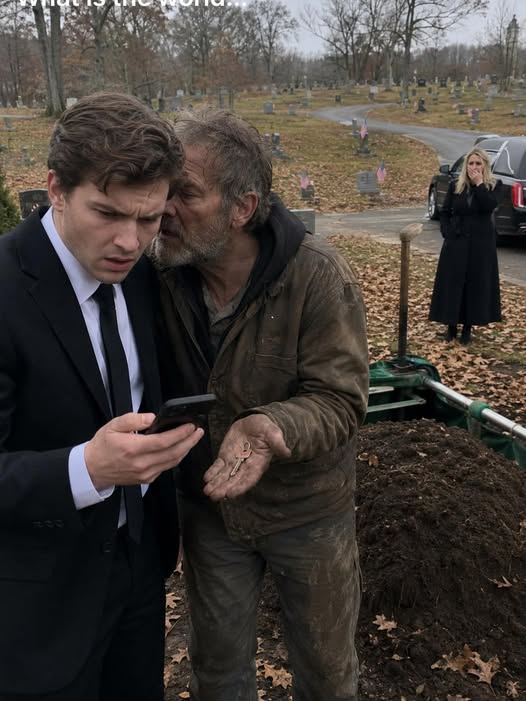
At Her Mother’s Funeral, a Daughter Received a Key That Exposed a Hidden Betrayal
A Quiet Warning Beside the Grave
Emily Carter was standing away from the rest of her family near the edge of her mother’s grave when the funeral director approached her.
At first, she believed Earl had come to offer a private word of comfort. He had known her mother for years and had helped arrange the funeral plan her mother had paid for long before her death.
Her mother had been careful about details. A decade earlier, she had sat in Earl’s office with a legal pad and a list of instructions, determined not to leave the arrangements for others to handle.
Earl was a quiet man in his sixties, the kind of person who moved through grief with professional calm. He stood beside Emily without speaking while the pastor continued his service.
The November sky was gray. Her aunt Linda was crying into a tissue. The casket rested nearby while mourners listened in silence.
Then Earl leaned close and spoke in a voice so low Emily nearly wondered if she had imagined it.
“Ms. Carter,” he said.
He glanced briefly toward the casket before looking back at her.
“Your mother paid me to bury an empty coffin.”
The Key to Unit 16
Emily’s first reaction was disbelief. The words seemed impossible, like something grief had created inside her own mind.
“Stop fooling around,” she said.
Earl did not smile. Instead, he placed a small brass key into her hand. A numbered metal tag was attached to it: Unit 16.
Then he gave her one instruction.
“Don’t go home. Go to Unit 16. Right now. Safelock Storage, out past the highway.”
Before Emily could ask what he meant, her phone buzzed inside her coat pocket.
She looked down and froze.
The message was from her mother’s number.
Come home alone.
Her mother had been dead for six days. Emily had identified the body herself at Saint Joseph’s. She had signed forms, prepared the obituary, and spent the morning accepting condolences from people who believed they had come to say goodbye.
Now her mother’s name glowed on the phone screen as if nothing had happened.
When Emily looked back up, Earl had already returned to the graveside. No one else seemed to have noticed the exchange.
Emily placed the key in her purse and walked to her car.
A Storage Unit Prepared for Escape
The drive to Safelock Storage took about twenty minutes. During that time, Emily tried to explain what had happened in any way that made sense.
Maybe Earl was confused. Maybe someone else had her mother’s phone. Maybe grief had finally pushed her mind into a place where ordinary logic no longer applied.
The storage facility sat near the edge of town, not far from the interstate. Rows of metal doors stood behind a chain-link fence, and the sign flickered in the afternoon light.
Emily found Unit 16 and struggled with the lock, dropping the key twice before it finally turned.
When she lifted the door, she stopped.
Inside was not a normal storage unit. There were no boxes of old clothes, no furniture, no seasonal decorations, and no forgotten household items.
There was a folding chair, a camping lantern, three plastic jugs of water, a legal file box, and her mother’s navy-blue handbag.
Emily knew that purse immediately. It was the same one her mother had carried to work for two years. It was also the purse the police had said was recovered at the scene of her death.
An envelope was taped to the front of the handbag. Emily’s name was written across it in her mother’s precise handwriting.
For Emily. If you’re reading this, they lied to you first.
Footsteps Outside the Door
Before Emily could fully process the message, she heard tires on gravel behind her.
A black SUV had pulled into the lane two rows away. Its engine remained running, and its windows were too dark to see inside.
Emily lowered the storage door enough to squeeze inside, then pulled it down until only a thin strip of daylight remained at the bottom.
She pressed herself against the wall and tried to keep her breathing quiet.
Car doors opened outside. Footsteps crossed the gravel slowly, with the confidence of people who did not appear worried about being seen.
The steps stopped near Unit 15, then continued.
A shadow crossed the narrow band of light beneath Emily’s door.
Then a man spoke through the metal.
“Ms. Carter? We just want to talk.”
Emily stayed silent.
A second voice followed, sharper than the first.
“Your mother involved you in something she shouldn’t have.”
Emily opened the envelope with shaking hands.
The note inside was brief and written quickly in her mother’s handwriting.
Emily, if anyone follows you here, do not trust the police, Richard Hale, or anyone from Lawson Financial. Take the red folder and leave through the back fence. I’m sorry.
The Name That Changed Everything
Richard Hale was Emily’s mother’s employer. She had worked for him for nineteen years as an executive assistant at Lawson Financial Group.
Emily remembered him from the funeral that morning. He had arrived in a gray suit and hugged her with the controlled warmth of a man who knew how to behave in public moments of grief.
She had thanked him for being there.
Now his name was written in her mother’s warning.
Outside the unit, something metallic scraped against the lock.
Emily opened the legal file box. Inside were carefully labeled folders, a flash drive taped beneath the lid, bank records, copies of documents, and one red folder.
The red folder appeared to contain wire transfer records and signatures.
Then Emily noticed the back wall.
A sheet of plywood leaned against it. Behind the plywood was a section of chain-link fence that had already been cut open, with the metal bent back just wide enough for a person to crawl through.
Her mother had prepared everything: the lantern, the water, the documents, and the escape route.
The man outside spoke again.
“Open the unit, Emily. Your mother is dead because she stopped cooperating.”
That sentence told Emily more than he likely intended. He did not say her mother had died. He said she was dead because she stopped cooperating.
Emily grabbed the red folder, pushed the plywood aside, and crawled through the cut fence.
Behind her, she heard a heavy strike against the storage door. Then another.
She ran through the weeds behind the units and did not stop until she reached a service road near the highway.
Messages From a Dead Woman
Emily’s phone buzzed again.
There were two more messages from her mother’s number.
Go to Daniel Brooks. County Recorder’s Office. Trust no one else.
A minute later, another message arrived.
And Emily, if Hale finds you first, burn everything.
Daniel Brooks did not appear to be the kind of person connected to a dangerous conspiracy. He worked at the County Recorder’s Office, wore rolled-up shirtsleeves, and had a coffee stain on his tie.
When Emily arrived with twenty minutes left before closing, he stood the moment he saw her.
“Emily Carter,” he said.
It was not a question.
“My mother sent you,” Emily said.
Daniel told her to lock the door.
Then he opened his desk drawer and handed her another sealed envelope, also addressed in her mother’s handwriting.
The Truth Inside the Letter
The letter was dated three weeks before the day Emily believed her mother had died.
In it, her mother explained that Lawson Financial had been moving client money through shell accounts and fraudulent estate transfers.
She had discovered the records by accident while reviewing files she had created herself. When she noticed changes she had not made, she confronted Richard Hale.
Instead of admitting wrongdoing, he used her access credentials to make it appear that she had helped hide the activity.
He also threatened Emily.
Her mother wrote that she pretended to cooperate while secretly copying everything she could find. She arranged the empty coffin through Earl because she believed that if Richard thought she had been buried, he would stop searching long enough for Emily to deliver the evidence.
Emily read the letter once, then again more slowly.
Her mother was alive.
Daniel told her that, as of four days earlier, she had called from a prepaid phone. She had instructed him to help Emily deliver the documents to a federal agent she trusted if she failed to contact him again.
Emily felt anger and relief at the same time. She was furious that her mother had allowed her to mourn for six days. She was also overwhelmed by the fact that the death she had been grieving was not final.
For the moment, she put the anger aside.
“Show me what’s on the drive,” she said.
Documents That Connected the Scheme
Daniel connected the flash drive to his computer, and the two spent the next forty minutes reviewing the files.
The records showed assets moved from client accounts after account holders died. Money had been redirected through shell companies before beneficiaries could file claims.
There were property transfer documents with dates that did not match official county filings. That appeared to be why Emily’s mother had chosen Daniel, because he had access to the county records that could confirm the discrepancies.
There was also a list of local officials linked to payments, including names Emily recognized from city council meetings and county elections.
One deputy coroner’s name appeared in connection with both documentation and a payment record from a Lawson subsidiary.
Emily understood then that her mother had not acted impulsively. She had built a file for months while surrounded by people capable of destroying her.
Emily told Daniel they needed to go to the federal agent that night.
Daniel said her mother had expected that response and had told him to say she was proud of her.
“She can tell me herself when this is over,” Emily said.
The Federal Case Begins
Two hours later, Emily and Daniel sat inside a secure conference room in the federal building downtown.
Across from them was Audrey Marsh, who worked in financial crimes. She reviewed the documents carefully and listened with the focused attention of someone who already understood pieces of the larger case.
She asked direct questions. She photographed the documents. She accepted the flash drive and issued a receipt.
She did not simply ask them to trust that something would be done. She explained what would happen next.
Richard Hale was arrested forty-eight hours later at his suburban home. Two associates were also taken into custody.
The deputy coroner who had altered paperwork connected to Emily’s mother’s death certificate was arrested at his office.
The case appeared in the news for about a week as a financial crimes matter with a conspiracy component.
To Emily, that description was technically accurate but far too small for what had happened.
A Call From Arizona
Nine days after the arrests, Emily’s mother called.
She was somewhere in Arizona under a federal witness protection arrangement. Emily was not told specific details and was instructed not to trace or call back the number.
Her mother’s voice sounded older than Emily remembered, as if the months of hiding and preparation had taken something from her.
Neither of them cried during the call. The seriousness of the situation seemed to hold them both still.
Her mother said she had not known another way. Richard had threatened Emily, and she believed him.
The funeral, she explained, had served the same purpose as the cut fence behind Unit 16. It was an exit prepared before it was needed.
Emily told her she understood.
She did not say she was still angry, though she believed her mother already knew.
What she did say was that she was glad her mother was alive.
The Cost of a Necessary Deception
In the weeks that followed, Emily thought often about the funeral.
She remembered the lilies, because they had been her mother’s favorite. She remembered the hymns her mother had selected long before. She remembered her aunt Linda crying and the pastor speaking about a life that had not actually ended.
She also thought about what it meant for someone to stage her own death in order to survive.
Her mother had made a decision in a situation where every choice carried a terrible cost. If she went openly to authorities, Emily might be harmed. If she stayed silent, the crimes might continue, and her own life might remain in danger.
Emily understood the logic.
Understanding it did not erase the pain.
Her mother had used Emily’s grief as part of the plan. That truth was difficult to accept, even when Emily recognized that it had been done to protect her.
What she kept returning to was the first line on the envelope.
For Emily. If you’re reading this, they lied to you first.
Her mother had known that Emily would need one clear truth before she could act.
A Mother Who Had Been Underestimated
For nineteen years, Richard Hale had seen Emily’s mother as someone who kept an institution running quietly.
He had seen reliability, order, and compliance.
He had not understood the woman who had raised Emily. He had not understood the person who could stay calm while building an emergency escape route inside a storage unit.
He had underestimated her completely.
The federal case continued with the slow movement of legal proceedings. Emily gave statements across two sessions.
Audrey Marsh kept her informed when necessary, though never with more detail than the process allowed.
Some clients whose estates had been plundered were still alive and were connected with recovered assets. Others had died, and their beneficiaries were notified about possible claims.
The deputy coroner resigned before his arrest warrant was served, but that did not prevent the case from moving forward.
A Return in Spring
Emily’s mother came home in the spring.
She looked changed. Months away from familiar places had left her smaller in some ways and stronger in others.
She came to Emily’s apartment, and they sat at the kitchen table drinking coffee.
At first, they did not rush to fill the silence. Some things required the right moment rather than the first possible one.
Eventually, Emily said, “The funeral.”
Her mother looked down at her coffee.
“I know.”
Emily told her what it had been like. She did not do it to punish her. She did it because the truth of that day needed to be spoken.
Her mother listened without defending herself.
When Emily finished, her mother apologized in a way that did not ask for forgiveness. It simply acknowledged the pain she had caused.
Then she said she would make the same decision again.
Emily said she knew.
The Key That Remained
Relief arrived late for Emily. It did not feel like simple joy.
It felt more like discovering that the ground beneath her feet was still there after believing it had disappeared.
Her mother was alive. The case was proceeding. The people who had believed her silence was guaranteed had been proven wrong.
Emily kept Earl’s brass key, the one with the Unit 16 tag, in a dish on her dresser.
She was not ready to put it away.
Sometimes she looked at it and remembered the cold weight of it in her palm beside the grave. She remembered standing over a coffin that held no body and learning that the story she had been told was false.
The experience left her with no simple conclusion.
Love and deception had become tangled together in a way she could not easily separate.
Her mother had made painful choices with the materials available to her. Those choices had wounded Emily, but they had also saved her.
For now, Emily had the key, her mother back at the kitchen table, and a story that had ended somewhere she never expected.
That was enough to begin building from.