
The Old Man in the Diner Who Turned a Bully’s Power Against Him
A Quiet Arrival in a Frightened Room
Walter Kane entered the diner with the slow steps of a man who wanted nothing more than a quiet cup of coffee.
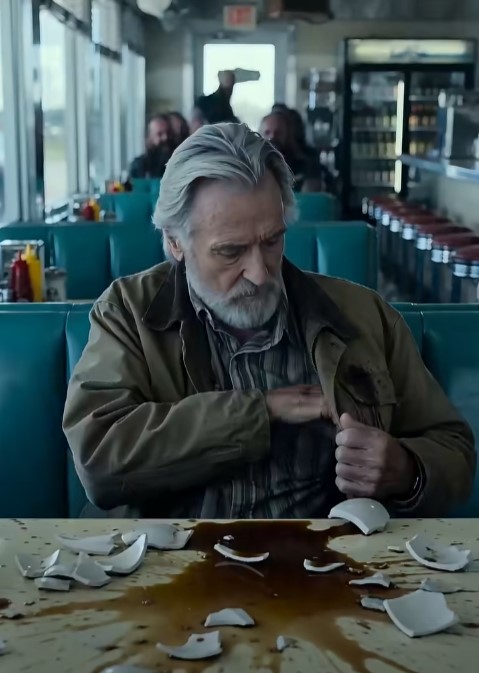
He chose the booth by the window, the same place he remembered from years before. His wooden cane rested across his knees, and his worn dark khaki-brown jacket made him look like any tired seventy-two-year-old passing through town.
But Walter had not come by accident.
He had come because the diner had changed. The white tables, teal booths, cracked sugar dispensers, and smell of coffee and grease were still there, but the feeling inside the room was different.
People no longer relaxed there. They lowered their eyes. They spoke softly. They moved as if one wrong sound could bring trouble to their table.
The Man Everyone Feared
Across the room sat Rex Dalton, a large bald biker with a beard and a voice that seemed to take over the diner even when he was laughing.
He occupied two booths with six men in black leather. They followed his mood, laughed when he laughed, and watched whoever he decided to watch.
That morning, Rex noticed Walter.
One of the bikers muttered, “Who’s grandpa?”
Walter did not respond. He kept looking toward the parking lot through the large front window.
Behind the counter, Marlene kept wiping the same clean spot. Her hand trembled, and Walter saw it. He also saw the broken lock, the marks near the register, the bills beside the pie case, and the fear that had settled over every customer in the room.
This was not just a diner with loud men inside. It was a business being squeezed by intimidation.
Rex Makes His Move
Rex rose from his booth and crossed the tile floor slowly, making sure everyone heard his boots.
He stopped beside Walter’s table and looked down at him.
“You lost, old man?”
Walter lifted his eyes. They were calm and cold.
“No.”
Rex smiled and told him the diner did not look like his kind of place.
Walter answered, “I knew it before you did.”
The answer bothered Rex. His smile sharpened, and then he reached down and snatched Walter’s cane from his hands.
Marlene gasped. The bikers laughed.
Walter only said, “Careful.”
Rex mocked him, lifted the cane, and slammed it onto the tabletop. The sound cracked through the diner. Cups jumped. A child flinched into his mother’s side.
Rex leaned toward Walter and asked what he planned to do about it.
Walter did not panic. He simply looked at the cane and said, “That cane has been through better men than you.”
A Phone Call That Changed Everything
Rex walked away with the cane, swinging it as if it belonged to him. His men laughed, though the sound had already begun to lose some of its strength.
Walter reached into his jacket and took out a smartphone.
Rex turned back and mocked him again, asking whether he was calling the nursing home.
Walter put the phone to his ear.
“It’s me,” he said. “Bring ’em.”
Then he ended the call and placed the phone on the table.
At first, Rex laughed louder than before. He wanted the room to believe nothing had changed.
But Walter did not look at Rex. He looked out the window.
For a few seconds, the parking lot remained empty. Then the first black SUV pulled in. Another followed. Then another. Soon, a line of black SUVs stood outside the diner, headlights shining through the glass.
The laughter stopped.
The Witnesses Arrive
Doors opened, and people stepped out.
They were not bikers. They were not thugs. They moved quietly and with purpose, wearing dark suits and long coats. Some carried documents. Others carried cameras.
A tall Black man with a gray beard entered first. Beside him came a woman in a navy coat holding a leather folder.
The tall man looked at Rex, then at the cane in his hand.
“Walter,” he said, “you all right?”
Walter nodded and told him to sit tight.
The woman introduced herself to Rex as Claire Hensley, counsel for the Kane Foundation and legal representative for Marlene’s Diner.
Rex laughed and said the diner did not have a lawyer.
From behind the counter, Marlene whispered, “It does now.”
The Truth About the Diner
Walter then revealed why he had come.
He said he had stepped into his wife’s diner.
The sentence changed the room.
Walter explained that his wife, Ruth Kane, had bought the diner in 1978 with money earned from years of waiting tables. She had built it as a place where truckers, veterans, families, and people with nowhere else to go could sit down without being judged.
To Ruth, the diner was not only a business. It was one safe room in a town where people sometimes needed kindness more than food.
Claire opened her folder and explained that the property had been placed in the Ruth Kane Community Trust after Ruth’s death. Walter was the controlling trustee, and Marlene had been operating under a protected lease.
Any effort to force Marlene out or make her sell was illegal.
The Patch Rex Never Earned
Rex tried to dismiss the documents, but the tall man with the gray beard stepped forward.
His name was Isaiah Brooks.
The name meant something to Rex. It belonged to one of the original riders connected to the club whose patch Rex wore on his vest.
Isaiah took out an old black-and-silver patch sealed in plastic. It was the original Black Ridge Riders patch.
He named the founders: Walter Kane, Isaiah Brooks, Tommy Vale, Marcus Reed, and Samuel Ortiz.
The club had not been created to threaten businesses or collect money from frightened owners. It had been formed to protect widows, veterans, and working people after the war.
Walter looked at Rex’s vest and told him, “You’re wearing a promise you never earned.”
Rex claimed his father had built the club.
Walter corrected him. Rex’s father had been helped by the club, not made king by it.
A Hidden Record of Every Threat
Rex still tried to act untouchable.
Walter calmly listed what Rex and his men had done. They had collected money from Marlene for sixteen months. They had threatened the bakery, gas station, barbershop, and church thrift store. They had damaged cars, broken windows, and convinced people that no one would help them.
Rex asked whether Walter had proof.
Walter tapped the smartphone on the table.
He explained that every word since Rex touched the cane had been recorded. The threats, the insults, the laughter, and the intimidation were all there.
Outside the diner, Walter’s team also had signed statements from business owners, former riders, and Rex’s bookkeeper.
That detail shook Rex’s men more than anything else.
The Cane That Carried Ruth’s Name
Then Rex noticed something on the cane.
Near the handle was a small brass plate with Ruth Kane’s name engraved on it. Beneath it were the words: For the ones who still need a seat.
Walter explained that Ruth had used the cane during the final year of her life, when cancer took her balance but never her dignity.
She had sat in that same booth and served coffee until her hands could no longer lift the pot.
Rex had slammed her name onto a table to make men laugh.
For the first time, Rex had nothing to say.
Authority Finally Steps In
Sheriff’s cruisers pulled into the parking lot behind the SUVs. The sheriff entered with two deputies.
No one shouted. No weapons were drawn. The room did not need drama anymore because the truth had already done its work.
The sheriff told Rex he needed to come outside.
Rex looked to his men and ordered them to do something.
Nobody moved.
Rex had lost the room. He was no longer the strongest man there. He was only the loudest man after the fear had disappeared.
Isaiah asked for the cane. Rex hesitated, then handed it over. Isaiah returned it to Walter, who ran his thumb over Ruth’s brass plate.
The Larger Scheme Comes to Light
By nightfall, the diner parking lot was full of sheriff’s cruisers, black SUVs, local news vans, and townspeople who had waited years to see Rex Dalton without control.
The investigation quickly grew beyond the diner.
Rex had not acted alone. His intimidation helped a development company pressure local owners into selling valuable properties along the highway for far less than they were worth.
The diner, bakery, gas station, and nearby houses were all part of a larger plan. The goal was to tear them down and build a luxury roadside complex that most people in town could never afford.
The threats were not random acts of cruelty. They were a strategy.
Rex created fear. Developers arrived with offers. Complaints disappeared. Money moved quietly.
That system held until Walter Kane came back.
Why Walter Returned
Walter had stayed away for years after Ruth died. Grief had emptied him, and he had mistaken isolation for peace.
He left the diner in Marlene’s care and lived quietly outside Nashville, answering letters, writing checks, and avoiding the place that reminded him most of Ruth.
Then Marlene sent him one message.
Ruth would be ashamed of what this place has become.
Walter read it again and again.
After that, he called Isaiah. He called Claire. He called every old Black Ridge Rider who still remembered what the patch had once meant.
Then he walked into the diner alone because he wanted Rex to reveal himself in front of the people he had bullied.
The Diner Opens Again
Rex Dalton was charged with extortion, criminal intimidation, vandalism, conspiracy, and coercion.
The development executives were indicted three months later, along with a county zoning official who had buried complaints for years.
Some of Rex’s men made plea deals and testified.
The Black Ridge Riders were dissolved by court order and rebuilt under a nonprofit charter by original members and younger veterans who wanted to restore the club’s purpose.
Six months later, Marlene’s Diner reopened.
The teal booths were repaired. The front window was replaced. The door lock was fixed. The neon sign glowed again.
Behind the counter hung a framed photograph of Ruth Kane smiling with a coffee pot in her hand.
Below the photograph were the same words from the cane: For the ones who still need a seat.
A Warning Left Behind
On opening day, Walter sat in the booth by the window. His cane rested beside him, and no one touched it.
Marlene poured his coffee and told him he had saved the place.
Walter said Ruth had saved it. He had only come back late.
Outside, the black SUVs were gone. In their place were pickup trucks, family cars, motorcycles, and old sedans from across the county.
People came because the diner had become more than a place to eat breakfast. It had become proof that fear does not own a town forever.
A little boy pointed at Walter’s cane and asked whether it was magic.
Walter smiled and said, “No,” he said. “It just remembers things.”
When the boy asked what kind of things, Walter looked at the brass plate, then at the diner, then at the road beyond the window.
“The truth,” Walter said.
A year later, Rex stood in court and heard the word he had forced others to fear: sentenced.
After the hearing, Walter was asked why he had walked into the diner alone that day.
He answered, “Because bullies always reveal themselves when they think nobody important is watching.”
When asked whether he was important, Walter smiled faintly.
“No,” he said. “But the people in that diner were.”
Then he walked away, slow but steady, his cane tapping the pavement.
It was no longer a sign of weakness.
It was a warning.