
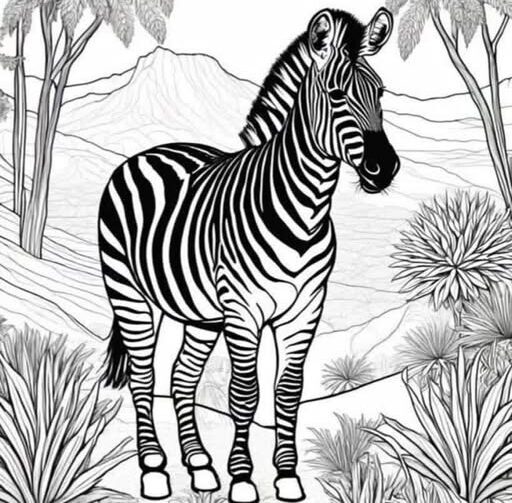
Can You Spot the Man Hidden in This Vintage Zebra Illustration?
The Zebra Is Easy to Find. The Second Figure Takes a Closer Look.
A zebra stands in a quiet countryside scene surrounded by trees, grass and low-growing plants, with mountains in the distance. Its bold stripes are likely to catch your eye first. Somewhere within the same drawing, a man’s figure blends into the landscape.
The premise is simple enough to explain in one sentence, but the search can take longer than expected. You know what you’re looking for. The challenge is that the lines forming the hidden figure can also look like part of something you’ve already recognized.
Before reading further, give yourself one uninterrupted look at the full scene. Let your eyes move away from the zebra and see where they settle. If a shape catches your attention, follow its outline a little farther before deciding what it represents.
Why Your Eyes Keep Coming Back to the Zebra
The zebra gives the drawing an immediate subject. Its shape is recognizable, and the contrast between its stripes can make it stand out even among the many details in the countryside. Once you’ve identified the animal, your eye can return to it each time you lose your place in the search.
That familiarity can work against you. When you look at a branch and recognize it as a branch, you may feel you’ve finished looking at it. The same thing happens with a patch of grass or the edge of a mountain. Naming what you see helps you understand the scene quickly. In a hidden-picture puzzle, it can also keep you from noticing what those same lines might suggest when viewed together.
The trick is to hold your first impression lightly. A line can belong to the landscape and still contribute to the outline of the man. Once you allow for that possibility, there’s more to examine in a section you might have passed over on your first look.
Look at the Spaces Between Objects
When people search an illustration for a hidden figure, they often inspect the objects they can name. They study the zebra, then the trees, then the plants. Another way to search is to follow the spaces those objects leave between them. The gap around a branch or the area between two patches of vegetation may have a shape of its own.
Imagine tracing a tree with your finger in the air. On the first pass, follow the tree. On the second, notice the shape of the space immediately beside that same edge. You’re looking at the same line both times, but your attention is on a different side of it. That small shift can make a familiar part of the drawing look less settled.
The zebra’s stripes offer a similar opportunity. Seen together, they tell you what animal you’re looking at. Seen one at a time, they become individual curves and edges. Examining them this way gives you a different view of the drawing without requiring you to assume the figure is hidden in any particular place.
Try a Systematic Search Before Asking for a Hint
If you keep jumping back to the same part of the illustration, pick a corner and work across the scene. Look at the foreground plants and grass, then give the trees and the more distant landscape their own pass. A steady search can reveal which areas you’ve been skipping while your attention returns to the zebra.
When something looks promising, start with the detail you think you recognize. It could be a curve that suggests a head or an angle that looks like a shoulder. Then check what happens where that line meets the next one. Does the shape continue in a way that supports your first impression? An interesting curve is a start. A series of connected details gives you a better reason to linger.
It’s easy to spend so long on a promising patch that everything in it starts to look like part of the answer. If you reach that point, move on. Keep the area in mind and return to it after you’ve examined the rest. You may find that the shape still holds together when you come back, or you may see what drew your eye there in the first place.
A Different View Can Bring the Outline Into Focus
Looking closely can help you see where one line ends and another begins. It can also make it harder to see the overall shape you’re trying to find. If you’ve been inspecting small details, try looking at the full scene again. Give yourself enough distance to take in several parts of the drawing at once.
You can also change the order in which you look. Start with the distant mountains and work forward instead of beginning with the zebra. Or focus on the edges of the illustration before returning to the center. Changing your route gives features that usually sit in the background a chance to become the first things you notice.
Occasionally, the most useful change is to look away for a moment. When you return, try to notice where your eyes go before you consciously begin searching again. You may see a shape you missed while concentrating on a particular tree or stripe.
How to Tell Whether You’ve Found the Figure
Once you think you’ve spotted the man, look away and see whether you can find him again. Pay attention to the first detail you recognize on your return. It might be the same feature that caught your eye initially, or a different part of the outline might stand out now that you know where to look.
Try describing the location in relation to something unmistakable in the scene. That gives you a way to share your answer with someone who has been looking at a different part of the drawing. It also helps you check whether you can follow the figure’s outline or are relying on a single shape that happens to look familiar.
Two people can look at the same patch and initially see different things. One may still see vegetation where the other has picked out a human figure. The interesting part is often the moment the second person sees both readings and realizes how the illustrator made them fit into the same space.
Challenge a Friend to Find Him Without Help
If you share the puzzle with a friend, give them time to look before telling them where your own search began. You may have gone straight to the stripes while they started with the trees. Comparing those first impressions can be as entertaining as comparing who finished first.
If they get stuck and ask for help, you can give them another way to look without pointing to the answer. Suggest following the spaces between objects or taking in the entire picture from farther away. Then see whether they spot the same feature you did when the figure finally comes into view.
Can you find the man without a hint? If you do, share how long it took and which detail gave him away. For friends who are still searching, save his exact location for when they’re ready to see it.