
I Found What Looked Like a Webbed Foot on the Beach—It Turned Out to Be a Toy Wing
A Strange Shape Beside the Waterline
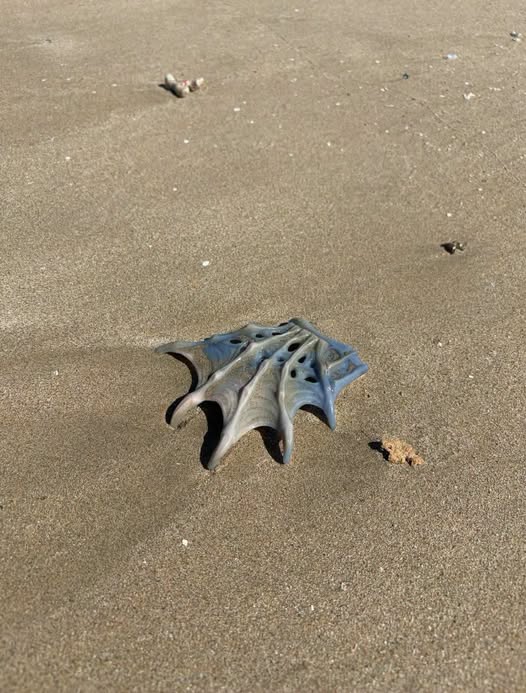
I was walking along the beach when I noticed a grayish-blue object lying on the wet sand. About the size of a small adult hand, it had pointed projections joined by thin sections that looked disturbingly like webbing.
My first thought was that it might be part of an animal. The eventual explanation was far less unsettling: it was a detached toy wing, matching the distinctive design of a Flying Alien Queen action figure.
That answer made sense once I considered the complete shape. Before then, however, the fragment looked remarkably convincing as something biological.
Raised lines crossed its surface like veins or bones. Several smooth, oval openings interrupted the thin material near its upper edge. Sand clung to the surface, softening its artificial appearance.
Surrounded by shells, seaweed and other objects deposited near the waterline, it seemed reasonable at first to search for a marine explanation.
The setting was doing much of the work. Had I found the same piece beside a box of action figures, I probably would have recognized it immediately. Alone on the beach, it looked like a small anatomical mystery.
Why Keeping Some Distance Was the Right Instinct
I initially stayed back and nudged the object with a stick. It did not move, curl or react, which made it seem even more like a detached body part.
However, that was not a reliable way to establish what it was—or whether touching it would have been safe. An animal can remain motionless, and the absence of a reaction does not identify an object.
Unknown marine life is best observed without touching or prodding it. Jellyfish washed onto a beach can still sting, including specimens that appear dead.
A photograph taken from a safe distance would have been a better starting point. It could preserve the shape and visible details without disturbing a living animal or bringing someone into contact with an unfamiliar material.
In this case, the important clues were visual. The arrangement of the holes, the raised ridges and the thicker attachment edge eventually explained more than the object’s lack of movement.
My initial caution was useful, but the stick did not solve the mystery. Understanding the design did.
Why It Resembled a Webbed Foot
Viewed in its original position, the object looked as though several long toes extended from a central section. Thin material stretched between them, creating the impression of a large webbed foot.
That resemblance was strong enough to influence everything I noticed next. Raised details became apparent bones, while the thinner areas looked like skin.
Yet the comparison never fitted comfortably. The points seemed exaggerated, the outline was unfamiliar, and the surface had an unusually consistent gray-blue color.
Those features did not independently rule out an animal fragment. They simply made the foot explanation less convincing the longer I considered it.
I also wondered whether it could be a damaged section of a ray or skate. Its broad, flattened appearance suggested that possibility, but I had no evidence to support it.
A shark or skate egg case briefly came to mind as well. Again, that was an association prompted by an unfamiliar beach find rather than an identification.
The mistake was treating each resemblance as though it brought me closer to a biological answer. All three possibilities began with the assumption that the object had come from an animal.
Once I questioned that assumption, the details started to look different.
The Smooth Openings Changed the Picture
The oval holes were particularly revealing. They did not look like irregular tears. Their rounded edges appeared integrated into the surrounding material.
Nearby ridges also seemed deliberate. Instead of looking like exposed anatomy, they resembled details formed as part of a manufactured surface.
One side ended in a thicker, straighter section. That edge suggested a connection point rather than a natural boundary.
None of these observations would identify a particular product by itself. Together, however, they offered a coherent explanation for why the object looked both organic and artificial.
It could have been designed to imitate anatomy.
I began considering props, costume accessories and rubber monsters. The fragment’s size and theatrical appearance suited those possibilities better than the animal theories I had been entertaining.
Then I reconsidered its orientation. What I had interpreted as toes could instead be the outer points of a spread wing.
The thinner sections became a wing membrane, and the raised lines became stylized supports. The overall shape stopped looking like an unusual foot and started looking like part of a fictional creature.
The Flying Alien Queen Connection
The fragment’s design matched the wing of a Flying Alien Queen action figure from Kenner’s Aliens toy line. The figure featured large translucent wings attached to a monstrous body.
That context accounted for the combination that had seemed so puzzling: pointed edges, thin membranes, prominent supporting ridges and openings incorporated into the design.
The piece was meant to suggest something biological without reproducing an ordinary animal. Detached from the figure, it retained enough anatomical detail to invite the wrong comparisons.
The apparent webbed toes were wing tips. The vein-like ridges were molded decoration. The thicker edge made sense as the section that connected to the toy.
Once the wing was understood in that orientation, there was no need to invent an unfamiliar marine creature to explain it.
The identification was satisfying partly because it accounted for the awkward details the earlier guesses had left unresolved. Instead of overlooking the smooth holes or exaggerated points, the toy explanation made them central to the answer.
A little of the mystery disappeared, but the design itself became more interesting. Someone had created a convincing fictional appendage—convincing enough to become confusing when separated from the rest of the figure.
Its Journey to the Beach Remains Unknown
Recognizing a toy part does not reveal how it arrived at the waterline. There was no information about its previous owner, where it had been lost or how long it had been outdoors.
It could have been dropped locally. It might have reached the shore from somewhere else. Those remain possibilities rather than established parts of the story.
The same uncertainty applies to the rest of the figure. There was no reason to assume it was buried nearby or that it had traveled with the wing.
Its muted appearance also could not provide a reliable timeline. Looking worn is not enough to determine how many days, months or years something has spent exposed to outdoor conditions.
The discovery therefore had two different outcomes. The shape had an understandable explanation, while its individual history remained unknown.
There was no need to connect those gaps with an elaborate journey. The object was interesting because of what could be recognized, even without knowing every step that brought it there.
From Apparent Creature to Recognizable Litter
Once identified as a detached plastic component, the wing belonged in the category of litter rather than wildlife. That distinction matters when deciding what to do with an unfamiliar beach find.
An unidentified animal should be left undisturbed. A clearly recognized piece of ordinary litter can be collected when it is safe to do so, using suitable protection and following local disposal guidance.
There is no reason to handle something uncertain merely to complete a cleanup. Photographs or help from beach staff can be more appropriate when an object remains unfamiliar.
What stayed with me was how thoroughly the location had shaped my first impression. Wet sand and scattered seaweed made an animal explanation seem obvious, while the possibility of a broken toy took longer to consider.
The object had not changed during that process. Only my understanding of its orientation and purpose had changed.
The “foot” was a wing, the “skin” was molded material, and the strange anatomical details belonged to an imaginary creature. One small piece of an action figure had turned an ordinary beach walk into a surprisingly effective puzzle.