
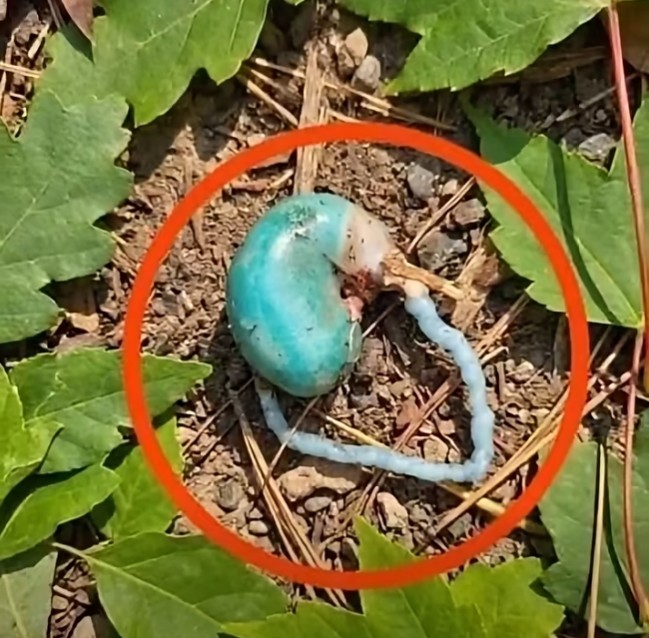
A Strange Blue Object on the Forest Floor Raises More Questions Than Answers
A Bright Discovery Among Fallen Leaves
A woodland walk usually offers familiar sights: fallen branches, patches of moss, scattered stones and leaves collecting along the trail. Occasionally, however, something stands out so sharply that it brings the walk to a halt.
In this account, it was a strangely shaped blue object resting among the leaves. Against the muted colors of the forest floor, its appearance attracted attention and prompted an immediate question about what it could be.
The description offers several intriguing details. The object had an irregular outline, with some areas appearing smooth and others uneven, layered or porous. It did not readily resemble a familiar flower, stone or piece of wood.
Those observations explain the curiosity surrounding it, but they do not establish its identity. No photograph, precise location, measurements or expert assessment accompanies the account.
Consequently, the discovery remains an unidentified object. It might have been a natural formation, but something manufactured or discarded cannot be ruled out simply because it was found in woodland.
The interesting part of the encounter is therefore the uncertainty itself: an ordinary setting contained something the observer could not immediately explain.
What the Description Reveals—and What It Leaves Out
The object’s blue color is its most distinctive reported feature. Its shape and apparent texture add to the description, but important details are missing.
For example, there is no indication of its size. A formation small enough to fit on a leaf would present a different identification problem from a large object lying across several branches.
It is also unclear whether it was growing from something or merely resting on the ground. An object attached to decaying wood would provide different clues from one lying loose among fallen leaves.
The description of softer or porous sections concerns appearance rather than a confirmed physical examination. Something can look soft without being soft, particularly when viewed briefly or under uneven light.
Likewise, an organic-looking outline does not prove that an object is alive or naturally formed. Weathering, damage and accumulated dirt can alter the appearance of discarded materials.
These gaps do not make the account uninteresting. They explain why a confident identification would be premature.
A useful description preserves what was actually observed while leaving room for the details that remain unknown. Calling the object mysterious is reasonable; calling it a particular species would require evidence that is not available here.
Why the Suggested Explanations Remain Unconfirmed
Fungus and slime mold were suggested as possible explanations in the account. Neither identification was supported by an examination or a named specialist.
The suggestions appear to come from the object’s unusual color, irregular shape and position on the forest floor. Those features may inspire comparisons, but a resemblance is only a starting point.
Describing something as fungus-like does not establish that it is a fungus. The same limitation applies to a comparison with slime mold or any other unfamiliar growth.
It would be equally premature to describe the discovery as rare. An observer’s unfamiliarity with an object does not reveal how frequently it occurs. Something surprising to one walker may be recognizable to someone with relevant local knowledge.
Nor does the woodland setting settle the question. Forest paths can contain both natural materials and objects carried there by people, animals, wind or water. The account does not explain how this particular object reached its location.
The available information therefore supports a narrow conclusion: something blue and unusually shaped was noticed among fallen leaves.
Anything beyond that—including whether it was living, manufactured, common or unusual in that region—remains unresolved. Keeping those possibilities open avoids turning an interesting observation into an unsupported discovery claim.
The Details That Would Make a Follow-Up More Useful
If someone wanted help identifying the object, a fuller record of the encounter would be more useful than a dramatic label. Clear photographs could show features that are difficult to convey through a general description.
A wider image could establish the surrounding setting, while closer views might document the outline, surface and relationship to nearby leaves or wood. Recording its approximate dimensions would also remove uncertainty about scale.
Location would provide another important piece of context. A country or region, the kind of woodland and the position beside or away from a trail could help someone assess the observation.
Other useful notes would include whether similar objects were nearby and whether the blue material appeared attached to a surface. These are observations that can be recorded without deciding in advance what the object must be.
The wording used when requesting assistance matters too. Asking what an unidentified blue formation might be leaves the question open. Introducing it as a rare mushroom can steer the discussion toward a conclusion that has not been established.
A careful record gives a knowledgeable reviewer more to work with. It also makes it easier to explain why a particular identification is plausible—or why the evidence remains insufficient.
Looking Closely Without Disturbing the Discovery
Curiosity does not require collecting the object. In an encounter like this, leaving it in place preserves both the item and its surroundings for any later assessment.
There is no need to taste, break or manipulate an unidentified substance to make the story more interesting. Its identity is unknown, and the account provides no reason for handling it.
Photographing it where it was found would retain information that could disappear once it was moved. The relationship between an object and the surface beneath it may be part of what helps explain it.
If the observer returned later, noting any visible change could add to the record. However, a different appearance would still need interpretation rather than an immediate conclusion.
Someone seeking an answer could share those observations with a relevant local natural-history organization or specialist. The request should include the original uncertainty, rather than presenting an online suggestion as an established identification.
Even then, an answer may not be possible from photographs alone. An incomplete result is preferable to certainty based on a superficial match.
The aim would be to understand the encounter accurately while keeping the original evidence intact.
An Interesting Encounter Can Remain Unsolved
Stories about unfamiliar objects often create an expectation that a surprising explanation will follow. Here, there is no verified reveal. The blue formation remains unidentified, and the available account does not justify selecting one possibility over the others.
That limit is worth preserving. There is a meaningful difference between describing an unusual encounter and claiming to have discovered a rare organism.
The first requires an honest account of what someone noticed. The second requires evidence supporting a much more specific conclusion.
For the walker, the encounter still changed the experience of the trail. Something easily overlooked became the focus of attention, encouraging a closer examination of an otherwise familiar setting.
The unresolved question can also encourage better observation. Instead of remembering only that the object was blue, a person might become more attentive to scale, surroundings, attachment and other details during a future encounter.
Those details would offer a stronger foundation for understanding than an exciting guess. Until they are available, the clearest description remains the simplest: an unusually shaped blue object was found among woodland leaves, and its identity has not been confirmed.