
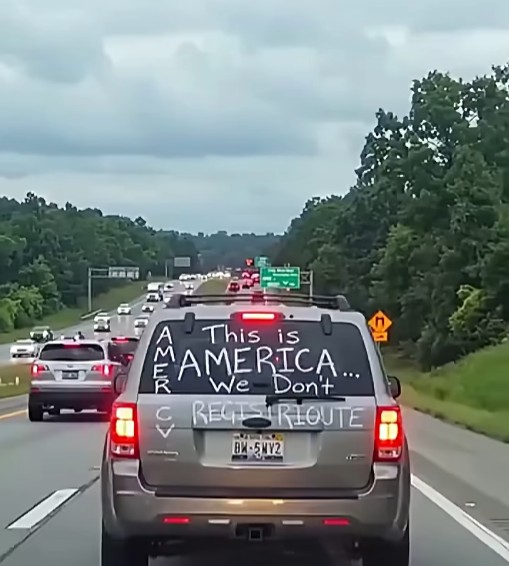
Why an Unusual Message on a Car Can Make Everyone Look Twice
A Few Words Can Turn an Ordinary Vehicle Into a Conversation
A vehicle does not need an unusual paint job or an expensive design to attract attention. Sometimes, a short message on its rear window or bumper is enough to make someone pause and wonder what it means.
The words might be funny, sentimental, puzzling or familiar only to a particular group. Without the background behind them, a passing observer sees only a small part of the story.
That uncertainty is central to an account involving an unexplained message on an SUV. The wording itself and an explanation from the owner are not provided, so its meaning cannot be established. It could have been a joke, a personal reference or simply a phrase the driver enjoyed.
What the example does illustrate is how easily an ordinary object can become a source of curiosity. A vehicle travels through public spaces, carrying its owner’s chosen words into view of people with different experiences and perspectives.
One person might recognize a reference immediately. Another might spend several minutes considering possible interpretations. The message remains the same, but the audience brings something different to it.
Why Unexplained Messages Catch Our Attention
Most writing encountered during a routine journey has an obvious purpose. Road signs provide directions, shop signs identify businesses, and advertisements promote products or services. People generally know how to interpret them without much effort.
An unexpected phrase interrupts that pattern. When its purpose is unclear, the reader may look again and try to work out what information is missing.
Perhaps the words resemble a song lyric. Maybe the unusual spelling is deliberate, or a seemingly random combination of names refers to people the owner knows. A phrase that initially appears mysterious may have a simple explanation.
This uncertainty gives observers something to discuss. Friends might compare interpretations, with one seeing a joke and another recognizing a reference to a television show or sporting event.
However, an interesting possibility remains a possibility. The ease with which an explanation comes to mind does not establish that it matches the owner’s intention.
The distinction is especially useful when a message becomes the subject of an online discussion. A clever answer can be entertaining without being correct, and several interpretations may remain plausible when the original context is unavailable.
The Personal Background Strangers Cannot See
Vehicle messages can reflect many parts of a person’s life. Drivers display support for teams, celebrate family milestones, remember loved ones, promote businesses or share something they find amusing.
Some messages are meant for a broad audience. A business name and telephone number usually have a clear purpose, while a familiar slogan may communicate an opinion directly.
Other displays make sense primarily within a smaller circle. A nickname, an anniversary date or a phrase associated with a family story might carry considerable meaning for its owner while revealing very little to strangers.
That difference can explain why an apparently random message is displayed so prominently. The owner may not consider it confusing because the missing background is already familiar to them.
It is also possible that no elaborate story exists. Someone may choose a sticker because they like its wording, color or design. A message does not have to represent a defining belief or a significant event.
Recognizing these possibilities leaves room for curiosity without turning a few words into an assessment of the person behind the wheel. A public display offers something to observe, but it rarely provides a complete portrait of its owner.
Culture and Presentation Can Change the Interpretation
The meaning of a short phrase often depends on where and by whom it is read. Local expressions, regional humor and references to community events may be immediately recognizable in one place and unfamiliar somewhere else.
A sports reference offers a straightforward example. Residents may recognize a team nickname without needing further explanation, while a visitor could mistake it for a personal message.
Music, films and television create similar differences. A few words can carry an entire scene or joke for someone who knows the reference. To everyone else, those words may appear incomplete.
Wordplay can be particularly difficult to interpret across languages. A phrase that relies on pronunciation or a double meaning may lose its humor when translated.
Presentation adds another layer. Bold lettering can make a message seem emphatic, while handwriting may make it appear personal or temporary. A symbol beside the words might provide a useful clue—or introduce another uncertainty.
These details influence the impression a message creates, but they cannot confirm its purpose. A polished decal can carry a private joke, just as a handwritten note can communicate something entirely practical.
Looking at both language and design can improve an interpretation, provided the reader remembers that the owner’s explanation may still be missing.
What Changes When a Photograph Goes Online
A message intended for people passing a vehicle can reach a much wider audience once someone shares a photograph. The image may travel far beyond the neighborhood where it was taken, bringing it to viewers unfamiliar with its local context.
Comments can make that encounter enjoyable. People contribute jokes, identify possible references and compare the meanings they associate with the same words.
Yet a photograph can also separate a message from information that would have made it easier to understand. Nearby wording may be cropped out, or a caption may suggest an explanation before viewers have considered the image themselves.
As the photograph is shared again, the suggested explanation can begin to sound like an established fact. Later readers may never see the original uncertainty.
A useful approach is to separate observation from interpretation. The visible wording is one thing; a claim about why the owner chose it is another.
In the SUV example, the absence of the actual phrase and the owner’s account prevents a specific conclusion. Adding a dramatic explanation would create a story rather than resolve the uncertainty.
Leaving a question unanswered can be more accurate than selecting the most entertaining answer. The discussion can still be interesting without presenting speculation as confirmation.
Sharing the Curiosity Without Making It Personal
Photographs of vehicle messages may include more than the words that attracted attention. A registration plate, a recognizable driveway or nearby landmarks can reveal details unrelated to the discussion.
Before sharing an image, it is worth considering which details are necessary. Cropping out identifying information can preserve the point of the photograph while reducing unwanted attention toward the owner.
The tone of the accompanying caption matters as well. Describing a message as unusual is different from making unsupported claims about the driver’s personality, relationships or circumstances.
A stranger’s choice of sticker may be open to interpretation, but it does not provide evidence for a personal accusation. Humor is easier to enjoy when it does not depend on inventing a humiliating story about someone who has not participated in the conversation.
There is also no need to pursue a vehicle or become distracted while driving to read its message. An interesting phrase is still a passing detail, and understanding it can wait.
The appeal of these encounters lies in their simplicity. A few unexpected words can prompt laughter, recognition or a conversation about how differently people understand the world around them.
Sometimes an explanation eventually emerges. Sometimes it remains a private reference known only to the owner and a few others. Either way, an ordinary vehicle can offer a brief glimpse of someone’s humor or interests without revealing their whole story.